

"May Contain Microplastics" Label Mandatory For Bottled Water, Sugar & Salt: Madras High Court Dismisses FSSAI's Review Petition
The Court said that the core principle behind labelling is disclosure; directions neither premature nor disproportionate, as Section 18 FSS Act speaks of "potential" and "reasonable grounds to suspect".

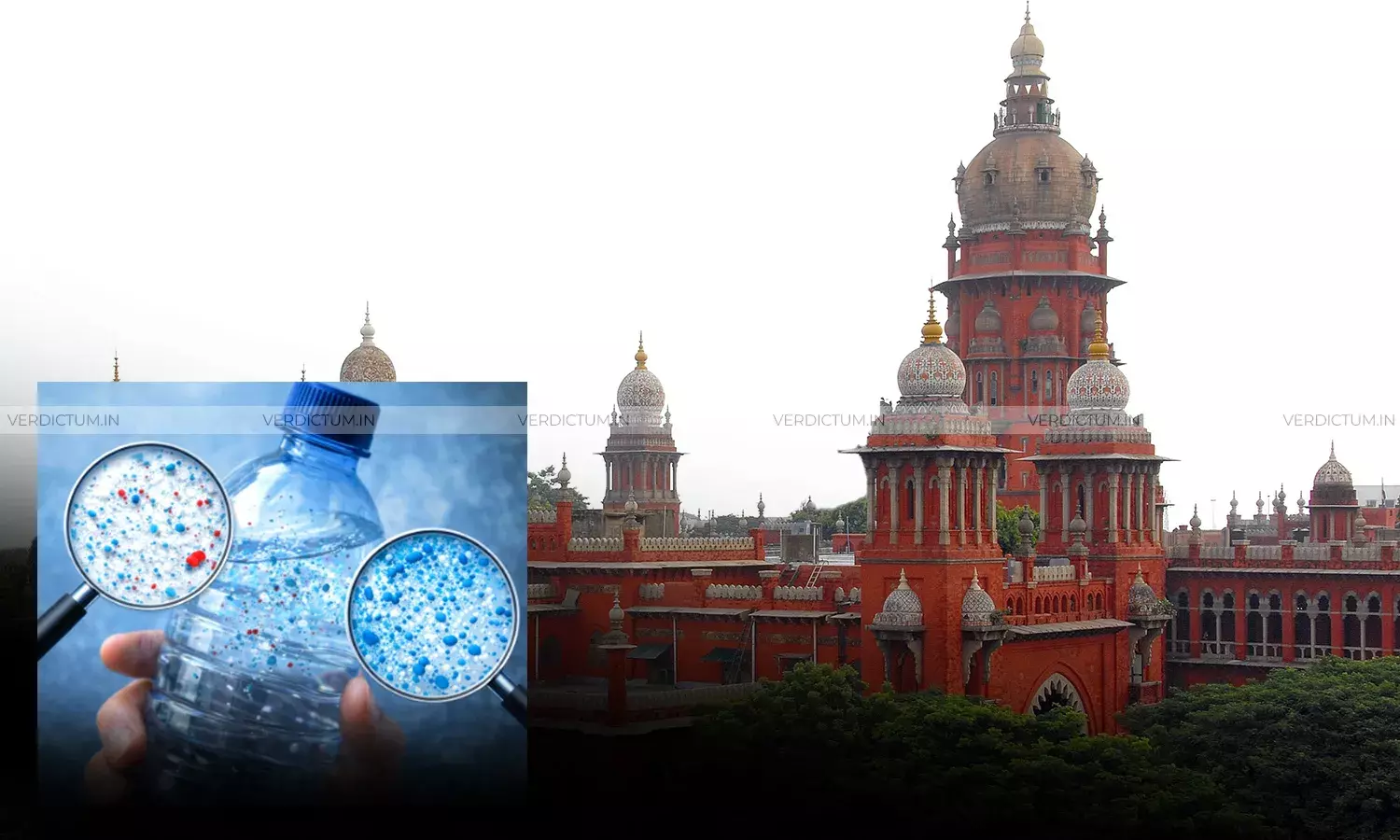
The Madras High Court has refused to recall or review its order of Februrary 06, 2026 directing that water sold in plastic/PET bottles, and sugar and salt sold in plastic packaging, carry a label stating that the product may contain micro or nano plastics. It dismissed the review application of the Food Safety and Standards Authority of India and the recall petitions filed by a PET packaging association and a packaged drinking water manufacturers' federation.
The Court observed that the core principle behind labelling is disclosure of information, and held that the directions are neither premature nor disproportionate. It noted that Section 18 of the Food Safety and Standards Act, 2006 speaks of the "potential" for harm and "reasonable grounds to suspect" a risk, not of actual harm or adequate proof. It clarified that it had not declared any of the products unsafe and that the order directs only labelling.
A Bench of Justice N. Sathish Kumar and Justice D. Bharatha Chakravarthy observed, “It must be made clear that the FSSAI, PACE and FPDWMA all admit and do not deny the presence of micro / nano plastics in packaged water/sugar or salt. If something is present inside, it would be mandatory to disclose it on the label. The core principle behind levelling is disclosure of information/truth. The arguments require sweeping inconvenient facts under the carpet because of a perceived commercial backlash”.
“…the arguments regarding ‘unsafe food’ and the requirement for further studies to declare the food as unsafe do not merit consideration, as this Court has neither declared packaged drinking water, sugar or salt to be unsafe food nor expressed any opinion in that direction. As rightly contended, those questions may arise at a later stage as further studies are being directed and conducted to ascertain the tolerance level of micro/nano plastics in the human body. What is directed by the above order is only labelling”, it noted further.
AR.L. Sundaresan, ASGI appeared for the applicant while Senior Advocate T. Mohan appeared as amicus curiae.
In the matter, in a continuing mandamus, the Court noted that FSSAI's analysis confirmed microplastics in bottled water from several States and higher levels in sugar and salt packed in plastic. On February 06, 2026 it directed FSSAI to notify that PET water bottles carry a label, in bold red letters of at least font size 10, stating "This water may contain Micro/Nano Plastics". Sugar and salt in plastic packaging were to carry a similar label, within four weeks.
PACE's Supreme Court petition was withdrawn on April 06, 2026 with liberty to seek recall, while FSSAI's was withdrawn unconditionally on May 18, 2026. FSSAI then sought review. The High Court noted that the review was not maintainable in view of the withdrawal without liberty, while referring to Satheesh V.K. v. Federal Bank Ltd., but heard all petitions on merits because the matter is a continuing mandamus.
On merits, the Court observed that FSSAI, PACE and the water manufacturers' federation all admit the presence of micro and nano plastics. It held that the hazard has been identified and only further steps remain, and that FSSAI, though mandated under Section 16 to frame labelling standards, had not mandated disclosure. Sections 18(1)(f) and 18(2)(e), it said, require informing the public of risk and ensuring informed choice.
“Thus, it can be seen that, in cases where scientific uncertainty persists, provisional risk-management measures necessary to ensure an appropriate level of health protection should be adopted. The measure should not be disproportionate and should not be restrictive of trade than what is required to achieve the appropriate level of health protection. The measures should be reviewed within reasonable period of time. More specifically, Section 18(1)(f) of the Act fastens a mandate upon the FSSAI to inform the general public of the nature of the risk to health. Further, Section 18 (2) (e) requires the right of ‘informed choice’ to be ensured. The choice of the words and phrases that the Parliament has used in the relevant provisions is the key factor in determining the disproportionality. The words are ‘potential’ and not ‘actual’; ‘probable’ rather than ‘certain’; and ‘reasonable grounds to suspect’ rather than ‘with adequate proof’. Thus, the directions cannot be termed as disproportionate”, the Bench said.
It rejected the argument that the water source may itself contain microplastics, noting that manufacturers had not supported their filtration claims with any test and that consumers must be informed irrespective of source. It also rejected the comparison with developed countries, citing Indian consumption patterns and conditions of storage and use. The order, it said, was only the barest essential minimum.
“…All studies confirm that these bio-non-degradable particles, once inside the body, pass through body barriers into the bloodstream and, as a contaminant, move through blood vessels into other organs. Even placental samples and breast milk contained these particles. Thus, there can be no dispute over the ‘plausible and ‘biological mechanism’. Further studies are on, only in respect of the ‘definitive epidemiological proof’ to confirm various harmful effects…”, it said.
The Court dismissed the review petition and the recall petitions with no costs, adding that the order remains subject to further hearing of all parties and continuation of the studies.
Cause Title: Food Safety and Standards Authority of India v. G. Subramania Koushik & Ors. (Neutral citation: 2026:MHC:3978).
Appearances:
Applicant: AR.L. Sundaresan, ASGI, V. Chandrasekaran, SPC, assisted by K. Aadhishankaran, Advocate.
Respondent: Sathish Parasaran, Senior Counsel, Arun Karthik Mohan, Harishankar, Anusha Peri, Amici Curiae: C. Mohan, T. Mohan, Senior Advocate, M. Santhanaraman and Rahul Balaji, Advocates.