

Interpretive Dispute Over Tender Conditions Does Not Amount To "Fraudulent Practice": Madras High Court
The Court found that the bidder’s certificates were genuine and that the disputes concerned the interpretation of eligibility conditions rather than any knowing or reckless misrepresentation.
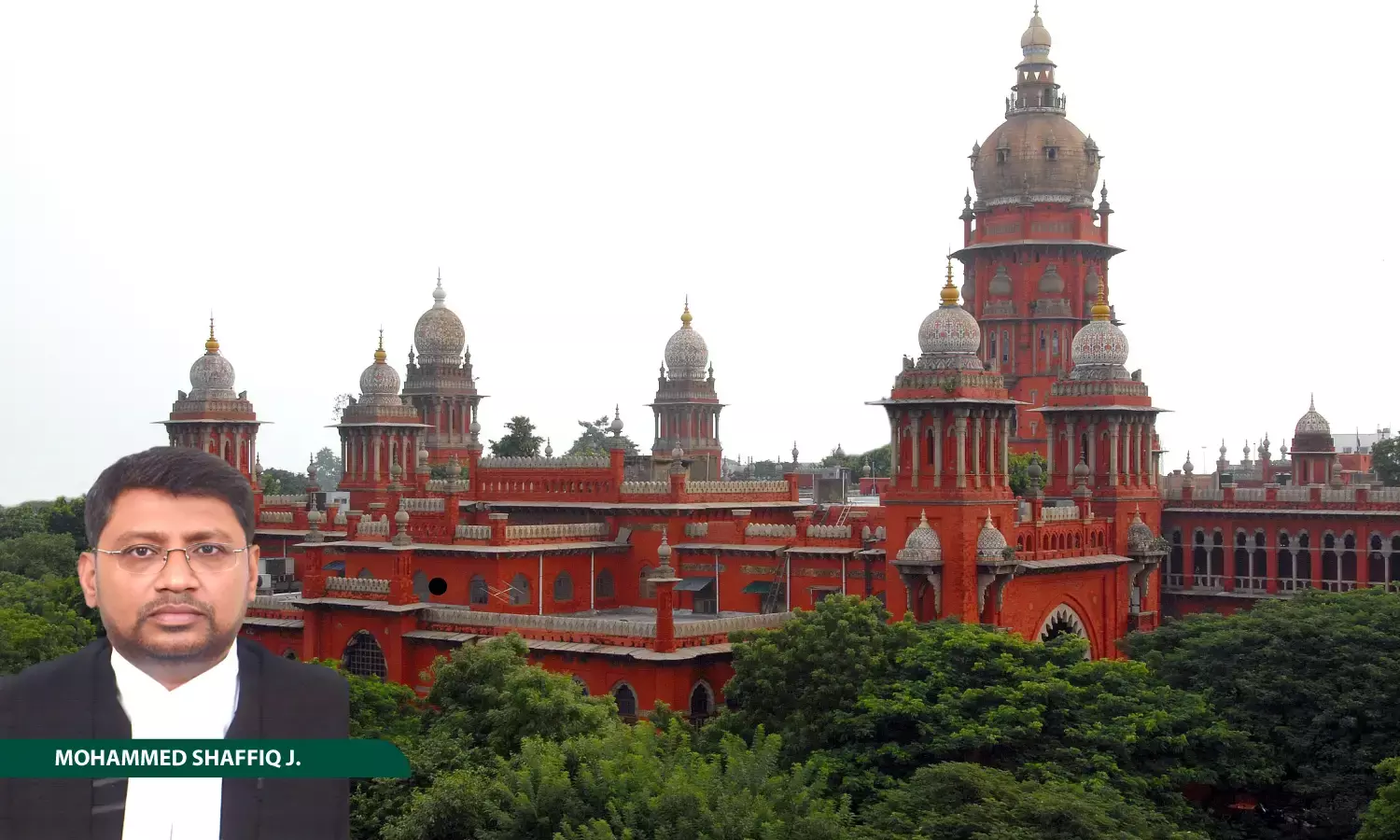
The Madras High Court has held that a difference in interpreting tender eligibility conditions cannot be treated as a “fraudulent practice” unless the tendering authority establishes a knowing or reckless act, omission or misrepresentation.
The Court consequently set aside an order blacklisting an infrastructure company and its joint venture partner for three years.
The Court was hearing a writ petition challenging their debarment from Asian Development Bank-financed, administered or supported contracts and future tenders floated by the Chennai Metropolitan Water Supply and Sewerage Board.
A Bench of Justice Mohammed Shaffiq observed: “Fraud even in terms of the tender document would require the respondent authority to show petitioner had committed an act or omission, including a misrepresentation, that knowingly or recklessly misleads or attempts to mislead, a party to obtain a financial or other benefit or to avoid an obligation.”
The Bench added: “It appears to me that in any view this again at the highest would be a matter of interpretation. If so, it is difficult to conceive/ comprehend as to how a matter which could be the subject matter of different interpretation can be construed as constituting fraudulent practice.”
Advocate M. Suresh Kumar appeared for the petitioner. Advocate Krishna Ravindran and Government Advocate A.M. Amutha Ganesh appeared for the respondents.
Background
The Chennai Metropolitan Water Supply and Sewerage Board invited bids for providing a Ring Main System in Chennai, including its operation and maintenance for ten years. The petitioner participated through a joint venture and emerged as the lowest bidder.
Its bid was subsequently declared non-responsive, and its earnest money deposit was refunded. The Board thereafter issued a show-cause notice and passed an order debarring the petitioner and its joint venture partner for three years.
The debarment was based on alleged non-compliance with two eligibility requirements. The first required experience in a similar water-supply contract in which the bidder’s participation exceeded ₹690 crore. The second required experience in constructing pipe-carrying bridges with a minimum span of 100 metres and an aggregate length of at least 300 metres for crossing water bodies in an urban area.
The Board treated the alleged non-compliance as a fraudulent practice under the Instructions to Bidders, which defined such conduct as an act, omission or misrepresentation that knowingly or recklessly misled, or attempted to mislead, another party to obtain a benefit or avoid an obligation.
The petitioner contended that certificates issued by statutory authorities demonstrated compliance with both conditions. It argued that the disputes raised by the Board concerned only the interpretation and measurement of the qualifying work and could not establish fraud.
The Board maintained that the value of qualifying work completed by the relevant stage fell below the prescribed threshold. It also contended that only the steel-truss portions situated over the water bodies could be considered while calculating the length of the pipe-carrying bridges.
Court’s Observations
The Court referred to Erusian Equipment & Chemicals Ltd. v. State of West Bengal (1975), Kulja Industries Ltd. v. Western Telecom Project BSNL (2014) and Techno Prints v. Chattisgarh Textbook Corporation and Another (2025) to underline the serious consequences of blacklisting.
It observed that blacklisting tarnishes an entity’s reputation, prevents it from entering into lawful commercial relations with the State and may continue to adversely affect its business even after the formal debarment period ends.
The Court remarked: “Black-listing / debarring has the effect of preventing a person from the privilege and advantage of entering into a lawful relationship with the Government for purposes of gain. Black-listing results in serious adverse consequences and is a very drastic measure thus ought to be resorted to sparingly and applied strictly.”
It further noted that even a three-year debarment could amount to the commercial “civil death” of an entity, with serious consequences for both the contractor and its employees.
On the condition requiring participation in a similar contract exceeding ₹690 crore, the Court examined certificates issued by the Tamil Nadu Water Supply and Drainage Board and the Siliguri Municipal Corporation.
It found that the certificate recorded the actual value of work performed as approximately ₹698 crore, thereby exceeding the prescribed threshold. The genuineness of the certificate had not been questioned.
The Court observed: “The only area where there seems to be divergence of views between petitioner and respondents is as to whether even on the date submission of bid it was required to show completion of work to an extent of Rs.690 crores and above.”
Even assuming that the Board’s interpretation was correct and completion of work exceeding ₹690 crore had to be demonstrated by the bid-submission stage, the Court held that the issue remained one of interpretation. No motive or knowing misrepresentation had been attributed to the petitioner.
The second dispute concerned whether reinforced cement concrete piers, aqueducts and other supporting structures could be included while calculating the length of pipe-carrying bridges.
The petitioner relied on a certificate stating that it had constructed three pipe-carrying bridges measuring 110 metres each, aggregating to 330 metres. The Board, however, sought to count only the steel truss situated directly over the water bodies.
Rejecting this interpretation, the Court observed: “The respondent attempt to submit that only pipes carrying bridges of minimum span of 100 metres for a total length of atleast 300 metres for crossing water bodies in urban area ought to be taken into account in other words supporting structure such as RCC pires, aqua ducts supporting portions though an integral part of any pipe which crosses a water body, ought to be excluded while measuring the span of pipes carrying bridges is unacceptable.”
The Court further remarked: “I would think, it is difficult to even conceive whether it would be technically feasible to put up a bridge across any water body only with a truss without supporting structure such as RCC pires, aqua ducts supporting portions for the same are an integral part of any pipe put across a water body. The above construction placed by respondent on the above clause may produce results which are unworkable rather obnoxious.”
The Court held that this disagreement was also, at its highest, an interpretive issue and could not constitute a fraudulent practice.
The Court distinguished between disqualification from a particular tender and blacklisting from future contracts. While the former affects only the tender under consideration, the latter carries substantially graver and wider consequences.
It held that an authority contemplating blacklisting must independently determine whether such a drastic measure is necessary on the facts and materials before it.
The Court observed: “Impugned order suffers from the vice of being non-speaking and suffers from gross non-application of mind to the facts / material on record. Disqualification for a tender and debarring are two different causes of action. While disqualification would only affect the particular tender however debarring will have consequences which are far more grave and as held by the Supreme Court may well tantamount to civil death of the entity.”
Conclusion
The Court concluded that the petitioner’s bid could not be regarded as tainted by fraud within the meaning of the tender document.
Having set aside the blacklisting order, the Court did not examine the petitioner’s separate challenge to the decision-making process. The writ petition was accordingly disposed of without costs.
Cause Title: Eco Protection Engineers Pvt. Ltd. v. The State of Tamil Nadu and Others
Appearances
Petitioner: Advocate M. Suresh Kumar, assisted by Advocates Rahul Aditya and A.P. Balaji, for Advocate R. Nalliyappan
Respondents: Advocate Krishna Ravindran; Government Advocate A.M. Amutha Ganesh
