

Police Cannot Negotiate Dilution Of Criminal Law: Madras HC Directs Police Officers To Pay ₹2 Lakh Compensation For Settling Dowry Complaint
The High Court held that police officers cannot act as private arbitrators in cognizable offences, directing two suspended officers to pay ₹1 lakh each as public law compensation.

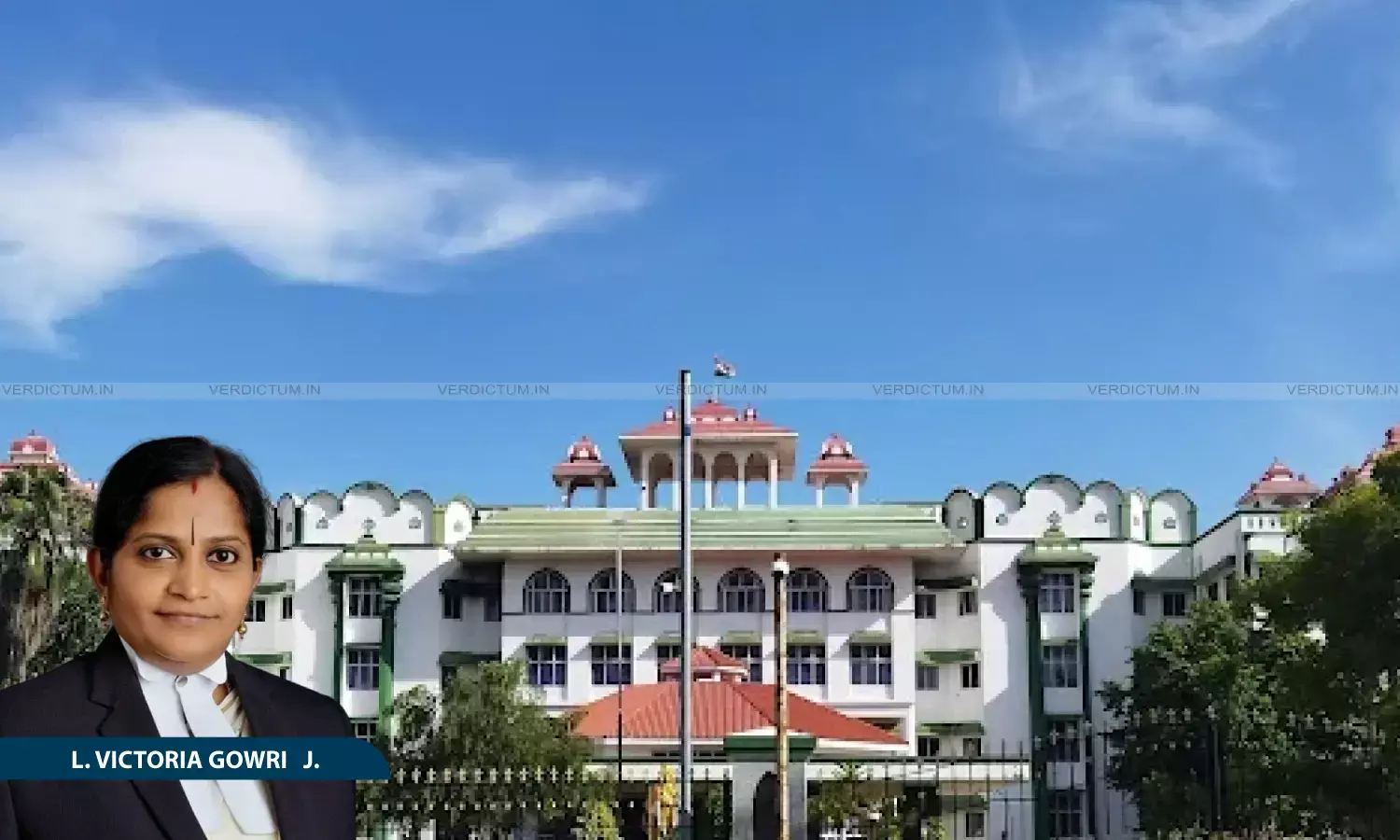
Justice L. Victoria Gowri, Madras High Court, Madurai Bench
The Madras High Court reprimanded police personnel for facilitating an out-of-court monetary settlement in a dowry complaint rather than registering a First Information Report (FIR).
The Court observed that police stations—particularly All Women Police Stations—cannot degenerate into informal arbitration forums that negotiate the dilution of criminal law based on the bargaining power of parties.
While acknowledging the State Government’s prompt corrective actions—including placing the erring officers under suspension and registering an FIR against the accused—the High Court directed the two police officers to individually pay ₹1,00,000 as public law compensation to the petitioner’s bank account for gross dereliction of statutory duty.
The Bench of Justice L Victoria Gowri observed, "It is deeply disturbing that, instead of inspiring confidence among women, some All Women Police Stations are increasingly perceived as informal forums for negotiated settlements, often overlooking the mandatory requirements of criminal law. Instances where complaints involving cognizable offences are informally compromised, depending upon the influence, financial strength or bargaining power of the parties, seriously erode public confidence in the administration of criminal justice."
Advocate S. Kishore Kumar appeared for the Petitioner, while Public Prosecutor John Sathyan appeared for the Respondents.
However, the Court on a further date of hearing directed, "Having considered the explanation submitted by respondents 2 and 3, their appearance before this Court expressing unconditional remorse and regret for the manner in which the petitioner's complaint was dealt with, and bearing in mind that they have already undergone suspension for a period of ten days pursuant to the earlier directions of this Court, this Court is inclined to take a lenient view insofar as further disciplinary consequences are concerned...As a measure of public law compensation for the injury caused by such dereliction of statutory duty, respondents 2 and 3 shall each pay a sum of Rs.1,00,000/- (Rupees One Lakh only) to the petitioner by crediting the said amount to the petitioner's bank account..."
Brief Facts
The petitioner was the father of a young woman whose marriage was solemnly arranged through conventional family negotiations with the fourth respondent, who was employed as a Senior Engineer in Bengaluru. The alliance was finalized with the concurrence of the respective families, comprising the fourth respondent and respondents five to nine, culminating in an engagement ceremony. On the date of the engagement itself, the petitioner was compelled to part with a substantial cash sum as dowry.
Prior to the scheduled wedding date, respondents four to six allegedly demanded additional dowry. Upon the petitioner expressing his inability to satisfy these illegal demands, the private respondents unilaterally cancelled the marriage.
Aggrieved, the petitioner submitted a representation to the police authorities seeking appropriate legal action. However, instead of registering an FIR and initiating criminal proceedings in accordance with law, the police officials (respondents two and three) facilitated an informal, private monetary settlement. They persuaded the petitioner to receive only a partial refund of the dowry amount, directed him to wait a month for the remaining sum, and subsequently closed the complaint without taking any penal action.
The petitioner then instituted a Writ Petition under Article 226 of the Constitution of India before the High Court, seeking a Writ of Mandamus to direct the state authorities to take appropriate legal action against the private respondents.
Contentions of the Parties
The petitioner submitted that after years of hard work and savings, the petitioner had arranged his daughter's marriage, which ultimately collapsed solely due to unlawful dowry demands. It was argued that despite the complaint revealing serious, cognizable offences under the Dowry Prohibition Act and the Bharatiya Nyaya Sanhita, the police turned a blind eye to the law. It was contended that the police illegally acted as private mediators, forcing a partial monetary compromise and closing the complaint without registering a case, thereby causing severe injury and prejudice to the petitioner.
The State initially contended that the complaint was duly enquired into and that both parties had voluntarily arrived at an amicable settlement outside the police station. It was submitted that written statements evidencing the settlement had been furnished before the third respondent, justifying the closure of the complaint.
At a later stage, it was submitted that the State Government had taken serious note of the institutional deficiencies highlighted by the Court. He informed the Court that prompt corrective measures had been taken: disciplinary proceedings were initiated by placing respondents two and three under suspension, an FIR was duly registered against the private respondents, and the matter was referred to the District Dowry Prohibition Officer for enquiry.
Observations and Directions of the Court
Vide order dated July 9, 2026, the High Court expressed deep dissatisfaction over the conduct of the police officers, observing that police stations—particularly All Women Police Stations—cannot be permitted to degenerate into informal adjudicatory or arbitration centers. The Court held that police officers have no jurisdiction to convert allegations of cognizable offences into private monetary settlements, emphasizing that their duty is to enforce the law, not negotiate its dilution.
The Court highlighted that while state policy initiatives like the "Singapenn Special Task Force" demonstrated a strong commitment to gender justice, the failure of foundational institutions like All Women Police Stations to register complaints of dowry harassment eroded public confidence in the criminal justice system.
The Court directed the second respondent (Inspector of Police) to appear in person and furnish a detailed explanation regarding the non-registration of an FIR. Furthermore, the Court ordered respondents two and three to deposit a sum of public law compensation directly into the petitioner’s bank account for the injury caused by their dereliction of duty.
It observed, "If the allegations contained in the complaint are accepted at face value, they unmistakably disclose commission of cognizable offences warranting registration of a First Information Report and investigation in accordance with law. Instead, the police appear to have facilitated return of only a portion of the alleged dowry amount, persuaded the complainant to await repayment of the remaining amount and thereafter proceeded to close the complaint. Such an approach not only lacks legal sanction but also trivialises the gravity of allegations relating to dowry harassment. Police officers cannot assume unto themselves the jurisdiction to convert allegations of cognizable offences into private monetary settlements. The duty of the police is to enforce the law not to negotiate its dilution."
Subsequently, on July 16, 2026, upon noting subsequent compliance developments—namely, the suspension of respondents two and three, the official registration of an FIR against the private respondents, and the transmission of the matter to the District Dowry Prohibition Officer—the Court observed that the petitioner's primary grievance stood substantially redressed.
The Court directed respondents four to nine to appear before the District Dowry Prohibition Officer and fully cooperate with the ongoing investigation. The Investigating Officer and the Dowry Prohibition Officer were instructed to proceed strictly in accordance with law and file a final report before the jurisdictional court, uninfluenced by any observations made in the High Court’s orders.
Taking note of the unconditional remorse expressed by respondents two and three during their personal appearance, as well as the period of suspension already undergone by them, the Court took a lenient view regarding further departmental consequences.
It clarified that no further departmental proceedings would be initiated against them on the subject matter, provided they credited the directed public law compensation to the petitioner's account within the stipulated time. The Court also granted liberty to the primary respondent to revoke the suspension of the police officers.
The Writ Petition was accordingly disposed of with no order as to costs.
Cause Title: P. Paul Abraham v. The State of Tamil Nadu & Ors. [W.P.Crl.(MD)No.3809 of 2026]
Appearances:
Petitioner: Advocate S. Kishore Kumar and Advocate Vanisha
Respondents: Public Prosecutor John Sathyan and Advocate C. Susikumar