Mere Suggestions In Cross-Examination Cannot Create Reasonable Doubt Without Supporting Evidence: Madras High Court
The High Court held that an alternative defence theory must be supported by substantive evidence and cannot rest solely upon suggestions made in cross-examination.
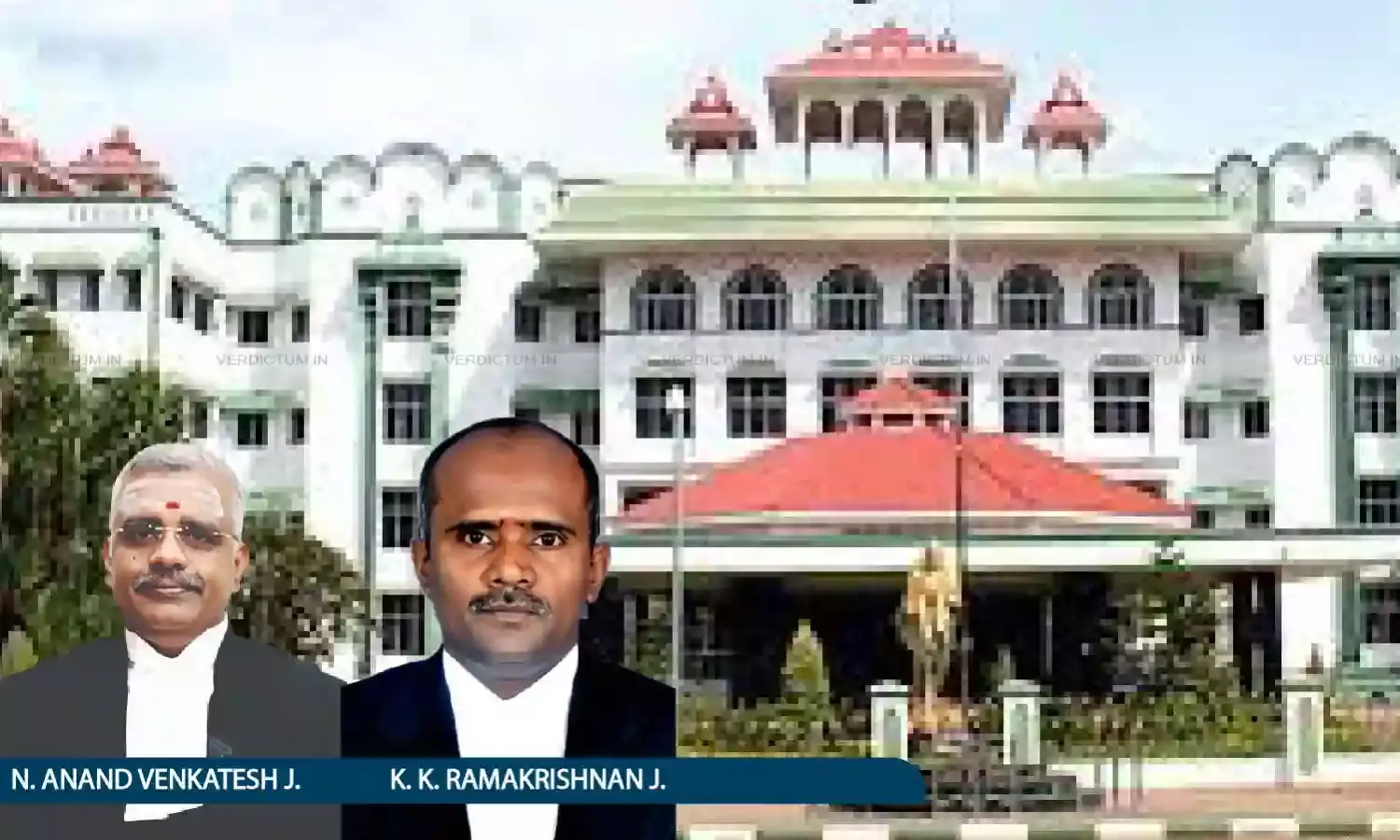
Justice N. Anand Venkatesh, Justice K. K. Ramakrishnan, Madras High Court
The Madras High Court has held that an accused cannot create a reasonable doubt in the prosecution's case merely by putting suggestions during cross-examination without leading any substantive evidence in support of such suggestions.
The Court observed that a defence theory alleging the involvement of some other person must be supported by credible oral or documentary evidence and cannot be accepted solely because such a suggestion was made to prosecution witnesses during cross-examination.
A Division Bench comprising Justice N. Anand Venkatesh and Justice K.K. Ramakrishnan, while dismissing a criminal appeal filed against the conviction of an accused for offences punishable under Sections 449, 380 and 302 of the Indian Penal Code, observed: "The defence further attempted to suggest that the murder might have been committed by some other person owing to an alleged partition dispute within the family. This suggestion was merely made during cross-examination of PW1. However, no documentary or oral evidence whatsoever has been produced to establish the existence of any such partition dispute. …A mere suggestion made during cross-examination, unsupported by any substantive evidence, cannot create a reasonable doubt regarding the prosecution case. Accordingly, the alternative theory projected by the defence is wholly untenable and deserves to be rejected."
Advocate Ponkarthikeyan, Legal Aid Counsel, appeared on behalf of the appellant, while Advocate Venkatesh, Counsel for State of Tamil Nadu (Criminal Side), represented the respondents.
Background
According to the prosecution, the accused allegedly trespassed into the residence of the deceased with the intention of committing robbery, murdered her by inflicting multiple stab injuries, and thereafter removed gold jewellery, cash, a mobile phone and an ATM card from the house.
Following the investigation, the police relied upon eyewitnesses who had seen the accused entering and leaving the house shortly before the occurrence, recovery of the stolen articles pursuant to the accused's disclosure statement, and fingerprint, footprint and other scientific evidence linking him to the crime.
The Sessions Court convicted the accused for offences punishable under Sections 449, 380 and 302 IPC. Challenging the conviction, the accused preferred the present criminal appeal before the High Court.
Court's Observations
The Court undertook an independent re-appreciation of the entire evidence and found that the prosecution had established a complete chain of circumstantial evidence connecting the accused with the commission of the offence.
The Bench noted that several prosecution witnesses consistently deposed that they had seen the accused entering the deceased's house shortly before the occurrence and leaving with a handbag soon thereafter. This evidence, coupled with the recovery of the stolen articles and the scientific evidence, constituted a complete chain of circumstances pointing only towards the guilt of the accused.
The Court observed: "The learned trial Judge rightly appreciated the cumulative effect of the 'last seen' evidence, the recovery of stolen articles at the instance of the accused, and the surrounding circumstances... When these circumstances are considered together, they form a complete chain leading only to the hypothesis of the guilt of the accused, excluding every other possible hypothesis consistent with innocence."
The Court rejected the challenge to the recovery proceedings, observing that the prosecution had proved the recovery strictly in accordance with law through the evidence of the attesting witnesses and the Investigating Officer.
The Bench observed: "Although PW17 and PW18 were subjected to lengthy cross-examination, nothing material has been elicited to discredit their testimony or cast any doubt upon the recovery proceedings. This Court, therefore, finds that the recovery has been proved strictly in accordance with law."
Dealing with the principal defence contention that the offence may have been committed by some other person owing to an alleged family partition dispute, the Court found that the defence had failed to adduce any evidence whatsoever to substantiate such a theory.
The Court also rejected the argument that the investigation had failed to consider the possibility of another person entering through the rear entrance of the house. It noted that the Investigating Officer had conducted a detailed investigation by obtaining fingerprint, footprint, handwriting and other expert reports before concluding that the appellant alone was involved.
The Bench observed: "The Investigating Officer did not mechanically conclude that the appellant was the offender. On the contrary, a detailed investigation was conducted by obtaining the reports of the fingerprint expert, footprint expert, handwriting expert and other scientific experts. Only after analysing the entire scientific evidence along with the oral evidence did the Investigating Officer arrive at the conclusion that the appellant alone was involved in the commission of the offence."
The Court further held that the recovery of the stolen articles from the accused immediately after the murder attracted the presumption under Illustration (a) to Section 114 of the Indian Evidence Act.
The Bench observed: "Once the recovery of the stolen properties belonging to the deceased was made from the accused is proved and the appellant is found to have been in possession of those properties soon after the murder, the presumption under Section 114 illustration (a) of the Indian Evidence Act, 1872 squarely applies... the Court can legitimately draw the inference that the accused committed both the theft and the murder."
The Court also rejected the contention regarding delay in registration of the FIR, observing that the sequence of events satisfactorily explained the time taken in lodging the complaint. Similarly, it rejected the plea that the accused had been arrested prior to the date shown by the prosecution, holding that the contention was unsupported by any evidence.
The Bench observed: "This contention is wholly unsupported by any evidence. There is absolutely no oral or documentary material on record to probabilise such a plea. A mere suggestion made during cross-examination cannot displace the positive evidence adduced by the prosecution regarding the date and manner of arrest."
Upon independently reassessing the evidence, the Court concluded that every incriminating circumstance had been proved beyond a reasonable doubt and that the findings recorded by the trial court were fully supported by the evidence on record.
Conclusion
Holding that the prosecution had successfully established every incriminating circumstance beyond a reasonable doubt and that the chain of circumstances pointed unerringly towards the guilt of the accused, the Madras High Court dismissed the appeal and affirmed the conviction and sentence imposed by the trial court.
Cause Title: Chandrasekar v. The State (Neutral Citation: 2026:MHC:2291)