

PMLA Court Can't Take Cognizance In Absence Of Sanction: Madras High Court Rejects ED Plea To Transfer Former Minister’s Disproportionate Assets Trial
The High Court said Section 44(1)(c) of the PMLA is meant to save time and avoid inconsistent findings, not to reopen a scheduled-offence trial that has almost reached conclusion.
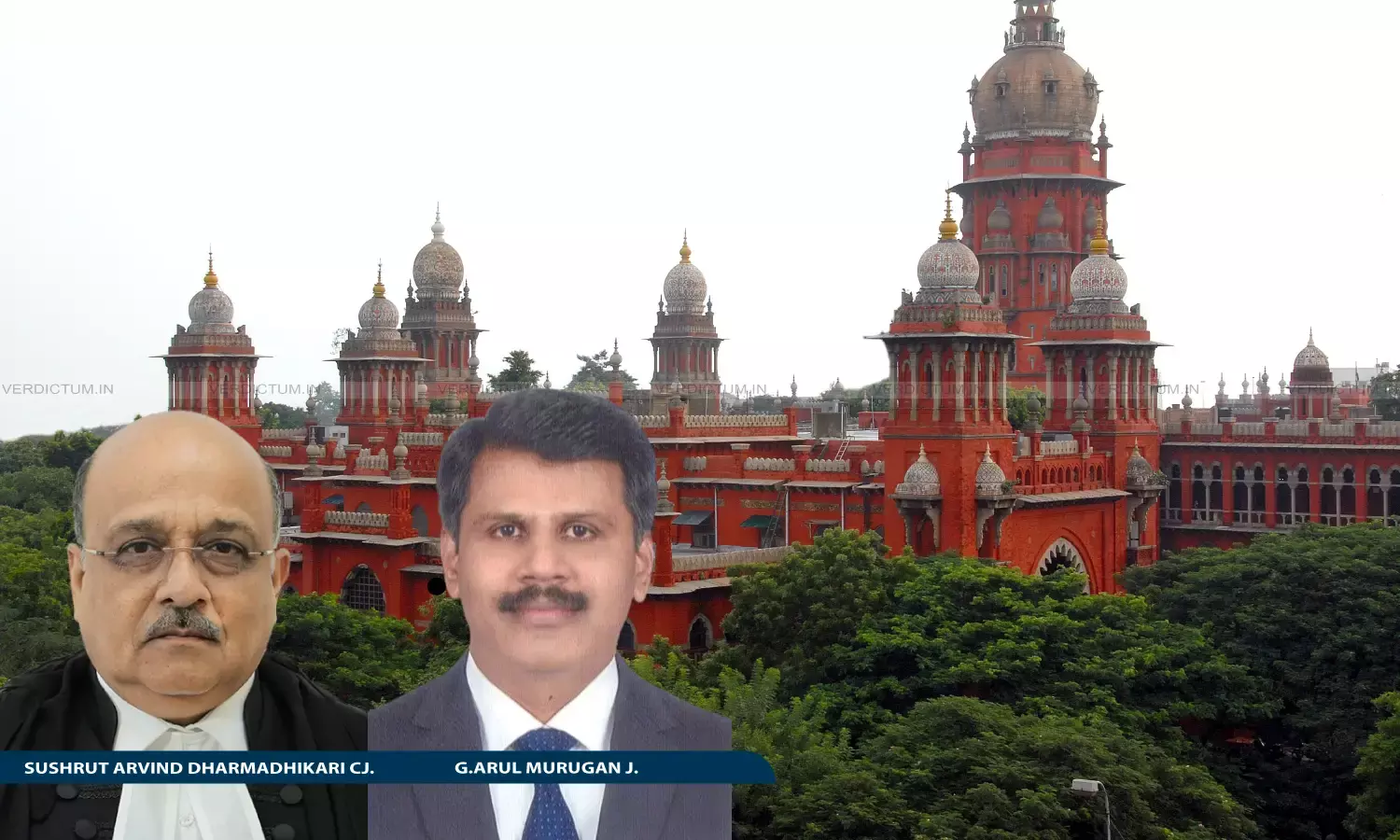
Chief Justice Sushrut Arvind Dharmadhikari, Justice G. Arul Murugan, Madras HC
The Madras High Court has rejected the Enforcement Directorate’s plea to transfer former Tamil Nadu Minister Anitha R. Radhakrishnan’s disproportionate assets trial to the PMLA Special Court at Madurai.
The High Court, while rejecting the plea, held that the Special Court had not taken cognisance of the money-laundering complaint and could not presently do so in the absence of the sanction required under Section 197(1) of the Code.
The Court was hearing a petition filed by the Enforcement Directorate challenging the Thoothukudi Principal Sessions Judge’s refusal to commit the pending disproportionate assets case against former Tamil Nadu Minister Anitha R. Radhakrishnan and others to the PMLA Special Court at Madurai under Section 44(1)(c) of the PMLA.
A Bench of Chief Justice Sushrut Arvind Dharmadhikari and Justice G. Arul Murugan, observed: “… this court is satisfied that the order dated 11.12.2025 passed by the learned Principal Sessions Judge, Thoothukudi, rejecting the petitioner’s application under Section 44(1)(c) of the PMLA, warrants no interference. The application was premature, since the Special Court at Madurai has not taken cognizance of the money-laundering complaint and cannot presently do so in the absence of the sanction required under Section 197(1) of the Code. The trial in Spl.C.No.3 of 2019 has reached a stage where sending it to another court would cause real prejudice to the accused and serve no legitimate object of the statute.”
Special Public Prosecutor P. Sidharthan appeared for the Enforcement Directorate, while Senior Counsel Abudu Kumar Rajarathinam appeared for Anitha Radhakrishnan.
Background
The Court was hearing a petition filed by the Enforcement Directorate challenging the order of the Principal Sessions Judge, Thoothukudi, rejecting its application under Section 44(1)(c) of the PMLA to commit the pending disproportionate assets case to the PMLA Special Court at Madurai.
The disproportionate assets case arose from allegations that Anitha R. Radhakrishnan, who was a Member of the Tamil Nadu Legislative Assembly from Tiruchendur and had held the portfolio of Minister for Housing and Urban Development, acquired assets beyond his known income during his tenure. The Vigilance and Anti-Corruption Wing registered the FIR in 2006, alleging that assets worth about ₹2.68 crore had been built up in his name and in the names of family members. The amount said to be disproportionate was about ₹2.08 crore.
The trial before the Thoothukudi court had substantially progressed. The prosecution had examined 79 witnesses and marked 312 exhibits; the defence had examined 6 witnesses and marked 74 exhibits; both sides had closed evidence; the prosecution had completed arguments; and the defence had argued in part. Meanwhile, the ED filed a money-laundering complaint before the PMLA Special Court at Madurai, but that court had not taken cognizance, particularly since sanction under Section 197(1) CrPC had not been produced.
Court’s Observations
The Court examined Section 44 of the PMLA and held that the committal mechanism under Section 44(1)(c) applies only when two courts have already taken cognizance: one of the scheduled offence and the other of the money-laundering complaint.
The Bench stated: “A bare reading of Section 44(1)(c) of the PMLA makes it clear as day that the clause is speaking of two courts, each of which has already taken cognizance — one of the scheduled offence, and the other, being the Special Court, of the money-laundering complaint. Only when both the courts have taken cognizance and they turn out to be different courts, does the mechanism of committal come into play. Section 44(1)(c) of the PMLA does not say "if the Special Court is likely to take cognizance" or "once the Special Court is seized of the complaint". It explicitly states that the Special Court must have "taken cognizance".”
The Court held that Rana Ayyub v. Directorate of Enforcement (2023), relied on by the ED, treated cognizance by the Special Court as an accomplished fact and did not dispense with it.
On facts, the Court noted that the Madurai Special Court had only issued a pre-cognizance notice under Section 223 BNSS and had not yet decided whether to take cognizance at all.
The Bench observed: “On the admitted facts here, the Special Court at Madurai has not taken cognizance of the money-laundering complaint. It has only issued a notice under Section 223 of the BNSS calling the accused to appear before it decides whether to take cognizance at all, which is a pre-requisite that is held to be mandatory and must be complied with before cognizance can be taken, as has been held by the Supreme Court in Kushal Kumar Agarwal (supra) and was also emphasized in Seeman (supra).”
It added: “Admittedly, one of the two essential facts on which Section 44(1)(c) of the PMLA is built, viz., cognizance by the Special Court, is not yet satisfied. An application asking the Thoothukudi Court to commit the case, even when cognizance was not taken by the Special Court, in our considered view, is premature.”
The Court also noted that the Special Court at Madurai had itself called upon the ED to produce sanction for prosecuting Anitha Radhakrishnan, considering his status as a former public servant under the Prevention of Corruption Act, 1988.
The Bench held: “That apart, the second respondent was a Minister and a sitting legislator during the period in question. The Special Court at Madurai itself asked for the sanction in September 2025. Nearly a year has gone by and the petitioner has still not produced the same. In the absence of such sanction being produced, the Special Court is not likely to take cognizance against the second respondent. Therefore, the default, if any, lies on the part of the petitioner.”
The Court said Section 44(1)(c) exists to save time and avoid inconsistent decisions, but cannot be used at the eleventh hour to delay a trial that has practically concluded.
The Bench stated: “Moreover, Section 44(1)(c) of the PMLA exists to save time and to avoid the risk of two courts reaching different conclusions on the same facts. It was never meant to serve as a means of reopening a trial that has, for all practical purposes, already been fought and finished.”
The Court then noted the advanced stage of the Thoothukudi trial and said committing it to Madurai would only delay the proceedings.
“To commit such a case, at this stage, to the Special Court at Madurai, which has not even taken cognizance of the connected money-laundering complaint would simply delay the case before the Thoothukudi Court, which is on the verge of conclusion.”
The Court distinguished Deputy Director v. Deputy Superintendent of Police (2026), noting that in that case the Special Court had already taken cognizance, both courts were within the same city and sessions jurisdiction, and the scheduled-offence trial was still actively in progress.
The Bench also held that Rana Ayyub (2023) dealt with forum at an early stage and did not apply to a case where cognizance had not been taken and sanction had not been obtained.
The Court stated: “The decision in Ranjit Singh Kothari (supra) emphasizes about the general legislative intention that one court should try both offences, which principle this Court does not doubt, but only states is not applicable to the facts of the present case where cognizance is not yet taken and there no sanction has been obtained.”
Relying on Pankajini Sahu v. Joint Director, Enforcement Directorate (2023), the Court held that committal under Section 44 PMLA is not automatic and must depend on the interest of justice.
The Bench observed: “The discretion recognised in Pankajini Sahu (supra) that committal under Section 44 of the PMLA is not to be ordered as a matter of course, but only where the interest of justice calls for it, is, in the circumstances, of direct application and points firmly against committal at this stage.”
The Court also noted that the ED had earlier sought similar relief before the same court under Sections 301(2) and 302(2) CrPC, which was dismissed on merits and not challenged.
Conclusion
The High Court dismissed the ED’s petition and upheld the Thoothukudi Principal Sessions Judge’s rejection of the Section 44(1)(c) PMLA application.
It allowed the accused persons’ application to vacate the interim stay on the disproportionate assets trial and directed the Principal Sessions Judge, Thoothukudi, to take up the case at the earliest available date and proceed with expedition. The Court clarified that it had expressed no opinion on the merits of either the disproportionate assets case or the money-laundering complaint, both of which must be decided independently by the respective courts.
Cause Title: Assistant Director, Directorate of Enforcement v. Additional Superintendent of Police, Directorate of Vigilance and Anti-Corruption, Thoothukudi and Others (Neutral Citation: 2026:MHC:3219)
Appearances
Petitioner: P. Sidharthan, Special Public Prosecutor for ED Cases
Respondents: Arun Anbumani, Additional Public Prosecutor, assisted by M. Dinesh, Government Advocate, for R1; Senior Counsel Abudu Kumar Rajarathinam for R2; A. Nagarajan for R3 to R9
Click here to read/download Judgment