

It Is A Complaint About Internal Procedure: Madras High Court Rejects AIADMK Whip's Mekedatu Resolution Challenge
The Court held that the petition was barred by Article 212 Constitution, finding member's silence on the floor when the amendment was read out defeats his belated challenge.

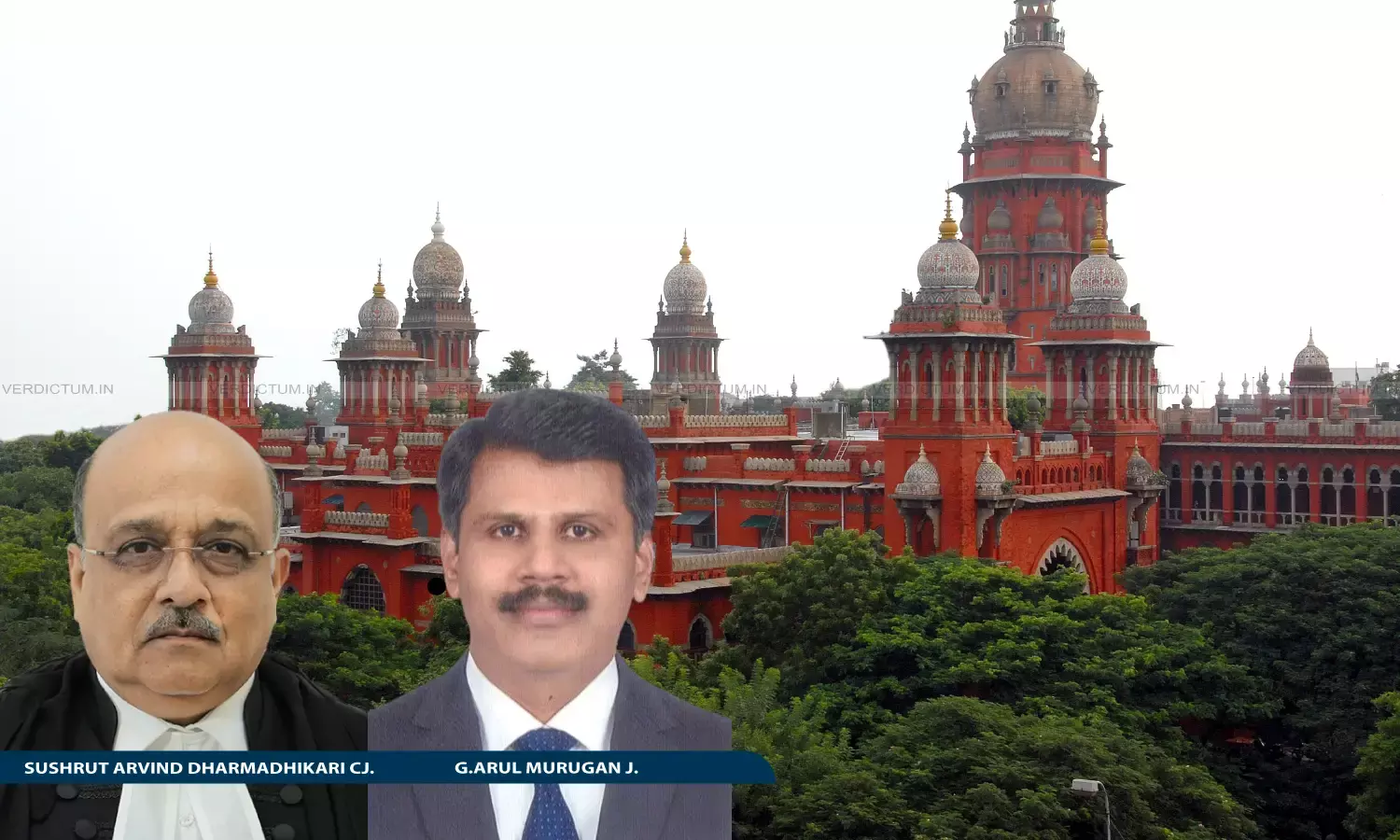
Chief Justice Sushrut Arvind Dharmadhikari, Justice G. Arul Murugan, Madras HC
The Madras High Court has dismissed a petition challenging how a clause seeking a fresh tribunal on the Mekedatu Dam dispute was added to a Tamil Nadu Assembly Resolution, holding that the challenge, however it was framed, was really about the internal procedure of the House. Since Article 212 of the Constitution of India bars courts from questioning the validity of legislative proceedings over mere procedural irregularities, the Court held the petition could not be entertained.
The petition was filed by Agri S.S. Krishnamurthy, Official Whip of the All India Anna Dravida Munnetra Kazhagam (AIADMK), against the Secretary of the Tamil Nadu Legislative Assembly, the State of Tamil Nadu, and the Union of India.
The dismissal was reinforced by the Court's further finding that, even on merits, a member who was present in the House, heard the amendment proposed and read out, and chose to remain silent rather than object, could not later ask a court to treat that silence as rendering the proceeding a nullity.
A Division Bench comprising Chief Justice Sushrut Arvind Dharmadhikari and Justice G. Arul Murugan observed, “…we hold that the grievance raised in this petition, however it is dressed up, is a complaint about the internal procedure of the House within the meaning of Article 194 read with Article 212 of the Constitution of India, and the writ petition is, on that ground alone, not maintainable”.
“…A challenge of this kind cannot succeed unless prejudice is "ex facie apparent". The petitioner's own conduct, his continued presence through the debate, his silence at the vote, and his party's subsequent unsuccessful attempt to reopen the issue within the House itself demonstrates that no such prejudice exists. Courts exercising jurisdiction under Article 226 of the Constitution of India are not obliged to entertain a challenge founded on an irregularity that the petitioner himself was in a position to object to at the time, and chose not to.”, the Bench further said.
Senior Advocate S.R. Rajagopal appeared for the petitioner and Vijay Narayan, Advocate General, A. Kumaraguru, Senior Panel Counsel appeared for the respondent.
The petitioner's case was that the Government Resolution circulated to members on 18 June 2026 opposing Karnataka's Mekedatu Dam proposal did not contain any demand for constitution of a fresh tribunal under Section 4 of the Inter-State River Water Disputes Act, 1956. According to the petitioner, this demand surfaced only during the Assembly debate on 19 June 2026, when the Leader of the Opposition raised it, and was accepted by the Chief Minister and incorporated into the Resolution without being separately moved, seconded, debated or put to a distinct vote, as required under Rule 104 of the Tamil Nadu Legislative Assembly Rules governing amendments.
The petitioner contended that the amended Resolution was nonetheless communicated to the Union Government as having been carried unanimously, notwithstanding that members of the AIADMK, PMK and CPI were said to have objected to the manner of its inclusion, and sought quashing of the tribunal clause and restoration of the Resolution to its original circulated form.
The first respondent's counter affidavit set out the sequence of events: the Leader of the Opposition had given a Rule 104 notice at 9:35 am on June 19, 2026, shortly before the Resolution was moved, which could not be taken up in the ordinary course owing to shortness of notice; during the debate, the Chief Minister, while replying, offered to add the tribunal clause, informing the House that consultations with legal experts had already taken place on May 26 2026; no member objected either then or when the amended Resolution was read out; and the Speaker declared it carried unanimously on a voice vote. The Assembly further placed on record that the identical grievance had been raised on the floor of the House on August 07, 2026 by the AIADMK Legislature Party leader, and the Speaker had ruled that no illegality had occurred, a ruling that went unquestioned at the time.
On the threshold objection, the Court held that the petitioner's grievance was, at its core, a complaint about internal legislative procedure falling within the combined protection of Articles 194 and 212, relying on the Supreme Court's decisions in Pandit M.S.M. Sharma v. Dr. Shree Krishna Sinha AIR 1960 SC 1186 and the Constitution Bench ruling in Ramadas Athawale v. Union of India (2010) 4 SCC 1, both of which draw a firm distinction between "want of jurisdiction" and "improper or irregular exercise of jurisdiction," the latter alone falling outside judicial reach.
The Court distinguished the petitioner's reliance on Dr. Sunil Kumar Singh v. Bihar Legislative Council Others (2026) 2 SCC 364, holding that judgment concerned an administrative decision of expulsion affecting constitutional rights, not internal floor procedure. On merits, the Court found that the Chief Minister's oral proposal, accepted by the Speaker without objection from any member present, and put to an unopposed unanimous vote, could not now be reopened by a member who had every opportunity to object at the time and chose not to.
“…if members present in the House, who had the opportunity then and there to object, chose instead to vote "Aye" or to remain silent, they cannot, weeks later, ask a court to treat their own silence as a nullity. The principle that a person who stands by, watches an act take place, and permits it to occur without protest cannot subsequently be heard to complain of it, applies with as much force to the floor of a legislature as it does to any other public proceeding. This is not a case of a citizen who was shut out or misled; it is a case of a Member, and of the party he belongs to, who was present in the House when the amendment was proposed, read out and voted upon…”, the Bench said.
Cause Title: Agri S.S. Krishnamurthy v, The Secretary, Tamil Nadu Legislative Assembly and Others (Neutral Citation: 2026:MHC:3892)
Appearances:
Petitioner: S.R. Rajagopal, Senior Counsel, assisted by Lamech Indian and I.S. Inbadurai.
Respondents: Vijay Narayan, Advocate General, J. Lenin, Special Government Pleader, Akash Srinandha, Government Advocate, A. Kumaraguru, Senior Panel Counsel.