

Dignified Final Rites Can’t Be Denied Merely Because Family Refused To Receive Body: Madras High Court Allows Cremation Of Custodial Torture Victim Akash Delison’s Body
The Court held that the dignity protected under Article 21 extends to mortal remains and that where family members refuse to receive a body despite having sufficient opportunity and the completion of all medico-legal formalities, the State is empowered to undertake a dignified disposal in accordance with the law.
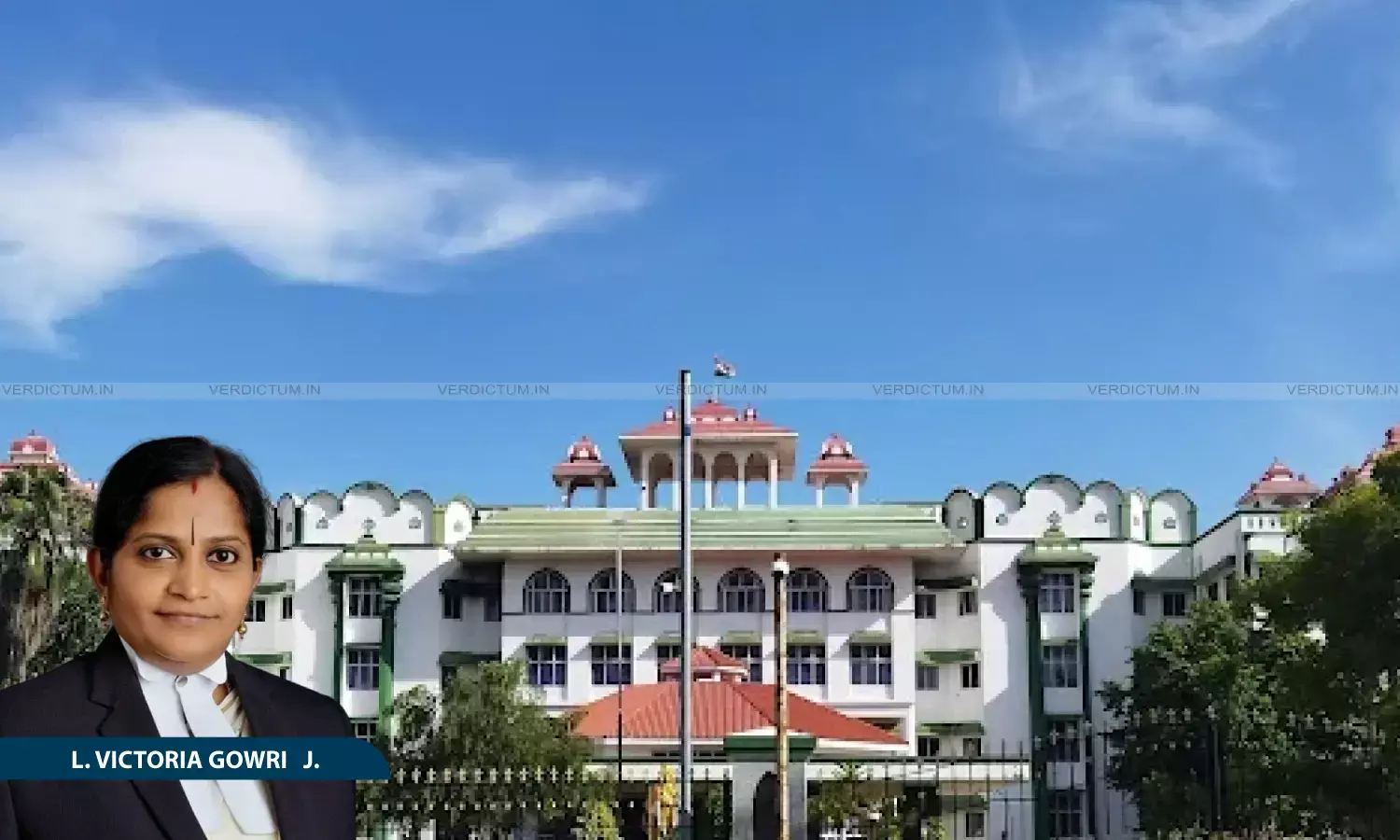
Justice L. Victoria Gowri, Madras High Court, Madurai Bench
The Madras High Court has held that the continued refusal of family members to receive the mortal remains of a deceased person cannot result in indefinite preservation of the body and that the State is empowered to arrange for dignified disposal in accordance with law after completion of all necessary legal formalities.
The Court directed the State authorities to take immediate steps for the dignified disposal of the mortal remains of Akash Delison, whose body had remained in a mortuary for more than three months following completion of all medico-legal formalities.
The Court was hearing proceedings arising out of a writ petition seeking the registration of a criminal case in connection with an alleged custodial death, the transfer of investigation to the Crime Branch-Criminal Investigation Department (CBCID), and the monitoring of the investigation.
A Bench of Justice L. Victoria Gowri, while stating that "a deceased person cannot be denied dignified final rites merely because relatives decline to act", further held that “the refusal of the petitioner and his family to receive the body, despite sufficient opportunity and despite a specific judicial direction, leaves this Court with no alternative except to authorise the State authorities to proceed in accordance with law.”
For the petitioner, Advocate C.M. Arumugam appeared. Additional Advocate General B. Saravanan appeared for the respondents..
Background
The writ petition had originally been instituted seeking registration of an independent criminal case in relation to an alleged custodial death, transfer of investigation to CBCID and judicial monitoring of the investigation.
The Court had earlier disposed of the petition after recording that the investigation had been transferred to CBCID, the penal provisions had been altered to include Section 103 of the Bharatiya Nyaya Sanhita, 2023 and Section 3(2)(v) of the Scheduled Castes and Scheduled Tribes (Prevention of Atrocities) Act, 1989, and after issuing appropriate directions concerning the investigation.
Subsequently, the Additional Advocate General mentioned the matter before the Court, stating that, notwithstanding completion of the post-mortem examination, preservation of material evidence and substantial progress in the investigation, the family members of the deceased had declined to receive the mortal remains for more than three months.
It was represented that the body continued to remain in the mortuary, had undergone substantial decomposition, and that continued preservation was creating practical and public health concerns while also causing hardship to the medical authorities responsible for preserving it.
Taking note of the submissions, the Court had earlier directed the petitioner and the family members to receive the mortal remains on or before the specified time on the previous day and posted the matter for reporting compliance.
When the matter was taken up thereafter, the petitioner's counsel informed the Court that the family had not received the body. The State consequently sought permission to enable the District Administration and municipal authorities to undertake dignified disposal of the mortal remains in accordance with law.
The petitioner contended that the family entertained serious apprehensions regarding the circumstances surrounding the custodial death and alleged lack of transparency immediately after the occurrence.
Reliance was placed on various international instruments and the decision in Kasturi v. State to contend that custodial deaths require independent, transparent and effective investigation. It was further contended that the deceased belonged to a Scheduled Caste community and that the family had withheld receiving the body to secure complete justice.
The State, on the other hand, submitted that the grievances which originally necessitated judicial intervention had already been substantially addressed. Investigation had been transferred to CBCID, a senior officer had been appointed as Investigating Officer, relevant records had been secured, and the offences had been appropriately altered.
It was further submitted that the body had remained unclaimed for more than ninety days, had undergone substantial decomposition, and that continued preservation served no investigative purpose.
Court’s Observations
The Court observed that allegations involving custodial deaths require the highest degree of judicial sensitivity and institutional accountability. It noted that judicial intervention had already ensured transfer of investigation to CBCID, alteration of offences and monitoring of the investigation until the immediate concerns stood substantially addressed.
The Bench then examined the constitutional dimension of the issue and observed that dignity does not cease with death. Referring to Article 21 of the Constitution, the Court held that the right to life has repeatedly been interpreted to include the right to decent and dignified treatment of mortal remains and that constitutional values protecting an individual during life continue to operate in respect of the body after death.
The Court referred to Ashray Adhikar Abhiyan v. Union of India (2002) and observed that the Supreme Court had recognised the State's obligation to ensure dignified disposal of unclaimed bodies. The Court also drew guidance from the judgment of the Jharkhand High Court in Maithon Power Limited v. State of Jharkhand and Others, which recognised that mortal remains should not be indefinitely retained and that the State bears an obligation to ensure dignified final rites.
Examining the facts of the case, the Court noted that the family members were known and identifiable, had been repeatedly informed and had been granted adequate opportunity to receive the body. The Court further noted that a specific judicial direction had been issued requiring the family to receive the body and that the direction admittedly remained uncomplied with.
The Bench observed: “The continued refusal of the family to receive the body cannot result in indefinite preservation of mortal remains. Such a course would ultimately defeat the very dignity sought to be protected.”
The Court then examined Section 2(f) of the Tamil Nadu Anatomy Act, 1951, which defines an “unclaimed body”. According to the Court, the expression “claimed” necessarily contemplates actual acceptance and receipt of the body by near relatives.
The Court observed: “Merely because relatives are identifiable does not mean that the body ceases to be unclaimed when they expressly refuse to receive it despite repeated opportunities.”
The Bench found that the post-mortem examination had long been completed, all medico-legal formalities had concluded, necessary samples had been preserved, and investigation was proceeding independently through CBCID. Consequently, no useful purpose would be served by preserving the body indefinitely.
The Court held that a conjoint reading of Section 2(f) of the Tamil Nadu Anatomy Act, 1951 and Rule 8 of the Tamil Nadu Anatomy Rules, 1951 empowered the State to arrange burial or cremation at Government expense where a body remains unclaimed after completion of legal formalities.
The Court further observed that legislative developments such as the Rajasthan Honour of Dead Body Act, 2023 and the Haryana Honourable Disposal of Dead Body Act, 2024, reinforced the constitutional principle that a deceased person cannot be denied dignified final rites merely because relatives decline to act.
The Court, ultimately, directed the state to "take immediate steps for the dignified disposal of the mortal remains of the deceased Akash Delison", while further adding that "the dignified performance of the last rites by the State authorities shall not in any manner affect, dilute or prejudice the ongoing investigation into the custodial death, which shall continue independently and strictly in accordance with law".
Conclusion
The High Court held that the continued refusal of the family members to receive the mortal remains could not justify indefinite preservation of the body and that the State was empowered to undertake dignified disposal after completion of all legal formalities.
The Court accordingly permitted and directed the District Collector, the Commissioner of the Municipal Corporation, the Dean of the Government Hospital and all other competent authorities to take immediate steps for the dignified disposal of the mortal remains.
The Court directed that the disposal be undertaken in accordance with the religious faith, customs and practices professed by the deceased and his family, to the extent ascertainable from available records.
It further directed preservation of adequate photographic and videographic documentation before the final rites, directed that the expenditure be initially borne by the State and clarified that disposal of the body would not affect or prejudice the ongoing CBCID investigation.
The Court also directed the investigating agency to proceed independently and file its final report as expeditiously as possible before the jurisdictional court. The proceedings arising out of the mention were accordingly closed.
Cause Title: A. Rajeshkannan v. The Home Secretary & Ors.
Appearances
Petitioner: Advocate C.M. Arumugam
Respondents: Additional Advocate General B. Saravanan, assisted by Government Advocate (Civil Side) Priyanka Jothi; Government Advocate (Criminal Side) C. Susi Kumar
