

Preponderance Of Probability Sufficient In Departmental Proceedings: Madras High Court Sets Aside Reinstatement Of Police Officer Found Drunk Inside Court Hall
The Court held that the absence of blood and urine tests is not fatal to departmental disciplinary proceedings if drunkenness is otherwise established.

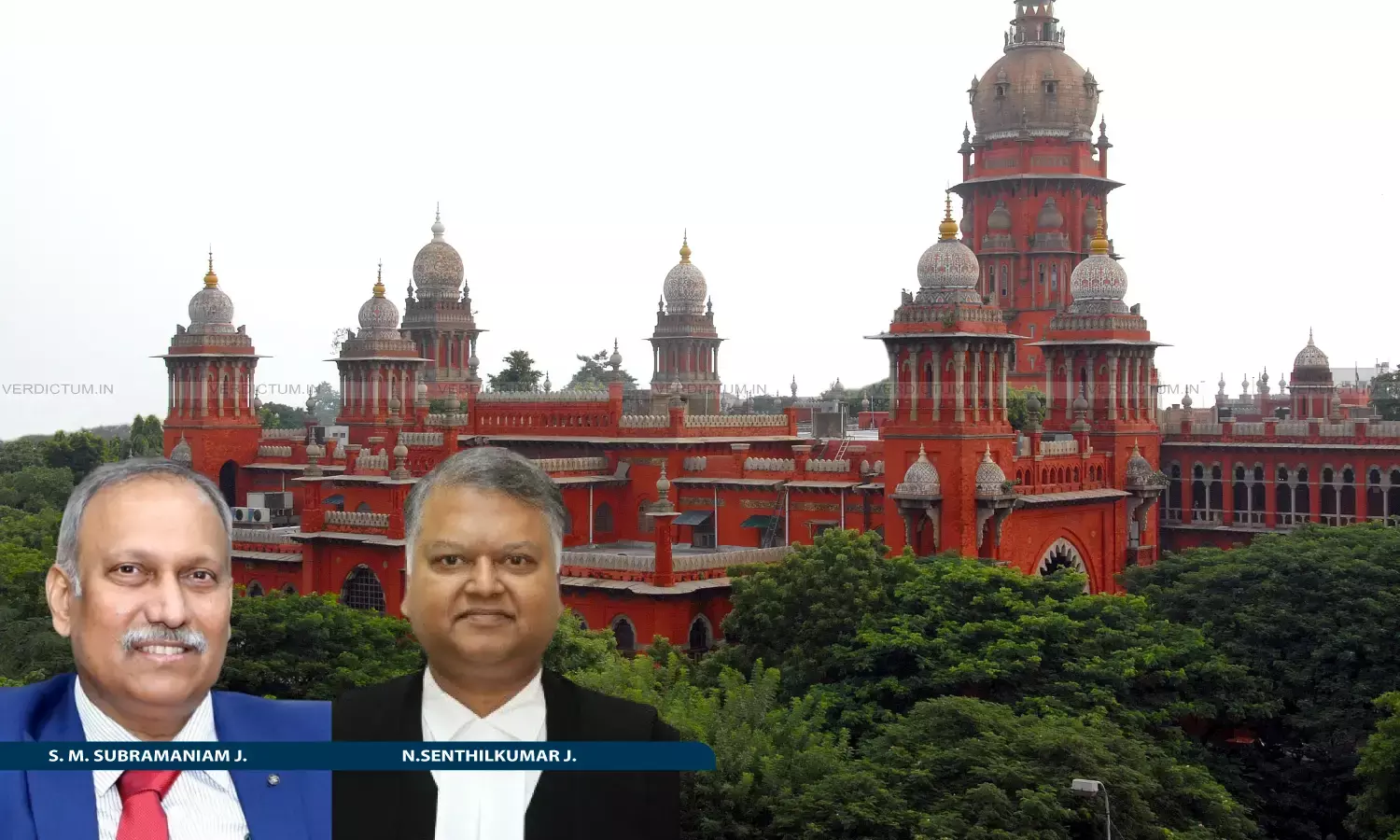
The Madras High Court has set aside a Writ Court order that had quashed a modified disciplinary penalty imposed on a Special Sub-Inspector of Police who appeared drunk while deposing before a Judicial Magistrate.
The Court ruled that, unlike the strict proof required in criminal trials, departmental disciplinary actions are governed by the principle of preponderance of probabilities.
Holding that the Drunkenness Certificate issued by the Medical Officer was sufficient evidence, the Bench observed that appearing before a court in an inebriated state severely degrades the integrity of the police force and cannot be tolerated.
Consequently, the Court allowed the writ appeal filed by the state authorities and directed the Director General of Police to issue a strict circular ensuring proper dress code and decorum for all police personnel attending court proceedings across the State of Tamil Nadu.
The Division Bench of Justice S.M. Subramaniam and Justice N. Senthilkumar observed, "Superintendent of Police / Disciplinary Authority, while imposing the major penalty of compulsory retirement, recorded a finding that the Drunkenness Certificate issued by the Medical Officer, which was filed and marked as Ex-P.6, will prove that he was found in a drunken state on 25.11.2014, while on duty. Such indifferent attitude of attending Court in a drunken state has to be viewed seriously. Departmental action is purely based on preponderance of probability and his act had totally degraded the image of police force in the Court hall and it has to be curbed, otherwise, the misconduct committed by the respondent will ruin the entire police force. The respondent had completed more than 30 years of service. However, he failed to maintain absolute integrity and devotion to duty while deposing as a witness before the learned Judicial Magistrate."
Advocate R. Gouri appeared for the Appellants, while Advocate T.K. Saravanan appeared for the Respondents.
Brief Facts
The respondent was serving as a Special Sub-Inspector of Police. While performing his duties, he appeared before a Judicial Magistrate to adduce evidence in a criminal case. During the recording of his evidence, the learned Magistrate observed that the respondent was in a drunken state, emitted a smell of alcohol, shouted, and spoke incoherently. The respondent was immediately sent for a medical examination, where the Medical Officer examined him and issued a Drunkenness Certificate, though no blood or urine tests were conducted.
Consequently, a complaint was forwarded by the Magistrate to the disciplinary authority. As the respondent's conduct was also published in the newspapers and brought discredit to the force, departmental disciplinary proceedings were initiated against him under the relevant service rules. Following a domestic enquiry where the charges were held proved, the disciplinary authority imposed the punishment of compulsory retirement.
On appeal, the appellate authority modified the penalty to the postponement of his next increment for three years with cumulative effect, which was subsequently affirmed by the revisional authority.
The respondent challenged this modified punishment before the Writ Court, which allowed his writ petition primarily on the ground that blood and urine tests had not been conducted to establish drunkenness. Aggrieved by the Writ Court's order, the state authorities preferred the present intra-court writ appeal.
Contentions of Parties
The appellants contended that the Writ Court erred in interfering with the punishment, as strict proof required in criminal trials is not necessary for departmental proceedings. They argued that the Drunkenness Certificate issued by the Medical Officer, combined with the fact that the respondent did not object to the examination and voluntarily submitted to it, was sufficient evidence for a domestic enquiry. They further submitted that the non-conduct of blood and urine tests is not fatal to departmental actions, which are guided by the rule of preponderance of probabilities.
Conversely, the respondent supported the Writ Court's order and contended that the conduct of blood and urine tests is an absolute prerequisite to conclusively establish drunkenness. He argued that in the absence of such biological tests, the allegation of being in an inebriated state could not be legally sustained, making the Writ Court's decision aligned with established judicial precedents.
Observations and Findings of the Court
The High Court set aside the order of the Writ Court and allowed the writ appeal. The Bench observed that while a criminal conviction demands strict proof beyond reasonable doubt, departmental disciplinary actions are decided on the touchstone of preponderance of probabilities.
The Court found that the Drunkenness Certificate issued by the Medical Officer was sufficient to prove the charges, especially since the respondent never disputed the certificate or raised any objection during the medical examination.
The Court took a grave view of the matter, noting that the misconduct occurred right inside the court hall and in the immediate presence of a Judicial Magistrate, leaving no reason to disbelieve the incident. It held that such indifferent and undisciplined behavior by a police official on duty totally degrades the public image of the police force and cannot be tolerated under any circumstances.
The Court emphasized that official witnesses, including police personnel and medical practitioners, are duty-bound to maintain absolute integrity, decorum, and discipline while appearing before courts.
It was observed, "It is brought to the notice of this Court that the police personnel attending the Courts for deposing are not wearing proper uniform and maintaining decorum. A Police Officer, a Medical Practitioner, or any other Professional, while appearing before the Courts to depose as a witness, has to attend the Courts in the prescribed uniform, wherever applicable, and to maintain absolute integrity, discipline, and devotion to duty while deposing evidence before the Courts. This discipline inside the Court Halls shall be strictly maintained by the Judicial Officers. In the event of any indiscipline misconduct or unusual behaviour on the part of any of the official witnesses, then the Judicial Officer concerned is bound to file a complaint before the Competent Authority for initiation of appropriate disciplinary proceedings and further actions under the relevant provisions of the Act."
Noticing a general decline in discipline, the Court issued a mandate directing the Director General of Police to issue a comprehensive circular ensuring that all police personnel across the state wear proper uniforms and maintain strict decorum while attending court proceedings, failing which they would face disciplinary action.
Cause Title: The Director General of Police and Ors. v. V. Arumuram [Neutral Citation: 2026:MHC:2846]
Appearances:
Appellants: Advocate R. Gouri
Respondents: Advocate T.K. Saravanan