

Appointments To Public Offices Should Be Guided By Competence And Not By Recommendations: Madras High Court
The Court said appointments to public offices should be guided by competence, integrity and professional ability and not by recommendations or other extraneous considerations.

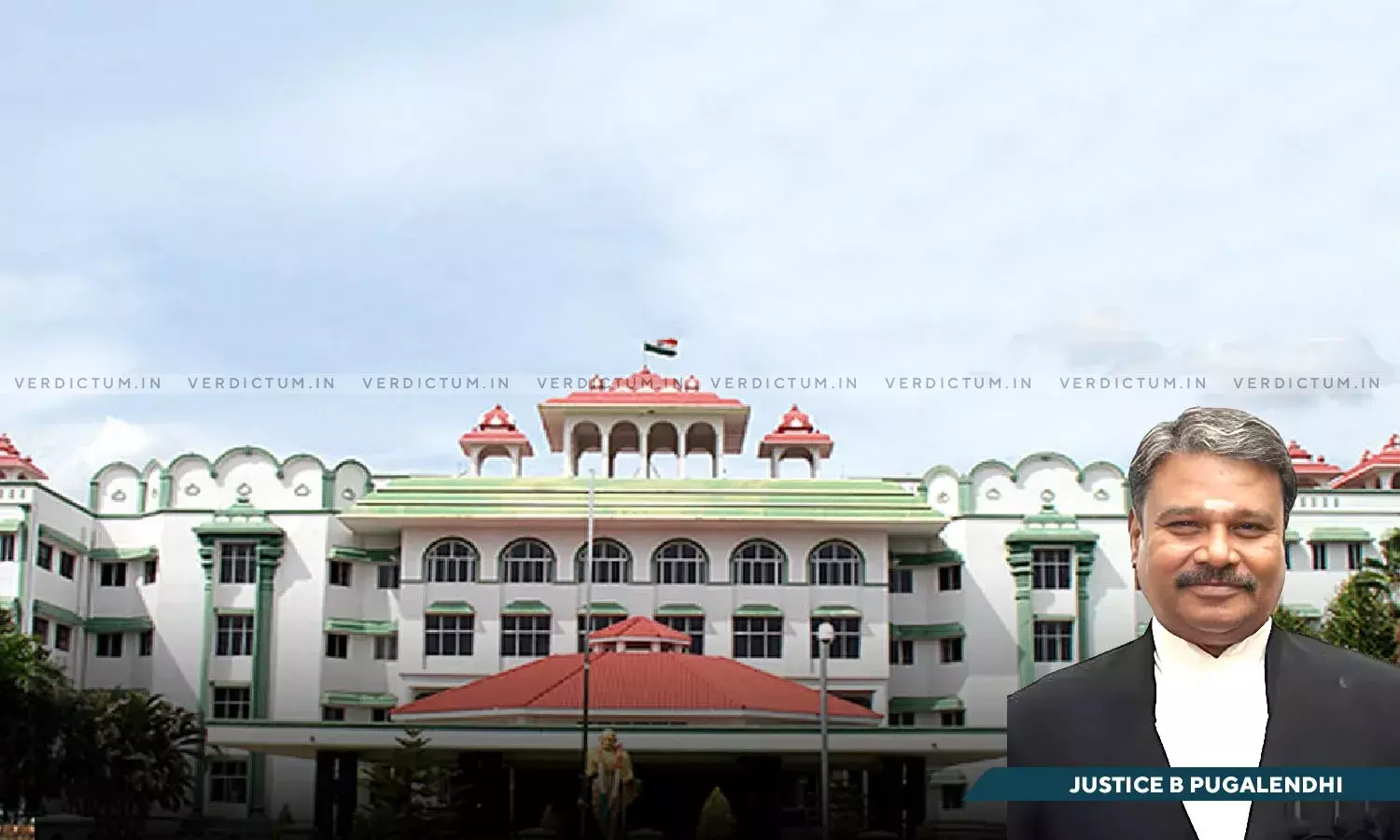
Justice B. Pugalendhi, Madras High Court, Madurai Bench
The Madras High Court has held that appointments to public offices should be guided by competence, integrity and professional ability and not by recommendations or other extraneous considerations.
Reprimanding both the defence counsel and the prosecution for failing to disclose a pending criminal appeal to a lower Sessions Court—which subsequently granted bail to accused persons facing charges under the SC/ST (Prevention of Atrocities) Act—the Court emphasized that effective advocacy demands professional candour and brevity over voluminous, unread pleadings.
The Court further noted that systemic failures in legal assistance often stem from appointments based on political proximity rather than legal acumen, explicitly declaring that the selection of State Law Officers must strictly conform to transparent, merit-based, and objective criteria to sustain public confidence in the criminal justice system.
The Bench of Justice B Pugalendhi held, "The legal profession today has many advocates, including young members of the Bar, possessing exceptional legal knowledge, sound advocacy skills and impeccable professional standards. Merit must receive due recognition. Appointments to public offices should be guided by competence, integrity and professional ability and not by recommendations or other extraneous considerations. The object of the selection process should always be to identify the candidates who are best equipped to represent the State and assist the Court."
Advocates P.Pethu Rajesh and P.Senguttu Arasan appeared for the Appellants, while Advocate A.Robinson appeared for the State.
Brief Facts
The de facto complainant, an excavator operator belonging to the Scheduled Caste community, actively pursued the restoration and redistribution of certain Panchami lands in Keeranur Village. He had previously approached the High Court and secured an order directing the revenue authorities to consider his representations regarding the illegal occupation of these lands by several individuals.
Aggrieved by his actions and complaints against illegal sand quarrying, the accused persons developed a grudge against him. On the pretext of cleaning a plot of land, the first accused lured the de facto complainant to a secluded location near a village lake. Upon arrival, the accused persons hurled casteist slurs, threatened him with dire consequences for asserting rights over the Panchami lands, and launched a brutal assault. The first accused attempted to slash his neck with a sickle, causing severe defensive injuries to his hands and wrists.
The remaining accused, including the present appellants who were armed with deadly weapons, chased and attacked him, inflicting multiple grievous injuries across his body. Following the incident, a criminal case was registered against the accused under the Bharatiya Nyaya Sanhita and the Scheduled Castes and Scheduled Tribes (Prevention of Atrocities) Act.
Contentions of the Parties
The Appellants submitted that they were entirely innocent and had been falsely implicated in the crime merely due to their alleged presence at the scene of the occurrence. It was contended that the primary and principal overt act of assault was attributed solely to the first accused, who had already been detained under the relevant preventive detention laws. The Appellants raised the plea of alibi, asserting that the said appellant was on duty as an ambulance driver at a rehabilitation institute during the relevant time and was engaged in transporting a patient to a hospital, making his presence at the crime scene impossible.
The State submitted that the de facto complainant was brutally assaulted by the accused persons on account of his social activism and had sustained severe, life-altering grievous injuries, including deep wounds on his hands. The prosecution brought to the notice of the Court that one of the appellants was a history-sheeted rowdy with several criminal antecedents, including a prior case registered under the offence of murder.
Observations of the Court
The Court observed that the subsequent entertainment and grant of bail by the learned Sessions Judge during the pendency of the criminal appeals raised a serious issue concerning judicial discipline. While acknowledging that both the High Court and the Court of Session exercise concurrent jurisdiction in matters relating to bail, the Court emphasized that concurrent jurisdiction does not imply concurrent exercise in a manner that defeats institutional discipline.
It was held that once the High Court is seized of a matter and the issue of bail is under its active appellate consideration, parallel consideration by the Sessions Court on the same subject must ordinarily be avoided to prevent conflicting decisions and ensure the orderly administration of justice, unless there is a clear and demonstrable change in circumstances.
The Court condemned the conduct of the learned counsel appearing for the accused for failing to bring the pendency of the criminal appeals to the notice of the Sessions Court.
It was observed that an advocate is primarily an officer of the Court, and while he owes a duty to protect the interests of his client, he has a corresponding and paramount duty to ensure that the administration of justice is not hindered by the suppression, omission, or concealment of material facts.
The Court noted that moving fresh bail applications before a lower court while actively challenging a previous rejection before the Higher Bench without disclosing the same was improper.
The Court also noted that a Public Prosecutor is not a counsel engaged merely to secure a conviction or mechanically oppose every application filed by the accused, but an officer of the Court and a representative of the State entrusted with the duty of assisting in the fair administration of criminal justice. This responsibility assumes even greater significance in prosecutions under the Scheduled Castes and Scheduled Tribes (Prevention of Atrocities) Act.
"The duty of the Public Prosecutor does not end with placing the entire record before the Court. A distinction must be drawn between placing the materials on record and effectively assisting the Court during the hearing. While detailed written objections may be necessary depending on the facts of the case, the real assistance to the Court lies in identifying the specific facts which have a direct bearing on the exercise of judicial discretion and bringing them clearly to the notice of the Court during oral hearing", the Court observed.
It was observed that effective advocacy is not measured by the volume of pleadings, and though the Special Public Prosecutor had filed a lengthy written objection, he failed to effectively highlight the material facts during oral arguments when explicitly called upon by the Sessions Judge.
The Court emphasized that prosecutors must develop the skill of brevity, compressing arguments into their absolute essence, and drawing the Court's attention to decisive factors like the pendency of appeals, rather than expecting overworked trial courts to independently sift through voluminous records.
Highlighting the systemic deficiencies exposed in the matter, the Court stressed the critical importance of ensuring that the State is represented by competent prosecuting officers who possess demonstrable professional ability and legal acumen. It was observed that when the Court is not effectively assisted in sensitive matters involving public policy, revenue, land, and atrocities against vulnerable groups, not only the interests of the victims but the broader public and societal interests suffer.
It held, "The present case demonstrates that where such effective assistance is lacking, the process of adjudication may proceed without consideration of all the material facts. Therefore, there is a need to ensure that the system is supported by properly equipped and competent prosecuting officers who are able to discharge this responsibility effectively."
The Court reiterated that the selection and appointment of law officers, both in the High Court and the District/Special Courts, must strictly conform to transparent, merit-based, and objective criteria rather than extraneous political considerations or proximity to the ruling dispensation, so as to inspire public confidence in the criminal justice system.
"It is therefore necessary to reiterate, particularly in the context of ongoing appointments of Law Officers, that such selections must strictly conform to the standards already laid down. It should not remain mere formal requirements on paper. A transparent and merit-based selection process alone will inspire confidence in the institution and ensure that the Government, as well as victims whom it represents, receive effective legal assistance before the Courts. The present case reinforces the importance of ensuring that Law Officers are selected on the basis of demonstrable professional ability and suitability to assist the Court effectively", the Court observed.
However, taking note of the field inspection report submitted by the Deputy Superintendent of Police which disclosed prima facie instances of encroachment and unauthorized quarrying on the subject Panchami lands, the Court directed the respondent police to ensure that the said report and all connected materials are placed before the trial court to be considered in accordance with law during the trial.
Cause Title: Chinnadurai and Ors. v. State of Tamil Nadu and Ors. [Neutral Citation: 2026:MHC:2534]
Appearances:
Appellants: Advocates P.Pethu Rajesh and P.Senguttu Arasan
Respondents: Advocates A.Robinson, N.Juliet Latha and M.Sudha Rani