

Al Tools Like Chat GPT Cannot Be Equated With Qualified Lecturer: Madras High Court Sets Aside Order Relaxing Attendance Requirements For Law Students
The Court held that artificial intelligence tools cannot teach integrity and morality, thereby enforcing the strict statutory minimum attendance requirements of the Bar Council of India.

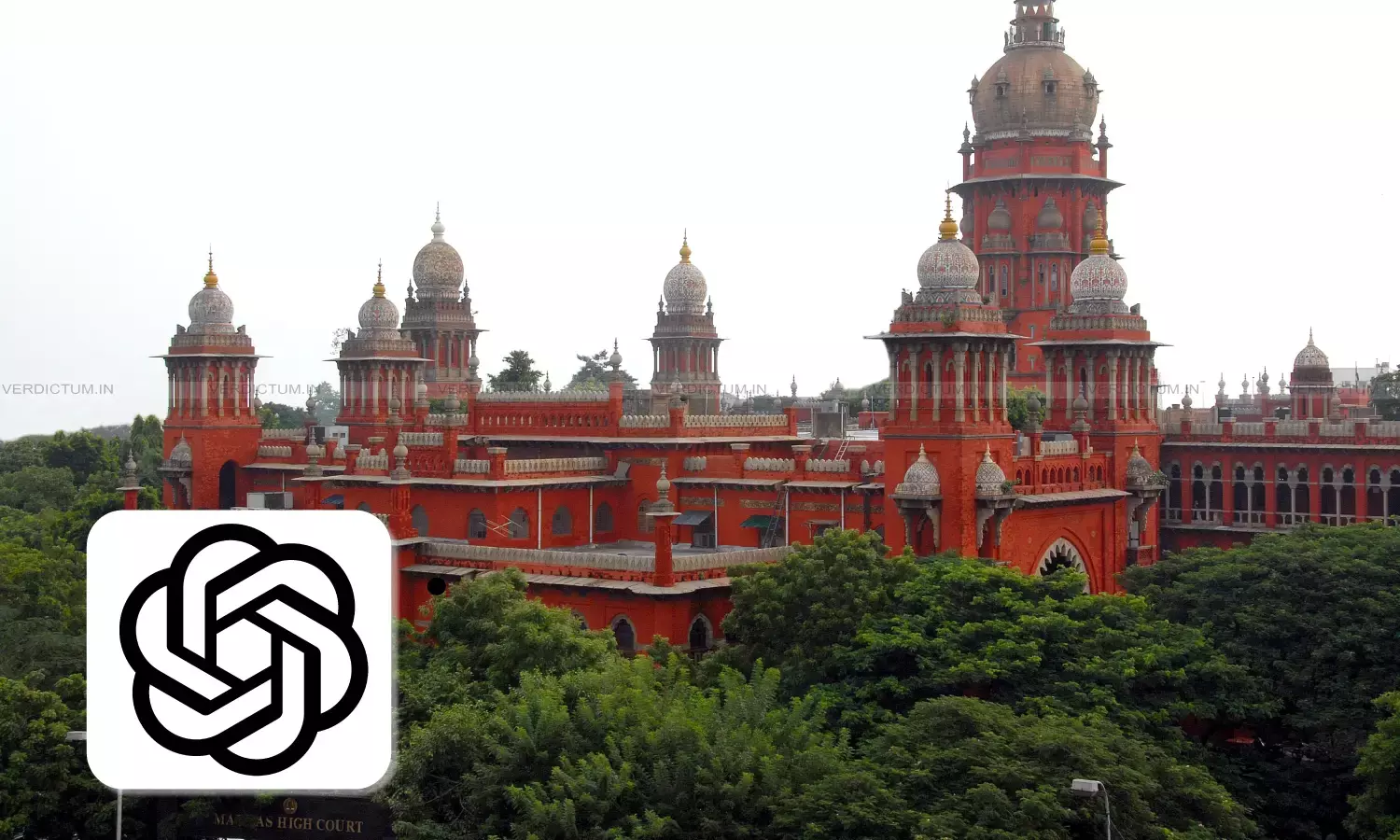
The Madras High Court has set aside a Single Judge's order that had relaxed mandatory attendance requirements for law students, observing that online classes and Artificial Intelligence (AI) tools like ChatGPT can never substitute the vibrant environment of a physical classroom or the role of a qualified lecturer.
While allowing the writ appeals instituted by the Tamil Nadu Dr. Ambedkar Law University, the Court held that Rule 12 of the Bar Council of India Rules is strictly statutory and mandatory, leaving no room for judicial condonation of attendance below the 65% absolute floor, as doing so would violate Article 14 of the Constitution of India by treating undisciplined students preferentially over those who regularly attended classes.
The Division Bench of Justice S.M. Subramaniam and Justice N. Senthilkumar observed, "Online classes provide an avenue for learning when need arises, but it cannot be a substitute for physical mode of learning. There are certain advantages that stem from regularly attending classes. It goes beyond mere acquisition of knowledge. It instills values of self discipline, punctuality, active classroom engagements, positive social behaviours etc. So online classes cannot be substituted with physical classrooms. Also neither Chat GPT nor any other Al tool can ever be equated with a qualified lecturer. Artificial intelligence can come as closer to human intelligence but cannot teach the aspects of integrity and morality that are also ethical pillars of legal professions. Such lessons can only be learnt in a vibrant classroom."
Senior Advocate A. Thiyagarajan appeared for the Appellants, while Senior Advocate P.M.Subramanian and Standing Counsel S.R.Raghunathan appeared for the Respondents.
Brief Facts
The respondent students, who were pursuing legal education at the School of Excellence in Law (SOEL) under the Tamil Nadu Dr. Ambedkar Law University, faced a severe shortage of attendance during their VII semester. Their attendance records stood at 46%, 41%, and 37% respectively, which fell significantly short of the mandatory minimum of 70% (relaxable up to 65% in exceptional cases) prescribed under Rule 12 of the Bar Council of India (BCI) Rules.
Consequent to this shortage, the University barred the students from appearing in the end-semester examinations and directed them to re-do the academic year. Aggrieved by this decision, the respondent students preferred writ petitions before the High Court, seeking permission to write their examinations and a reconsideration of the University's mandate compelling them to lose an academic year.
The Single Judge, via a common order, partly allowed the writ petitions. The Single Judge directed the BCI to revisit its Rules of Legal Education, ordered the University to explore alternative options to its "re-do" policy, and permitted the students to continue to the VIII semester.
Furthermore, the Single Judge allowed the students to make up for their VII semester attendance shortage through flexible modes during the summer vacation of 2026 and subsequent to that, write their pending exams. Aggrieved by these directions, the Registrar of the University and the Dean of SOEL jointly instituted the present intra-court writ appeals under Clause 15 of the Letters Patent.
Contentions of the Parties
The appellant University authorities contended that Rule 12 of the Bar Council of India Rules is mandatory and statutory in character. It was submitted that the rule strictly prescribes a minimum of 70% attendance, which can only be condoned up to 65% upon showing sufficient cause, leaving absolutely no room for further relaxation or judicial condonation.
The appellants further argued that the flexible teaching methods, alternative attendance modes, and systemic transformations suggested by the learned Single Judge fell squarely within the domain of expert bodies like the BCI. In the absence of any amendments to the current rules, the existing framework had to be strictly adhered to. It was also urged that granting ad-hoc relaxations to a select few students would violate the principle of equality under Article 14 of the Constitution of India and cause heartburn to regular students.
On the other hand, the respondent students sought the sustenance of the Single Judge's order. It was implicitly contended on their behalf that a rigid application of the attendance rules forcing them to re-do the entire academic year would severely hamper their career progression. They supported the alternative, flexible mechanisms carved out by the Single Judge to make up for the attendance deficit without causing an additional burden on the faculty.
Observations of the Court
The Division Bench of the High Court observed that the statutory rules governing legal education are unambiguous and clear. Since Rule 12 of the BCI Rules explicitly caps the maximum condonation of attendance at 65%, any further relaxation by the Court would completely defeat the very object and purpose of the rule.
The Bench noted that while a systemic transformation involving technological, financial, and manpower adjustments could be considered, such an exercise must be left to the wisdom of expert regulatory bodies like the Bar Council of India, and courts cannot bypass the rules as they stand today.
The Court strongly emphasized that equality under Article 14 of the Constitution of India dictates that students who strictly disciplined themselves to secure the legally mandated attendance should not be subjected to differential treatment.
The Bench further observed that legal education traverses beyond mere commercial asset-building; it requires a deep commitment to the Constitution and society. Such values, alongside dynamic social discussions and legal novelty, can only emanate from the collective and diverse voices present within a physical classroom.
"More so, studying law is a valuable educational stream and it directly connects the students with the legal and human rights prevalent in the society thereby affording an opportunity to be a voice for the voiceless. Legal education is not just for making money but traverses beyond that. It requires a commitment to the society and to the Constitution thereby requiring the presence of collective and diverse voices of the students in a classroom. It is from classroom debates and dynamic social discussions that legal ideas and novelty emanates. Classrooms provide a platform for the students to debate and engage in productive discussions thereby creating a future for a generation of energetic and vibrant legal professionals", the Bench observed.
The Court further observed that while online classes provide an avenue for learning during exigencies, they cannot substitute physical modes of learning. The Court categorically noted that neither ChatGPT nor any other Artificial Intelligence (AI) tool could ever be equated with a qualified lecturer.
While AI might closely approach human intelligence, it can never impart the core values of integrity, morality, and ethics that form the foundational pillars of the legal profession.
Consequently, the Division Bench held that the directions of the learned Single Judge could not be sustained, set aside the common order dated 17.12.2025, and allowed the Writ Appeals without costs.
Cause Title: The Registrar, The Tamil Nadu Dr. Ambedkar Law University and Anr. v. B.Vadhanan and Ors. [Neutral Citation: 2026:MHC:2167]
Appearances:
Appellants: Senior Advocate A. Thiyagarajan, Advocate M. Nallathambi.
Respondents: Senior Advocate P.M. Subramanian, Standing Counsel Bar Counsel of India S.R. Raghunathan, Advocate Manoj Sreevalsan, Advocate S.Bageerathan, Advocate B.M.Subash.