Second Marriage During Pendency Of Divorce Appeal Not Void Merely Because Appeal Was Filed Within Time: Kerala High Court
The Court observed that Section 15 of the Hindu Marriage Act, 1955, does not treat the dissolved marriage as subsisting during the period when remarriage is prohibited and rejected the contention
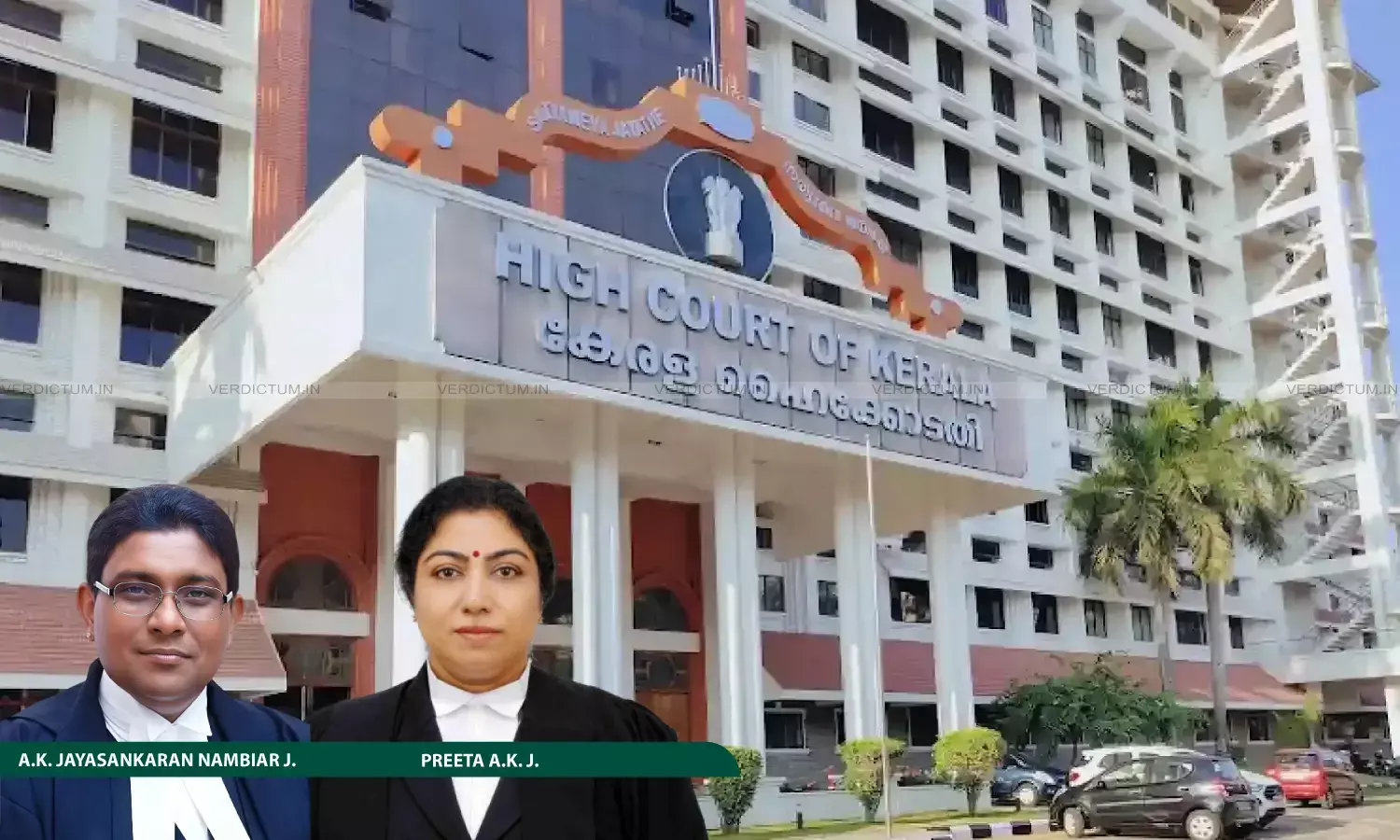
Justice A.K. Jayasankaran Nambiar, Justice Preeta A.K., Kerala High Court
The Kerala High Court has held that a second marriage contracted after dissolution of a marriage by a decree of divorce does not become void merely because an appeal against the decree is pending.
The Court observed that Section 15 of the Hindu Marriage Act, 1955, merely prohibits remarriage during the statutory period in certain circumstances and does not have the effect of reviving or treating the earlier marriage as subsisting. Consequently, a subsequent marriage cannot be regarded as void or bigamous solely on that ground.
The Court was hearing a matrimonial appeal filed by a husband challenging a Family Court decree dissolving the marriage on the grounds of cruelty and desertion, as well as the award of permanent alimony. During the pendency of the appeal, the wife contracted a second marriage.
A Division Bench of Justice A.K. Jayasankaran Nambiar and Justice Preeta A.K. observed: "We cannot accept the interpretation sought to be placed by the learned counsel for the appellant on the provisions of Section 15 of the Hindu Marriage Act that, if one of the parties to a marriage that has been dissolved by a decree of divorce, marries again during the pendency of an appeal that is filed within time, it would render the subsequent marriage void ab initio in view of the provisions of Section 5(i) read with Section 17 of the Hindu Marriage Act, 1955."
Advocate Dr Sebastian Champappilly appeared for the appellant, while Advocate A. Parvathi Menon appeared for the respondent.
Background
The respondent-wife instituted proceedings before the Family Court seeking dissolution of marriage on the grounds of cruelty and desertion under Section 13(1)(ia) and (ib) of the Hindu Marriage Act, 1955, along with permanent alimony under Section 25 of the Act. The Family Court allowed the petition, dissolved the marriage and awarded permanent alimony in favour of the wife.
The husband preferred a matrimonial appeal before the High Court with a delay, which was subsequently condoned. No interim order staying the operation of the divorce decree was granted. During the pendency of the appeal, the wife remarried. The husband contended that the subsequent marriage was void under Sections 5(i), 15 and 17 of the Hindu Marriage Act and further challenged the award of permanent alimony.
Court's Observations
The Court first considered the challenge to the validity of the respondent's second marriage.
The Bench observed that the appeal, insofar as it challenged the decree of divorce, had become infructuous on account of the respondent's remarriage. It rejected the appellant's contention that Section 15 of the Hindu Marriage Act rendered the subsequent marriage void merely because the appeal remained pending.
The Court observed: "Section 15 of the Hindu Marriage Act only clarifies that when a marriage has been dissolved by a decree of divorce, and if an appeal has been preferred within the period permitted by the Statute, it would be unlawful for either party to the marriage to marry again, … merely because either party to the marriage is prohibited from contracting a second marriage for a certain period, it could not be said that despite there being a decree of divorce for certain purposes, the first marriage subsists or is presumed to subsist. In other words, an incapacity for second marriage for a certain period does not have the effect of treating the former marriage as subsisting."
Referring to the decisions of the Supreme Court in Leela Gupta v. Laxmi Narain and Krishnaveni Rai v. Pankaj, the Court explained that Section 15 merely postpones the right to remarry in specified situations and does not revive the dissolved marriage or create a legal fiction that the earlier marriage continues to subsist.
Holding that the settled legal position was sufficient to answer the issue, the Bench concluded: "This settled position in law would suffice to reject the argument of the learned counsel for the appellant that the second marriage was void since it was bigamous in nature."
The Court additionally found that the appellant's appeal itself had not been filed within the period prescribed under the statute but only after a delay, which was subsequently condoned. It was observed that the statutory embargo under Section 15 applies only where an appeal has been filed within the prescribed period of limitation. The Court observed:
"Since the bar under Section 15 of the Hindu Marriage Act applies only if there is an appeal filed within the period of limitation and not afterwards upon condonation of delay in filing the appeal, we are of the view that the bar will not come to the aid of the appellant to contend that the second marriage of the respondent was, in any way, unlawful."
The Bench also noted that no interim order had been passed restraining the respondent from remarrying during the pendency of the appeal, which further weakened the appellant's contention.
Turning to the issue of permanent alimony, the Court observed that the Family Court had determined the quantum in the absence of any evidence adduced by the husband. However, in view of the respondent's subsequent remarriage and the provisions of Section 25(3) of the Hindu Marriage Act, the Court found that the issue required fresh consideration.
The Court observed: "In the light of the changed circumstances where the respondent has contracted a second marriage during the pendency of this appeal, the issue of entitlement of the respondent to permanent alimony and the quantification thereof, would have to be necessarily gone into by the court below as and when an application under Section 25(3) of the Hindu Marriage Act is preferred before it by the appellant."
Conclusion
Holding that the respondent's subsequent marriage did not render the appeal against the decree of divorce maintainable, the Kerala High Court dismissed the appeal as infructuous insofar as it challenged the dissolution of marriage.
However, the Court set aside the Family Court's direction awarding permanent alimony of ₹20 lakh and remitted the issue for fresh adjudication after permitting both parties to lead evidence. The Court requested the Family Court to complete the exercise within two months from the date of receipt of the judgment.
Cause Title: VRN v. L (Neutral Citation: 2026:KER:42087)
Appearances
Appellant: Advocates Dr Sebastian Champappilly, Dr Abraham P. Meachinkara, George Cleetus, Annie George, Margaret Maureen Drose, Swathi Krishna P.H. and Rincy R.
Respondent: Advocates A. Parvathi Menon, P. Sanjay, Biju Meenattoor, Indira K.P., Paul Varghese (Pallath), Kiran Narayanan, Rahul Raj P., Muhammed Bilal V.A., Meera R. Menon and Basila Beegam.