

Acts Wholly Unrelated To Official Functions: Kerala High Court Refuses To Quash Rape Probe Against Police Officers
The Court held that procedural safeguard under Section 175(4) BNSS requiring superior officer's report is not attracted merely because accused are public servants.

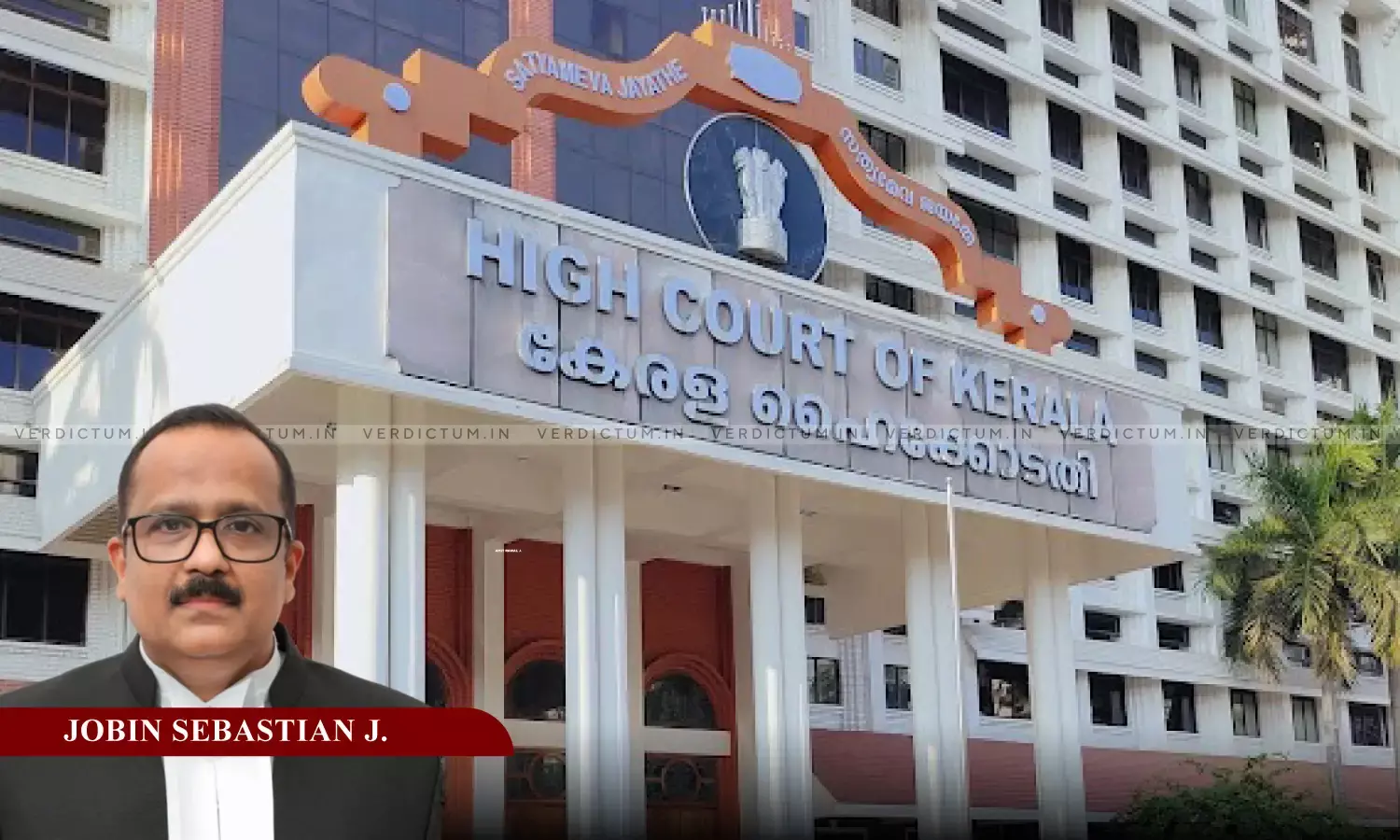
Justice Jobin Sebastian, Kerala High Court
The Kerala High Court has held that allegations of rape and sexual assault against police officers cannot be regarded as acts done in the discharge of official duty merely because the accused hold public office, and has accordingly declined to interfere with a Magistrate's order forwarding a private complaint against three police officers for investigation.
The Bench was hearing a criminal miscellaneous case filed by three police officers seeking to set aside an order of the Judicial First Class Magistrate, Ponnani, forwarding for investigation a private complaint filed against them.
The Court further held that the procedural safeguard under Section 175(4) BNSS which requires a Magistrate to obtain a report from a superior officer before ordering investigation against a public servant, applies only where a reasonable nexus exists between the alleged act and the official's discharge of duty, and cannot be invoked as a blanket protection for public servants against whom serious criminal allegations wholly unconnected to their functions have been made.
A Bench of Justice Jobin Sebastian observed, “Whether an act was committed in the discharge of official duty has to be determined with reference to the nature of the act complained of and not merely with reference to the status of the accused as a public servant. Merely because the accused is a police officer does not ipso facto attract the protection or the procedural safeguards available under Section 175(4) of BNSS. Acts which are wholly unrelated to official functions or which constitute a clear abuse of official position for personal ends cannot ordinarily be regarded as acts done in the discharge or purported discharge of official duty”.
Senior Advocate S. Sreekumar appeared for the petitioners and T. Asaf Ali, DGP appeared for the respondent.
The complainant had alleged that a Circle Inspector of Police, a Deputy Superintendent of Police, and a Superintendent of Police, whom she had approached over a property dispute, had separately subjected her to rape and sexual assault over a period of time, and had threatened her with consequences if she disclosed the incidents. She filed a private complaint under Section 210 of the BNSS alleging offences under Sections 375, 376(2)(a)(i), 377, 354, 354A(1), 354B, 354D, 506, 446 and 450 read with Section 34 of the Indian Penal Code.
The matter had a prolonged procedural history. The Magistrate initially called for a report from a superior officer under Section 175(4) of the BNSS, prompting the complainant to approach the High Court. A Single Judge held that Section 175(4) compliance was not mandatory and directed registration of an FIR, but this was set aside by a Division Bench on the ground that intervention under Article 226 Constitution of India was premature while the complaint remained pending before the Magistrate.
The Supreme Court, while dismissing the complainant's subsequent appeal, left it open to her to argue before the Magistrate that the acts were not committed in discharge of official duty, while also directing the Magistrate to ensure compliance with the affidavit requirement under Section 333 of the BNSS. The Magistrate thereafter independently examined the matter and forwarded the complaint for investigation under Section 175(3), prompting the present challenge by the accused officers.
Rejecting the officers' contention that Section 175(4) compliance was mandatory, the Court held that the applicability of the safeguard depends on the nature of the act complained of, not merely the status of the accused, and that allegations of rape and sexual assault bear no reasonable nexus with the discharge of police duties.
“…the specific allegations contained in the private complaint are that the petitioners, police officers, committed rape and subjected the complainant to sexual assault and molestation when she approached them for redressal of her grievances. If the allegations are taken at their face value, solely for the purpose of deciding the applicability of Section 175(4) of BNSS, it is impossible to hold that such acts bear any reasonable nexus with the discharge of the official duties of police officers”, the Bench noted.
On the second contention regarding the affidavit accompanying the complaint being sworn before an advocate rather than an authority specified under Section 333 of the BNSS, the Court held that Rule 40 of the Criminal Rules of Practice, Kerala, permitting authentication before an advocate, supplements rather than conflicts with Section 333, and that no prejudice had been shown to invalidate the proceedings on this ground.
Accordingly, the Court found no perversity, illegality or jurisdictional error in the Magistrate's order and dismissed the criminal miscellaneous case.
Cause Title: Vinod Valiyattoor & Ors. v. State of Kerala & Anr. (Neutral Citation: 2026:KER:53414)
Appearances:
Petitioners: S. Sreekumar, Senior Advocate, S. Rajeev, M.S. Aneer, Sarath K.P., Anilkumar C.R., K.S.Kiran Krishnan, T.P. Aravind, Akash Cherian Thomas, Azad Sunil, Maheswar Padickal, Akshara S., Nivedita Rajeev, Dipa V., Advocates.
Respondent: T. Asaf Ali, Director General of Prosecution, C. Rasheed, Muhammed Firdouz A.V., Gentle C.D. and M.P. Shameem Ahamed, Advocates.