

Suit By Worshipper Maintainable In Cases Where Trustee Acts Prejudicially To Temple Deity's Interest: Kerala High Court
The Court held that where a trustee acts prejudicially to the interest of a deity and fails to protect temple property, courts are not powerless in a suit instituted by a worshipper or next friend on behalf of the idol and can restructure the relief to safeguard the deity’s interest.
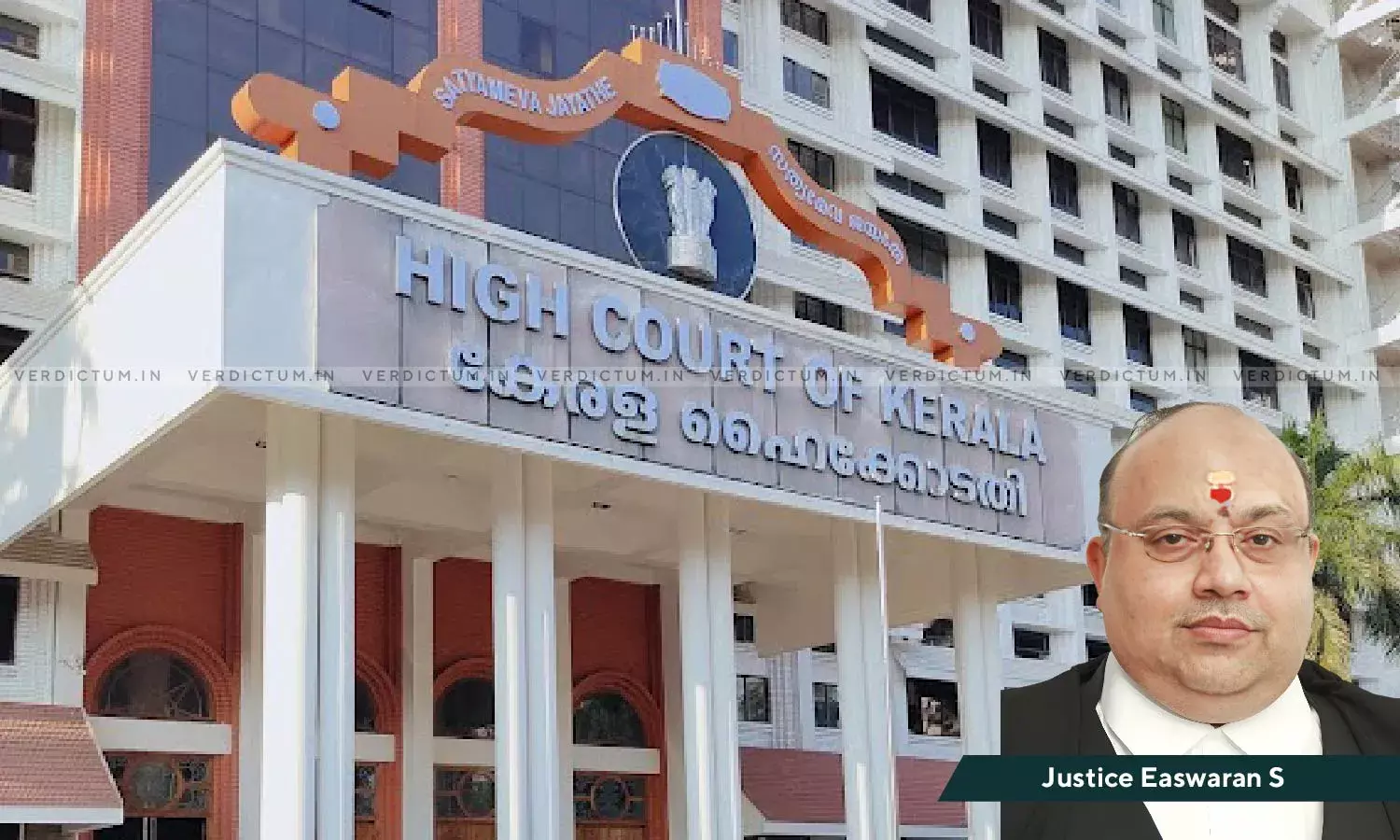
Justice Easwaran S., Kerala High Court
The Kerala High Court has held that even though recovery of possession may not ordinarily be granted directly to a worshipper or next friend suing on behalf of a deity, courts are empowered to restructure reliefs where trustees act prejudicially to the interest of the idol and fail to protect temple property.
The Court was hearing Regular Second Appeals and connected Cross Objections arising out of a suit instituted on behalf of the Govindapuram Temple Idol seeking a declaration that an assignment deed executed by the erstwhile trustee in favour of a third party was not binding upon the deity and seeking consequential reliefs, including recovery of possession of temple property.
A Bench of Justice Easwaran S. observed: “The thrust of the argument of the learned Senior Counsel is that even if it is found that the assignment in favour of the 2nd defendant is found to be bad, still decree for recovery of possession cannot be granted. However, in cases where the trustee shows dereliction in protecting the interest of the Idol, the suit by the next friend on behalf of idol is inevitable. It may be true that, in such cases, recovery of possession cannot be granted. But that by itself need not deter the court from entertaining the suit because ultimately, the courts can always recast the relief when it is found that the trustee acts prejudicially to the deity's interest.”
The Bench further added: “The courts are not powerless to grant relief, especially when a statutory Board like the Malabar Devaswom Board is in the party array, which has the overall supervision and control over the affairs of the temple and has been constituted with larger interest to protect the interest of the temple and also to keep the trustee in check.”
Senior Advocate T. Krishnanunni, assisted by Advocate P.K. Mohanan and others, appeared for the appellants. Advocates Santheep Ankarath, Arun Mathew Vadakkan, P. Anirudhan and others appeared for the temple and worshippers. Senior Advocate R. Lakshmi Narayan, along with Advocate R. Ranjanie and other Standing Counsel, appeared for the Malabar Devaswom Board.
Background
The litigation concerned properties belonging to the Govindapuram Temple Idol. The original trustee of the Temple had executed a Kanam deed in respect of the temple property in 1899 in favour of a lessee. Subsequently, in 1964, the lessee surrendered the leasehold rights back to the idol represented by the trustee through a registered document.
Proceedings were thereafter initiated under Section 57(a) of the Madras Hindu Religious and Charitable Endowments Act, 1951, resulting in an order declaring the temple to be a public religious institution.
A suit for recovery of possession was later instituted by the temple against the original second defendant, alleging trespass into the temple property. The suit was decreed in favour of the temple, and the appeal against the decree was also dismissed.
According to the defendants, a compromise had subsequently been entered into during the pendency of proceedings before the High Court pursuant to which the trustee executed an assignment deed in favour of the original second defendant in 1985. The second defendant thereafter mortgaged the property with the Vallappuzha Service Co-operative Bank, which initiated recovery proceedings and purchased the property in auction before subsequently reconveying it.
The plaintiffs instituted the suit contending that the assignment deed executed by the trustee was fraudulent, prejudicial to the interest of the deity and not binding on the idol, who was described as a perpetual minor. The plaintiffs further contended that the trustees had acted in breach of trust by alienating temple property without protecting the interests of the deity.
The trial court dismissed the suit after holding that recovery of possession could not be granted to the next friend suing on behalf of the idol. However, the first appellate court reversed the findings in part and granted recovery of possession in respect of one schedule property after holding that the assignment deed executed by the trustee did not confer a valid title on the second defendant.
Court’s Observation
The High Court first examined the maintainability of the suit instituted by a worshipper as next friend of the deity and the contention that the suit was defective for want of compliance with Order XXXII Rule 3 CPC.
The Court noted that although a formal application under Order XXXII Rule 3 CPC had not been filed, an application seeking permission to represent the idol as next friend had, in fact, been allowed by the trial court. The Court further observed that the appellants themselves had subsequently sought appointment of a disinterested person to represent the idol during the pendency of the appeals and that the Court had permitted such representation after satisfying itself regarding protection of the deity’s interest.
The Court observed that the original trustee had failed to protect the interests of the deity and had effectively disqualified himself from acting on behalf of the idol by executing assignments prejudicial to the temple. The Court further noted that the Malabar Devaswom Board exercised overall supervision over the affairs of the temple and was already a party to the proceedings.
The Bench remarked: “… it must be remembered that though the properties of the Temple vest with the trustee, it has come out in evidence that the original trustee had failed to protect the interest of the deity and has thus disqualified himself from acting for and on behalf of the Idol. Moreover, since the Malabar Devaswom Board is having an overall supervision over the affairs of the Temple, and that the Temple is a listed temple under the Devaswom, and that the Devaswom Board is also a party to the proceedings as the 5th respondent in RSA No.420 of 2012/5th defendant, this Court is satisfied that the interest of the deity is sufficiently protected by the presence of the 20th respondent as well as the Malabar Devaswom Board.”
Referring to the maintainability of suits instituted by worshippers or next friends on behalf of idols where trustees act adversely to temple interests, the Court relied upon the Constitution Bench judgment in M. Siddiq (Dead) Through Legal Representatives v. Mahant Suresh Das (2020).
The Court extracted paragraph 445 of M. Siddiq and observed that where a shebait or trustee acts negligently or sets up a claim hostile to the deity, worshippers or next friends interested in protecting the idol’s property may maintain proceedings to remedy the situation.
The Court further examined the scope of declaratory relief sought by the worshippers and relied upon Vemareddi Ramaraghava Reddy v. Konduru Seshu Reddy (1967), wherein the Supreme Court held that suits seeking a declaration that transactions entered into by trustees are not binding upon deities fall outside the restrictive scope of Section 42 of the Specific Relief Act.
The Court observed, “When the trustee is derelict and leaves the idol in a lurch, a person interested in the worship of the idol can be clothed with an ad hoc power of representation.”
Addressing the contention that recovery of possession could not be granted in a suit instituted by a next friend on behalf of the idol, the Court held that such limitation by itself could not defeat proceedings instituted to protect temple property from wrongful alienation.
The Bench emphasised: “ … though in a suit by the next friend on behalf of the idol, recovery of possession cannot be granted by the court to the next friend, the court can always restructure the relief and act accordingly”.
The Court further held that the assignment executed by the trustee after the temple had been declared a public religious institution under Section 57(a) of the Madras Hindu Religious and Charitable Endowments Act, 1951, could not bind the deity in the absence of prior sanction under Section 29 of the Act.
The Court also rejected the contention that the surrender of tenancy rights in favour of the temple in 1964 was invalid under the Kerala Land Reforms Act, 1963, holding that statutory vesting under Section 72K of the Act took effect only from 1 January 1970 and that surrender prior thereto was legally permissible.
Conclusion
The High Court upheld the findings that the trustee had acted prejudicially to the interests of the deity and that the assignment deed executed in favour of the original second defendant did not validly bind the idol.
The Court further held that worshippers and next friends may maintain proceedings on behalf of the deity where trustees fail to protect temple property, and that courts possess sufficient equitable powers to restructure reliefs to safeguard the interests of idols and temples.
The Regular Second Appeals and connected Cross Objections were accordingly disposed of in terms of the findings recorded by the Court.
Cause Title: Vijayakumaran & Ors. v. Govindapuram Temple & Ors. (Neutral Citation: 2026:KER:33749)
