

“A Soldier Is A Blank Cheque Written To Country”: Kerala High Court
The High Court held that it is a core responsibility of the Government and society to protect the morale of the soldiers.
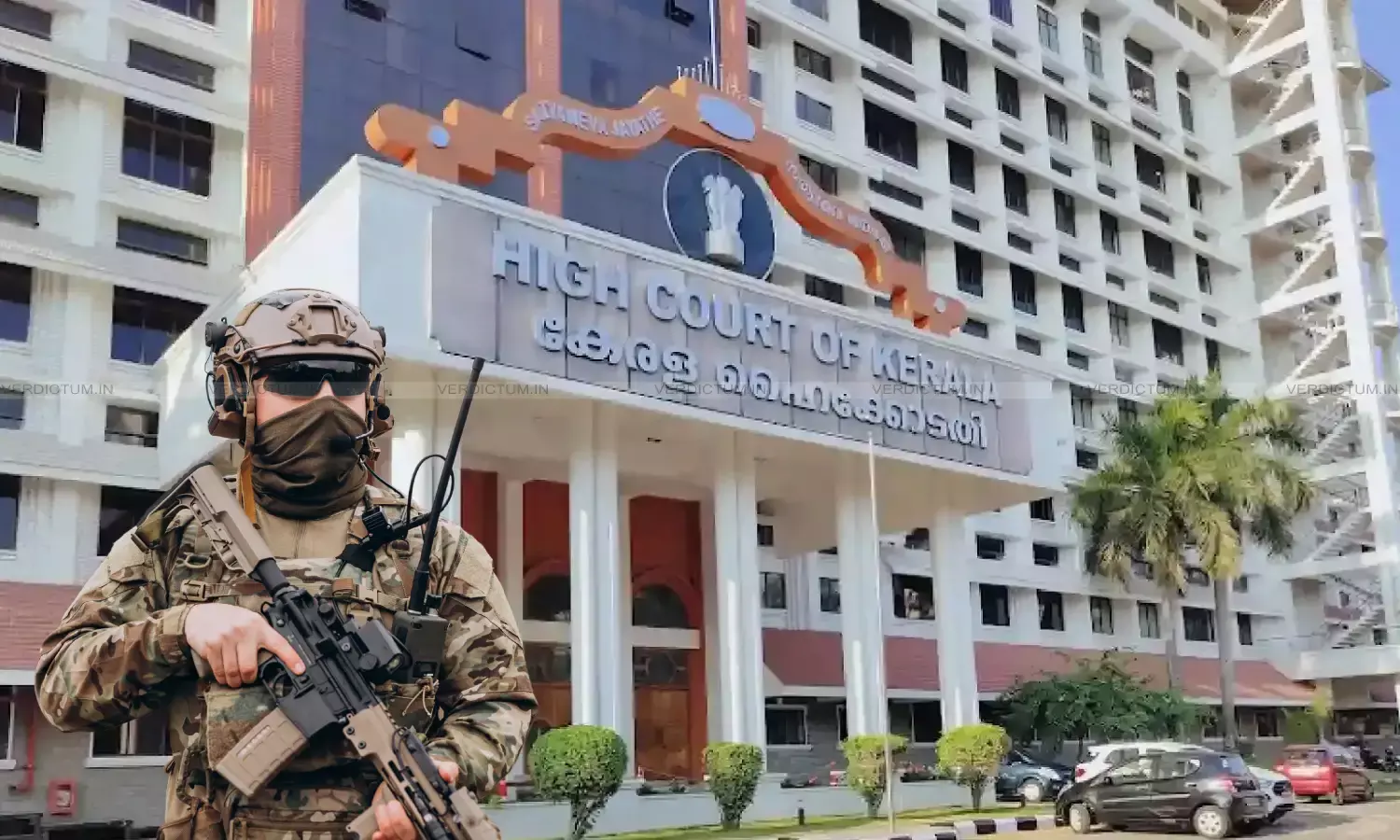
The Kerala High Court has held that the plea that Type-II Diabetes Mellitus and Primary Hypertension are “lifestyle” diseases is not, by itself, sufficient to deny disability element of pension to a soldier, observing that “a soldier is a blank cheque written to the country for any amount up to and including his life.”
The Court was hearing a writ petition filed by the Union of India and its officials against an Armed Forces Tribunal order which had directed the authorities to obtain the composite degree of disability for the ex-serviceman’s invaliding diseases and issue a corrigendum Pension Payment Order granting disability element of pension from the date of discharge.
A Bench of Justice K. Natarajan and Justice Johnson John observed: “It is a core responsibility of the Government and society to protect the morale of the soldiers, as soldiers are the ones who risk their lives for the country. A soldier is a blank cheque written to the country for any amount up to and including his life. Article 33 of the Constitution of India allows the Government to restrict or abrogate some rights of the members of the armed forces in order to ensure proper discharge of duties and maintenance of discipline and in such a situation, the contention that the disease is a lifestyle disorder cannot be accepted as a sufficient reason to deny the claim for disability element of pension.”
Senior Panel Counsel M.S. Kiran appeared for the Union, while Advocate Ratheesh B. appeared for the respondent.
Background
The respondent had approached the Armed Forces Tribunal after rejection of his claim for disability pension. The Tribunal directed assessment of the composite disability for Type-II Diabetes Mellitus and Primary Hypertension, which were assessed separately at 20% and 30%, and directed the grant of disability element of pension according to the composite disability quantified by the competent Medical Board.
The Union argued before the High Court that the Tribunal was not justified in going against the Medical Board’s opinion that the disabilities were neither attributable to nor aggravated by military service. The respondent relied on Dharamvir Singh v. Union of India (2013), Sukhvinder Singh v. Union of India (2014) and Bijender Singh v. Union of India (2025) to contend that, where no disease is noted at entry into service, later deterioration is presumed to be due to service unless the employer proves otherwise.
Court’s Observations
The Court noted that the Tribunal had relied on Regulation 423 of the Regulations for Medical Services for Armed Forces, 1983, under which a disease leading to discharge is ordinarily deemed to have arisen in service if no note of it was made at the time of acceptance into the Armed Forces.
The Court observed: “In the present case, it is undisputed that no note of any disease has been recorded at the time when the respondent enrolled for military service. Therefore, in the absence of any medical opinion or records to indicate that the disease could not have been detected on medical examination prior to acceptance for service, the respondent is entitled for the benefit of the statutory presumptions, especially in view of sub clause (c) of Regulation 423 of the Regulations, 1983.”
Referring to Dharamvir Singh (2013), the Court reiterated that disability pension is payable where an individual is invalided from service on account of disability attributable to or aggravated by military service and assessed at 20% or more.
The Court quoted the governing principles: “A member is to be presumed in sound physical and mental condition upon entering service if there is no note or record at the time of entrance. In the event of his subsequently being discharged from service on medical grounds any deterioration in his health is to be presumed due to service [Rule 5 read with Rule 14(b)].”
The Court further noted: “The onus of proof is not on the claimant (employee), the corollary is that onus of proof that the condition for non-entitlement is with the employer. A claimant has a right to derive benefit of any reasonable doubt and is entitled for pensionary benefit more liberally (Rule 9).”
The Release Medical Board had denied attributability and aggravation for Type-II Diabetes Mellitus and Primary Hypertension by describing them as linked to lifestyle modification under the Guide to Medical Officers.
The Court, however, referred to Rajumon T.M. v. Union of India (2025), where the Supreme Court held that a bare medical opinion without reasons can be questioned. It also noted that merely describing a disease as a lifestyle disorder is insufficient to deny attributability.
The Court stated: “Regarding the disability mentioned in column Nos. 1 and 2 in Part VII of the Release Medical Board opinion, the detailed justification shown for not considering the said disability as neither attributable to nor aggravated by military service, is that the same is a lifestyle disease.”
It then added: “In Rajumon T.M (supra), the Honourable Supreme Court held that mere fact that at the time of onset of the disease, military service was being rendered in peace locations or that the disease is a lifestyle disorder would not by itself be a sufficient reason to deny the attributability of the disease to military service.”
The Court also referred to Maniben Maganbhai Bhariya v. District Development Officer, Dahod (2022), observing that welfare and social security provisions must be interpreted liberally.
The Court quoted: “When social security legislations are being interpreted, it always has to be interpreted liberally with a beneficial interpretation and has to be given the widest possible meaning which the language permits, known as beneficial interpretation. When a statute is meant for the benefit of a particular class and if a word in the statute is capable of two meanings i.e. one which would preserve the benefits and one which would not, then the former is to be adopted.”
On the scope of writ interference, the Court relied on Union of India v. Parashotam Dass (2025) and held that Article 226 jurisdiction may be invoked for denial of fundamental rights, jurisdictional error or error apparent on the face of the record, but not to correct every alleged error in a Tribunal’s order.
The Bench held: “The extraordinary jurisdiction under Article 226 of the Constitution of India can be invoked only to prevent manifest injustice and the same cannot be used to correct every error or mistake in the order of the Tribunal.”
Finding no illegality or jurisdictional error in the Tribunal’s order, the Court concluded: "... we find no reason to disagree with the finding of the Tribunal that the respondent is entitled to get disability element of pension for his invaliding diseases—Type II Diabetes Mellitus and Primary Hypertension and that composite disability of the aforesaid diseases has to be assessed by a competent Medical Board."
Conclusion
The High Court dismissed the writ petition and upheld the Armed Forces Tribunal’s direction.
Cause Title: Union of India v. Mohanraj T.K. (Neutral Citation: 2026:KER:52646)
