Details Of Unauthorised Modifications & Alterations In Accident Vehicles Must Be Uploaded With Photos, Videos On e-DAR: Kerala High Court
The direction followed the Transport Commissioner’s disclosure that some inspecting officers were bypassing photo uploads despite e-DAR providing fields for recording modification details and uploading photographs and videos.
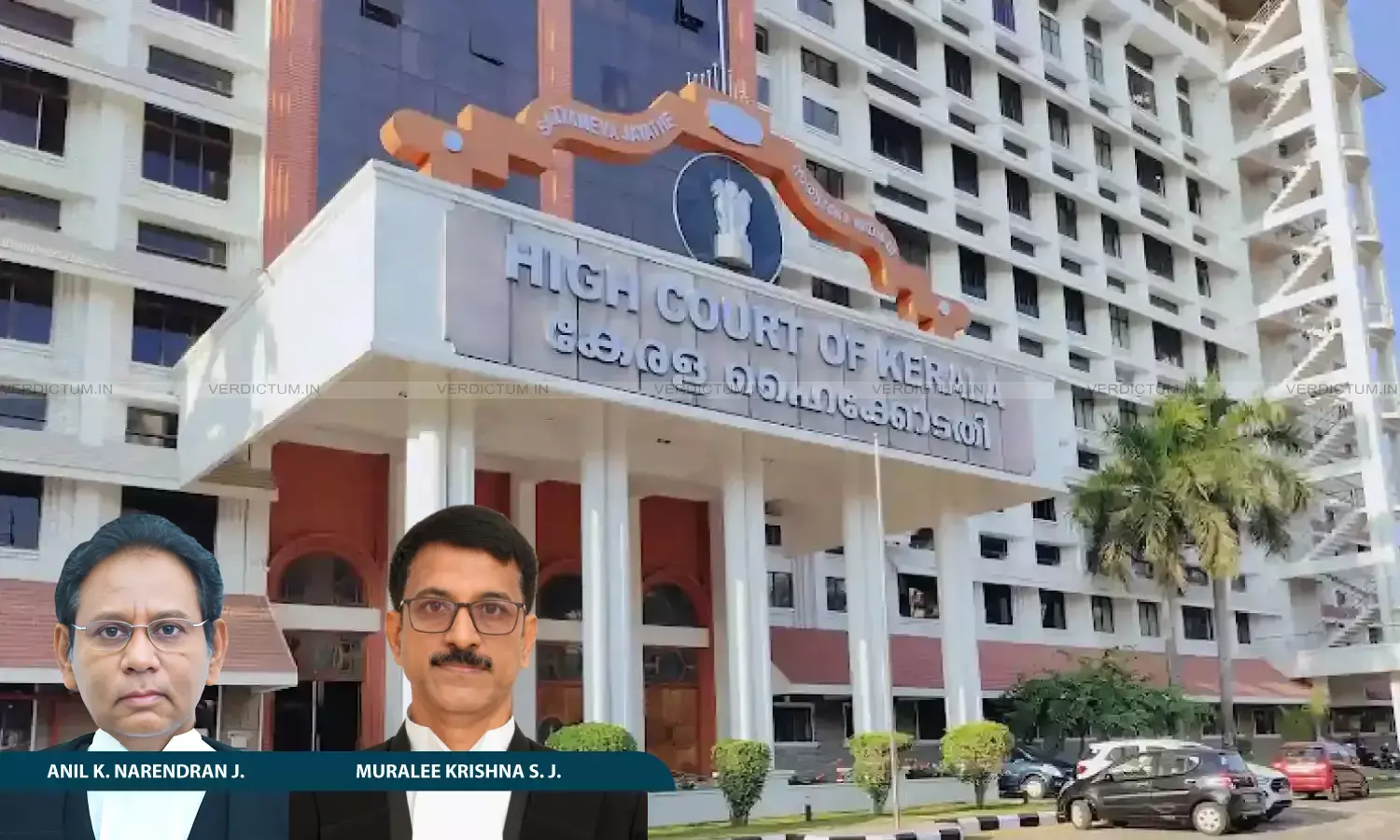
Justice Anil K. Narendran, Justice Muralee Krishna S., Kerala High Court
The Kerala High Court has directed the Transport Commissioner, acting through the concerned Deputy Transport Commissioners, to ensure that inspecting officers upload modification details, photographs and videos of vehicles involved in accidents on the e-DAR portal.
The uploaded details, the High Court added, must include unauthorised alterations made to increase engine horsepower or performance, modifications to the braking system provided by the manufacturer and safety violations that increased the risk or seriousness of bodily injury during a collision. The Court also directed the State Police Chief to ensure strict compliance with its orders.
The Court was hearing connected suo motu proceedings concerning unauthorised vehicle modifications and violations of road-safety standards. It considered a statement filed by the Transport Commissioner concerning accident inspections, the use of e-DAR and officers bypassing the process of uploading photographs.
A Bench of Justice Anil K. Narendran and Justice Muralee Krishna S. observed: “Having considered the aforesaid statement dated 28.09.2026 filed by the 4th respondent Transport Commissioner, we deem it appropriate to direct the 4th respondent, through the concerned Deputy Transport Commissioners, to ensure that vehicle modification details with photographs and videos of vehicles involved in accidents are uploaded through e-DAR portal (www.irad.parivahan.gov.in), by the concerned inspecting officers, including any violation of the safety standards, which increased the risk or seriousness of bodily injury to a person hit by the bodywork or brushing against it in the event of a collision, attracting punishment under Sub-section (4) of Section 182A of the Motor Vehicles Act.”
The Bench further stated: “The breaking system provided by the manufacturer in a motor vehicle, as per the requirements of sub-rule (2) of Rule 96 of the Central Motor Vehicles Rules, 1989, shall be of strength capable of stopping the vehicle within the distance specified in sub-rule (8). The breaking system shall be capable to bring the vehicle to hold within the distance specified in the Table below sub-rule (8) of Rule 96. Therefore, in the case of vehicles involved in accidents, the vehicle modification details uploaded on e-DAR portal shall include any unauthorised alterations made to increase the engine horse power and performance as well as modifications in the breaking system provided by the manufacturer.”
Senior Panel Counsel R.V. Sreejith appeared for the Union Government. A Special Government Pleader appeared for the State authorities, while Advocates K. Rakesh, Deepu Thankan and Kevin James represented the other appearing respondents.
Background
The proceedings had previously resulted in orders concerning high-intensity lights, unauthorised exterior lighting, wide tyres, wheel spacers, replacement retro-reflectors and after-market exhaust systems fitted with flame kits. The Court had also directed that photographs of vehicle bodies, passenger compartments and driver compartments form part of records concerning fitness certificates.
The Transport Commissioner subsequently informed the Court that the iRAD system, later renamed e-DAR, had been made mandatory throughout the Motor Vehicles Department for inspection reports concerning accident vehicles. Under the applicable procedure, inspections were to be completed and reports uploaded within 48 hours of receiving a request from the police.
The Commissioner stated that e-DAR contained specific fields for recording vehicle modifications and uploading photographs and videos. However, some inspecting officers had been bypassing photo uploads, prompting directions requiring colour photographs of unauthorised alterations to form part of accident-inspection reports.
The Commissioner also informed the Court that photographs uploaded to e-DAR could be viewed and downloaded online but did not appear in printed reports. The issue was communicated to the Deputy Director General (Head of Group), National Informatics Centre.
Court’s Observations
Earlier Orders Addressed Unsafe Vehicle Alterations
The Court referred to its earlier consideration of motor vehicles fitted with unauthorised lighting capable of dazzling drivers, pedestrians and other road users.
Reproducing its previous observations, the Court stated: “Today, when this writ petition is taken up for consideration at 2.00 p.m., we have viewed in open court videos uploaded by vloggers on YouTube regarding the use of motor vehicles in public places, openly flouting the safety standards in the Central Motor Vehicles Rules, AIS-008, etc., which are fitted with lights and light-signalling devices capable of dazzling the drivers of oncoming vehicles, pedestrians, etc., thereby posing a potential threat to the safety of other road users. Such lights and light-signalling devices include red-blue strobe lights, tri-colour fog lamps, etc., capable of causing temporary visual disorientation to the drivers of oncoming vehicles, pedestrians, etc. Promotional videos are uploaded on YouTube, either by those who are closely associated with automobile accessory shops or ‘YouTube influencers’, who are content creators with a dedicated subscriber base.”
The Court also referred to vehicles fitted with wheel spacers and wide tyres that caused wheels to project beyond the body or protecting cover, thereby posing a risk to cyclists, two-wheeler riders and pedestrians. It further noticed after-market exhaust systems with flame kits that replaced the manufacturer-provided catalytic converter and silencer.
External Projections Must Not Increase Collision Injuries
The Court stated that AIS-120 prescribes external-projection requirements for category M1 vehicles comprising not more than eight passenger seats in addition to the driver’s seat. It noted that the standard was intended to reduce the risk or seriousness of injuries to persons struck by or brushing against vehicle bodywork.
The Court observed: “As per Para.1.2 of AIS-120, the purpose of this standard is to reduce the risk or seriousness of bodily injury to a person hit by the bodywork or brushing against it in the event of a collision. This is valid both when the vehicle is stationary and in motion. As per Para.2.2, ‘external surface’ means the outside of the vehicle and including the bonnet, the lid of the luggage compartment, the doors, the wings, the roof, the lighting and light-signalling devices and the visible strengthening components.”
Referring separately to the general specifications under AIS-120, the Court added: “Para.5 of AIS-120 deals with general specifications. As per Para.5.2, the external surface of vehicles shall not exhibit, directed outwards, any pointed or sharp parts or any projections of such shape, dimensions, direction or hardness as to be likely to increase the risk or seriousness of bodily injury to a person hit by the external surface or brushing against it in the event of a collision. As per Para.5.3, the external surface of vehicles shall not exhibit, directed outwards, any parts likely to catch on pedestrians, cyclists or motorcyclists.”
The Court further stated that AIS-147 governs external projections on two-wheeled motor vehicles, while AIS-093 contains corresponding requirements for trucks, commercial vehicles, truck bodies and trailers.
Safety Violations Must Form Part Of e-DAR Records
The Court noted that e-DAR provided fields for recording vehicle-modification details and uploading photographs and videos of vehicles involved in accidents. It also noted the Commissioner’s statement that some officers had bypassed the uploading process despite those facilities being available.
The Court directed that accident-inspection records uploaded to e-DAR must cover modifications violating safety standards where they increased the risk or seriousness of bodily injury to a person struck by the bodywork or brushing against it during a collision. It linked such violations to the punishment prescribed under Section 182A(4) of the Motor Vehicles Act.
Engine And Braking Alterations Must Be Included
The Court referred to Rule 96 of the Central Motor Vehicles Rules, 1989, which requires the manufacturer-provided braking system to be capable of stopping and holding a vehicle within the prescribed distance.
The Bench consequently directed that modification details uploaded for accident vehicles must specifically include unauthorised changes intended to increase engine horsepower or performance and modifications to the braking system supplied by the manufacturer.
Deputy Director General Of NIC Impleaded Over Portal Glitch
The Court noted the Transport Commissioner’s statement that photographs uploaded to e-DAR remained available online but did not appear on printed copies of inspection reports.
The Court stated: “The ‘technical glitch’ pointed out by the Transport Commissioner is that, while photographs uploaded on e-DAR can be viewed and downloaded online from the portal database, they do not currently appear on the printed hard copy of the report. This technical glitch was formally communicated to the National Informatics Centre (NIC) for rectification, vide Annexure R4(b) letter dated 17.09.2026. A formal request is being made to NIC to incorporate a photo-upload facility in the VAHAN portal for Regional Transport and Sub-Regional Transport Offices to satisfy the court directions.”
After considering the Union Government’s submission, the Court suo motu impleaded the Deputy Director General (Head of Group), National Informatics Centre as the additional ninth respondent. The newly impleaded respondent sought time to obtain instructions concerning the technical issue.
Police Directed To Ensure Compliance
The Court directed the State Police Chief to take necessary steps to ensure strict compliance by the police with its directions.
The Bench stated that the directions were to be implemented “in letter and spirit” to ensure the safety of road users, including pedestrians.
Conclusion
The Court directed the Transport Commissioner, through the concerned Deputy Transport Commissioners, to ensure that inspecting officers upload vehicle-modification details, photographs and videos of accident vehicles on e-DAR.
The records must include bodywork-related safety violations attracting Section 182A(4) of the Motor Vehicles Act, unauthorised alterations increasing engine horsepower or performance and modifications to manufacturer-provided braking systems.
The Court also directed the State Police Chief to ensure strict compliance with its orders and suo motu impleaded the Deputy Director General (Head of Group), National Informatics Centre as the additional ninth respondent.
The connected proceedings were listed for further consideration on October 28, 2026.
Cause Title: Suo Motu v. Union of India and Others (Neutral Citation: 2026:IO:KER:14)
Appearances
State: Senior Panel Counsel R.V. Sreejith; Special Government Pleader; Advocates Deepu Thankan, Ummul Fida, Lakshmi Sreedhar, Lekshmi P. Nair, Vineetha Bose, Cindia S. and Gayathri G.
Respondents: Advocates Kevin James, Shabnam Saidalavi, Athul M.V., Deago John K. and Aswin V. Nair; Advocate K. Rakesh