State Can Restructure Police Associations It Created; Members Have No Fundamental Right To Their Continuance: Kerala High Court
The Division Bench upheld the abolition of one recognised police association and the redistribution of its members between two others according to rank and common service conditions.
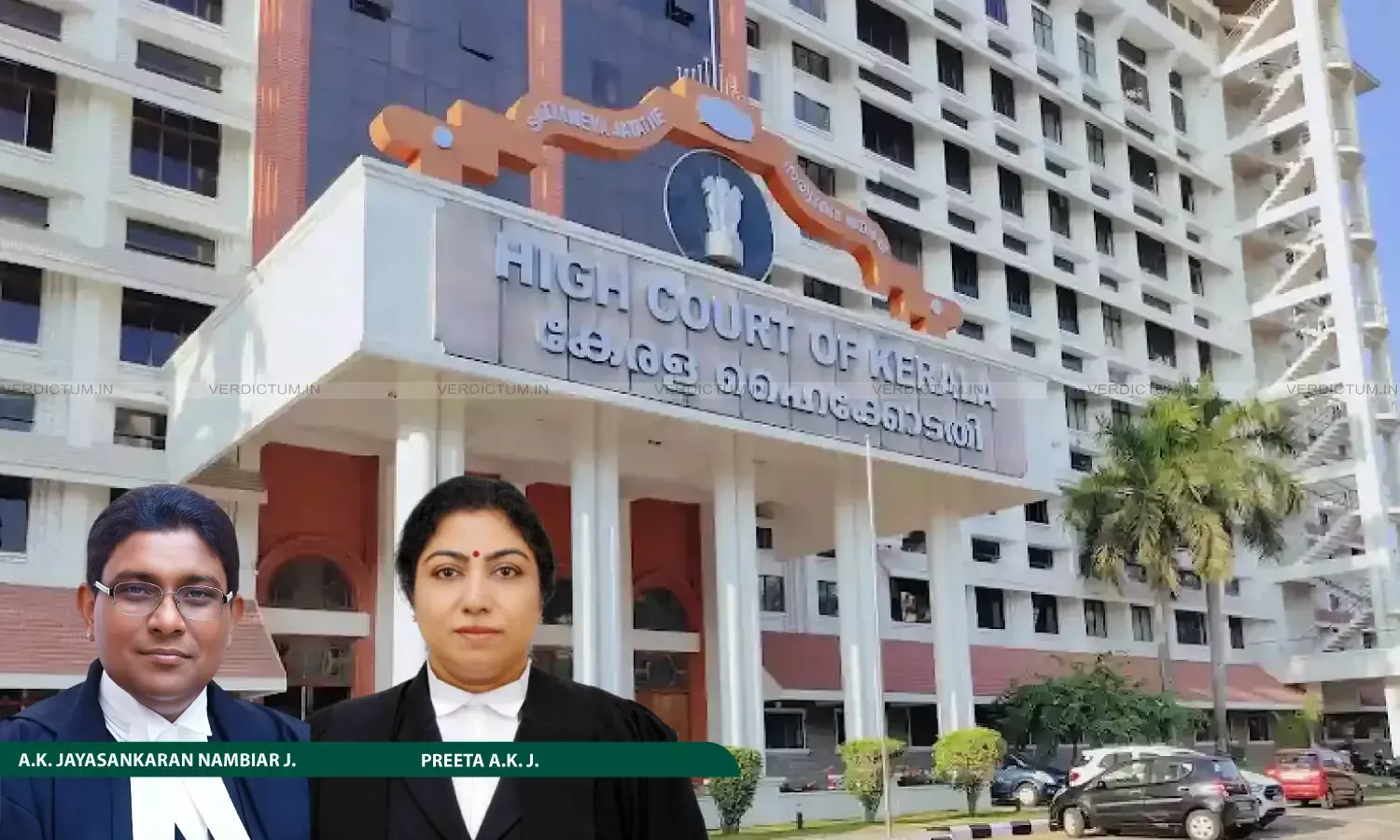
Justice A.K. Jayasankaran Nambiar, Justice Preeta A.K., Kerala High Court
The Kerala High Court held that the State Government may restructure police associations it created, whose membership arises automatically from the rank held by police personnel.
The High Court added that the associations and their members could not claim a fundamental right under Article 19(1)(c) of the Constitution over the formation or continuation of such associations.
The Court was hearing connected writ appeals filed by the State and members of police associations against a Single Judge’s judgment quashing a Government Order that abolished the Kerala Police Officers’ Association and redistributed its members between the Kerala Police Association and the Kerala Police Senior Officers’ Association.
A Division Bench of Justice A.K. Jayasankaran Nambiar and Justice Preeta A.K. observed: “The State Government, as the authority competent to grant permission to members of the Police Force to form associations, must surely be conceded the power to form associations by itself and frame bye-laws for the efficient functioning of those associations through Committees elected by the General Body of members of the respective associations. Those bye-laws, however, can only be seen as regulating the functioning of the association, and any stipulation in those bye-laws that mandates that an amendment of the bye-laws must be approved by the State Government only indicates that the State Government is the ultimate repository of the power to permit the formation and continuation of the associations for the members of the Police Force in the State in accordance with the constitutional scheme envisaged under Article 19(1)(c), 19(4) and Article 33 of the Constitution of India.”
The Bench added: “We would think that the only rights conferred on members of associations that have been formed by the State Government through its bye-laws are those in connection with the efficient functioning of the associations and the election of its office bearers. The right to amend the bye-laws in that sense is a restricted one available to the members since it is subject to approval by the State Government. At any rate, the restricted right to amend the bye-laws cannot be seen as conferring on the members a right, fundamental or otherwise, in the formation of and continuation in the association”.
Senior Advocate George Poonthottam appeared for the individual appellants. Additional Advocate General P.A. Mohammed Shah represented the State. Advocate P.C. Sasidharan appeared for the Kerala Police Officers’ Association, while Advocate Babu S. Nair represented the Kerala Police Association.
Background
Through a 1979 Government Order, Kerala permitted three police associations organised by rank. The Kerala Police Association represented Civil Police Officers and Senior Civil Police Officers. The Kerala Police Officers’ Association represented personnel from Grade Assistant Sub Inspectors to Inspectors, while the Kerala Police Senior Officers’ Association represented Deputy Superintendents and non-IPS Superintendents.
The impugned Government Order abolished the Kerala Police Officers’ Association. It moved Grade Assistant Sub Inspectors, Assistant Sub Inspectors and Grade Sub Inspectors to the Kerala Police Association, while Sub Inspectors and Inspectors were placed in the Kerala Police Senior Officers’ Association.
The writ petitioners argued that the Government lacked authority to abolish or amalgamate a recognised association without hearing it. They also relied on the procedure for amending bye-laws and contended that the restructuring infringed the members’ right under Article 19(1)(c) of the Constitution.
The Single Judge accepted the challenge. The judgment held that the right to form an association protected its agreed composition and that the Government could approve an amendment to the bye-laws but could not itself bring about the amendment. It consequently quashed the restructuring.
The State maintained that the existing membership pattern predated the Grade Promotion Scheme and no longer reflected the cadre structure. It said the regrouping brought together personnel sharing service conditions, promotional avenues, transfer policies, administrative responsibilities and welfare concerns.
Court’s Observations
Police Personnel Had No Voluntary Role In Forming Associations
The Court found that the Government itself had formed the three associations by categorising police personnel according to rank. Members neither chose the association nor decided whether to continue in it; membership changed automatically with advancement in rank.
The Bench held: “The associations that we are concerned with in these appeals are not those in which a member, or the association itself, can claim any right traceable to Article 19(1)(c); if that be so, the restructuring exercise undertaken by the State Executive cannot be seen as infringing the rights of the writ petitioners under Article 19(1)(c) of the Constitution of India.”
Referring to Daman Singh v. State of Punjab (1985) and Zoroastrian Cooperative Housing Society Ltd. v. District Registrar, Cooperative Societies (2005), the Court noted that Article 19(1)(c) did not apply where formation and membership did not involve voluntary choice.
Rights Of Police Personnel Were Constitutionally Restricted
The Court read Article 19(1)(c) with Articles 19(4) and 33 of the Constitution, the Police Forces (Restriction of Rights) Act, 1966, and the rules framed under it. It held that police personnel accepted restrictions necessary for discipline and the efficient discharge of their functions.
The Court observed: “The content of his right under Article 19(1)(c) of the Constitution is therefore significantly reduced when compared to a similar right available to other citizens.”
It relied on Ous Kutilingal Achudan Nair v. Union of India (1976) and Delhi Police Non-Gazetted Karmachari Sangh v. Union of India (1987) while explaining Parliament’s power to restrict the rights of forces entrusted with maintaining public order.
Bye-Laws Did Not Confer A Right Over Continuation
The Court held that the bye-laws conferred rights connected with efficient functioning and the election of office-bearers. Their amendment remained subject to Government approval and did not give members a fundamental or other right concerning the association’s formation or continuation.
It traced the 1979 Government Order to the State’s executive power under Article 162 of the Constitution and its continuation to Section 109 of the Kerala Police Act, 2011.
Restructuring Was Rationally Connected To Association Objects
The Court treated formation and restructuring as policy matters. It held that judicial interference was unwarranted unless the State’s action failed the test of rationality when measured against the associations’ principal objects.
The Bench observed: “On the contrary, it appears to us to be an attempt by the State Government to pursue the objectives of the respective associations more efficiently by grouping together ranks of Officers who are connected in their service conditions by common features.”
It found that the restructuring grouped the constabulary wing separately from directly recruited Sub Inspectors and officers promoted from that rank. The stated objective was more effective representation of personnel sharing service conditions and welfare concerns.
Conclusion
The High Court allowed the connected writ appeals, set aside the Single Judge’s judgment and dismissed the writ petitions challenging the restructuring Government Order. It made no order as to costs.
Cause Title: Sugunan A.P. v. Kerala State Police Officers’ Association and connected cases (Neutral Citation: 2026:KER:86252)
Appearances
Appellants: George Poonthottam, Senior Advocate, assisted by Kavya Varma M.M. and Nisha George, Advocates
Respondents: P.A. Mohammed Shah, Additional Advocate General, assisted by Laya Mary Joseph, Government Pleader; P.C. Sasidharan, Advocate; Babu S. Nair, Advocate