

Judicial Officer's Official Vehicle Not "Protected" Public Property Under PDPP Act: Kerala High Court Quashes Case Against Bus Driver For Hitting MACT Judge’s Car
The Court held that an official vehicle, though public property, does not fall within the specific class of properties protected under Section 3(2)(e) of the 1984 Act.
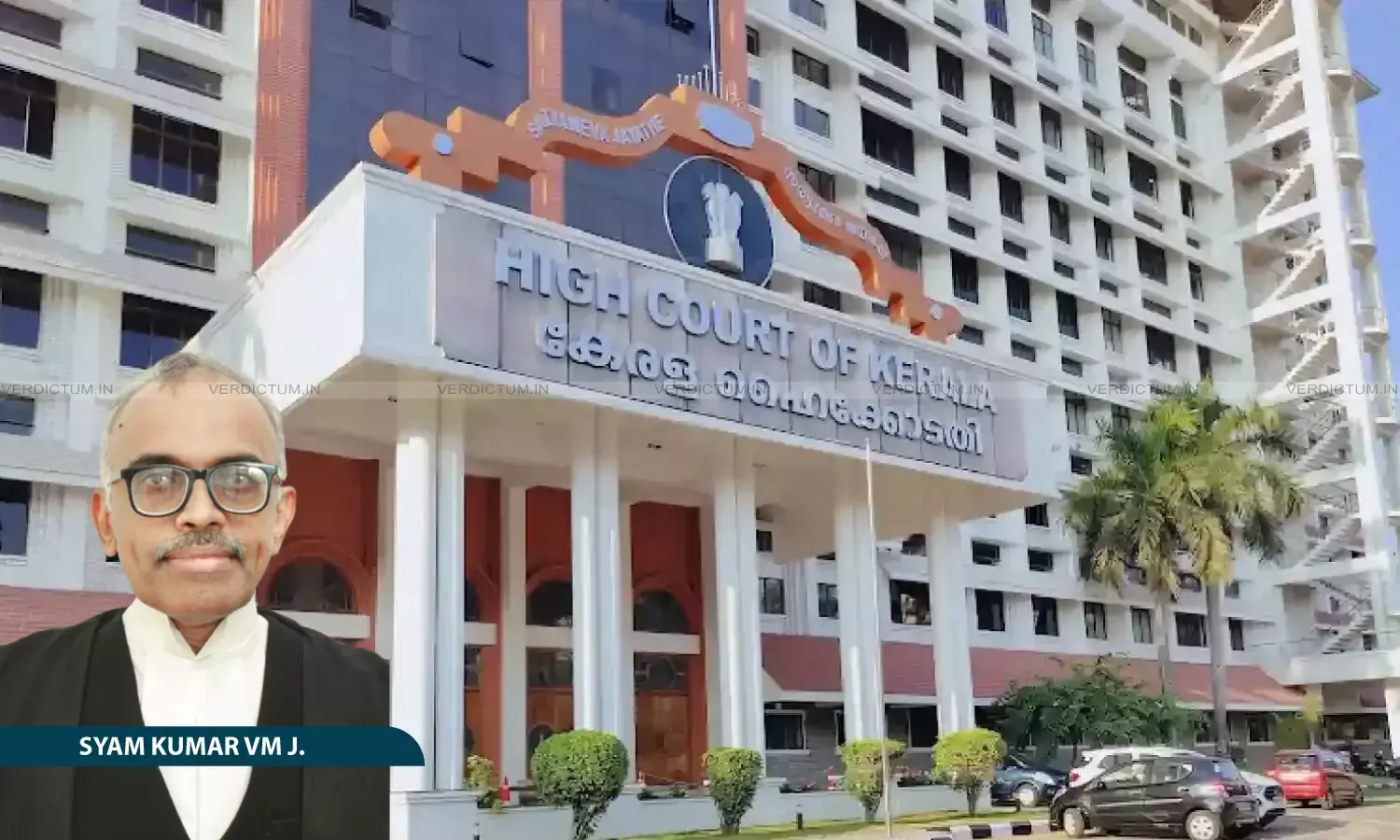
The Kerala High Court has held that an official vehicle of a judicial officer, though public property, does not qualify for the protection afforded under Section 3(2)(e) of the Prevention of Damage to Public Property Act, 1984, as the provision applies only to specifically enumerated classes of public property.
The Court clarified that the statutory protection cannot be extended to all forms of public property in a general sense, thereby rendering the provision inapplicable in the facts of the case.
The Court was hearing a petition seeking the quashing of criminal proceedings arising out of a road incident involving a private bus and the official vehicle of the MACT Judge, Alappuzha, where charges had been framed under Sections 324 and 353 of the Indian Penal Code, along with Section 3(2)(e) of the 1984 Act.
A Bench of Justice Syam Kumar V.M. observed: “It is relevant to note that in the case at hand, the ‘Public Property’ involved is the official Car of the judicial officer. Undoubtedly, being an official vehicle purchased and maintained using the amounts availed from the state exchequer and being used as a conveyance for a judicial officer, the same could be deemed a Public Property on that count”.
However, the Bench clarified that “Public Property to which Section 3(2)(e) of the Act of 1984 is extended has been specifically enumerated in the said Section”, while further adding that “when the legislature has specifically enumerated a class of Public Property that is intended to be covered by the relevant statute, then the said enumerated property alone can be termed to possess the protection envisaged by the statute or by the relevant provision”.
Advocates Gokul Das VVH, Ameena R and Poornima S. Nair appeared for the Petitioner, while Maya MN, Public Prosecutor, appeared for the State.
Background
The prosecution case arose from an incident wherein the petitioner, while driving a private bus, allegedly collided with the official vehicle of the Judge, MACT, Alappuzha, which was being driven by the de facto complainant in the course of official duty.
It was alleged that the petitioner overtook the vehicle and caused damage to the car, resulting in the shattering of the glass pane and minor injuries to the driver. On this basis, the prosecution invoked offences under Sections 324 and 353 IPC, along with Section 3(2)(e) of the Prevention of Damage to Public Property Act, 1984.
The petitioner challenged the proceedings, contending that the allegations, even if taken at face value, did not satisfy the ingredients of the offences alleged, particularly disputing the applicability of the 1984 Act to the official vehicle involved.
Court’s Observation
The Court first examined the applicability of Section 353 IPC and held that the essential ingredients of assault or use of criminal force against a public servant were absent.
It noted that “there is absolutely no allegation to indicate that the Petitioner had any criminal intent or mens rea to obstruct the de facto complainant,” and further held that the requirement of use of criminal force was “totally absent.”
The Court emphasised that mere contact or brushing of vehicles during overtaking cannot be equated with use of criminal force, observing that “the mere brushing or contact of the bus against the car… cannot be brought within the scope and ambit of the said provision.”
On the charge under Section 324 IPC, the Court held that there was no material to show the use of any dangerous weapon or means.
It observed that the alleged injury was caused by the shattering of glass during the incident and not by any intentional act involving a dangerous weapon, holding that “such an allegation… would not satisfy the essential ingredients of Section 324 IPC.”
The Court then examined whether the official vehicle of a judicial officer could fall within the ambit of Section 3(2)(e) of the Prevention of Damage to Public Property Act, 1984.
While acknowledging that the vehicle could be termed “public property” in a general sense, the Court held that the statute specifically restricts the category of property protected under the provision.
The Court rejected the argument that any public property would fall within the provision, holding that such an interpretation would be impermissible. It noted that “the legislature has not incorporated… a ‘catch all’ clause… and had rather deliberately chosen to provide a closed list,” thereby limiting the applicability of the provision strictly to the categories specified therein.
The Court further observed that “the said statute was never intended to deal with isolated incidents like the one at hand, which lack an element of assault and criminal force aimed at causing destruction to a 'Public Property' and would fall more within the category of motor accident”.
On an overall assessment, the Court concluded that none of the offences alleged was made out even prima facie. It held that the charges did not disclose any intentional act or the essential ingredients required to constitute offences under the IPC or the 1984 Act.
Conclusion
The High Court allowed the petition and quashed the final report and all consequential proceedings pending before the Chief Judicial Magistrate Court, Alappuzha, holding that continuation of the proceedings would amount to an abuse of process of law and intervened to secure the ends of justice.
Cause Title: Shajeer v. State of Kerala (Neutral Citation: 2026:KER:32850)
