Third-Party Pillion Rider’s Compensation Cannot Be Reduced For Negligence Apportioned Between Two Drivers: Kerala High Court
The Court set aside a Tribunal’s 50% deduction from the compensation awarded to an injured pillion rider, holding that even if both vehicles were negligent, the case would be one of composite negligence and the claimant could recover the entire amount from any tortfeasor.
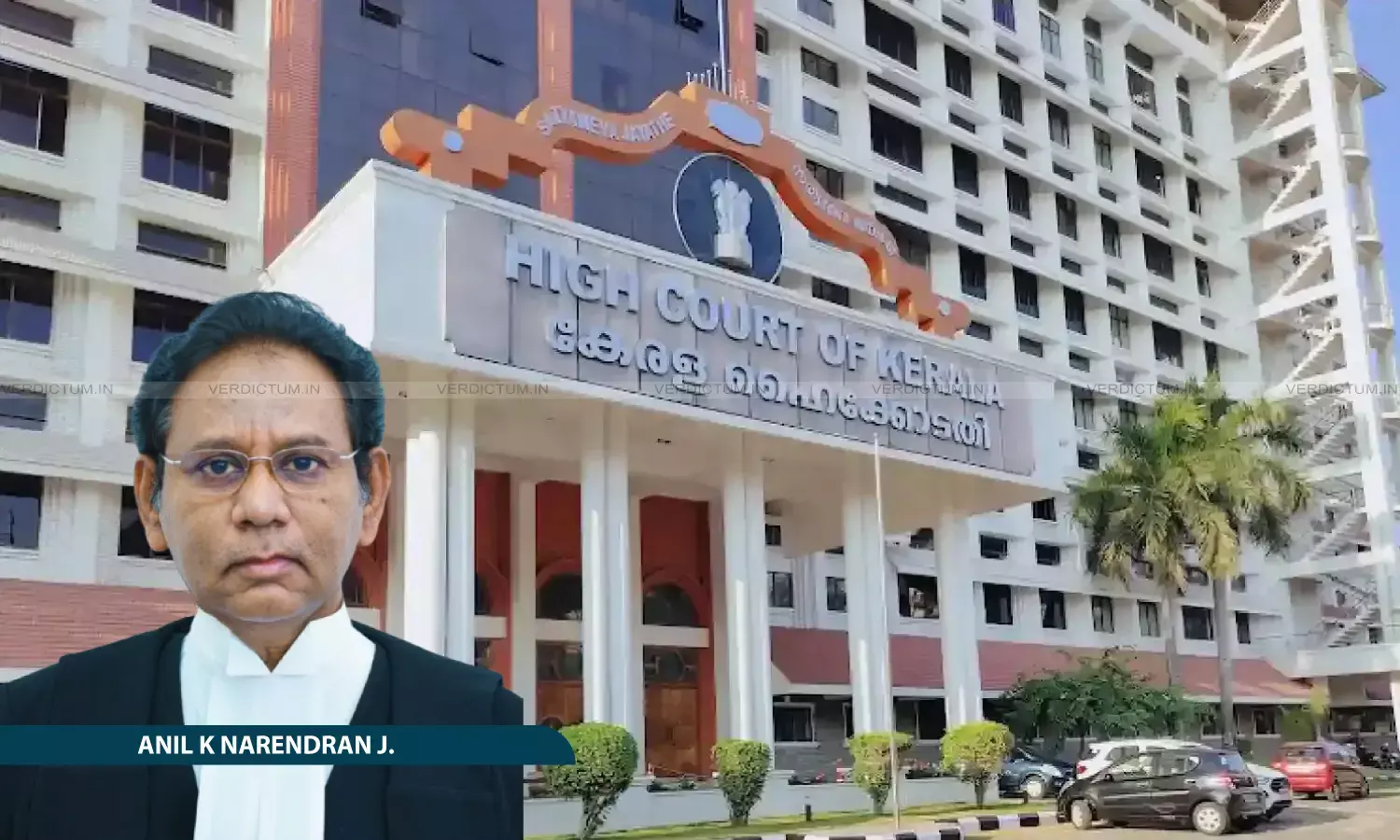
The Kerala High Court has held that a third-party pillion rider cannot be made to suffer a reduction in motor accident compensation merely because negligence is apportioned between the driver of the offending vehicle and the rider of the two-wheeler on which he was travelling.
The Court was hearing a motor accident appeal filed by an injured claimant who had been awarded only half of the compensation assessed by the Motor Accidents Claims Tribunal, after the Tribunal attributed 50% contributory negligence to the rider of the two-wheeler.
A Bench of Justice Anil K. Narendran observed:
“Even if the 2nd respondent-driver of stage carriage and the rider of two-wheeler are assumed to have been negligent, the case would fall within the realm of composite negligence, and the appellant-claimant, being a third-party pillion rider on the two-wheeler, cannot be held to be responsible or having contributed to the accident”.
In such circumstances, the Bench added, “the appellant-claimant is entitled to recover the entire compensation from any one of the tortfeasors, and there is no legal warrant for reducing the award on account of apportionment of negligence between the driver of the stage carriage and the rider of the two-wheeler.”
Advocate Cherian Sebastian appeared for the appellant, while Advocate N.S. Najeeb appeared for the insurer.
Background
The claimant was travelling as a pillion rider on a two-wheeler when it was hit by a stage carriage. He filed a claim under Section 166 of the Motor Vehicles Act, 1988, seeking compensation for the injuries sustained in the accident.
The Tribunal assessed total compensation at ₹57,922. However, it fixed 50% contributory negligence on the rider of the two-wheeler, who was not a party to the claim petition, and consequently awarded only ₹28,961 with interest.
In appeal, the claimant challenged both the deduction on account of contributory negligence and the adequacy of compensation.
Court’s Observations
The Court noted that the stage carriage driver had been charge-sheeted for rash and negligent driving. The rider of the two-wheeler was not charge-sheeted, and the respondents had not adduced oral evidence to establish negligence on his part.
The Court observed: “In the instant case, the document marked as Ext.A1 is a copy of the First Information Report (FIR) in Crime No.2004/04 of Kochi City Traffic Police Station, whereby the 2nd respondent-driver of the stage carriage bearing Reg.No.KL-07/AN-4708 was charge-sheeted under Section 279 (rash driving or riding on a public way), Section 337 (causing hurt by act endangering life or personal safety of others) and Section 338 (causing grievous hurt by act endangering life or personal safety of others) of the Indian Penal Code.”
The Court held that the Tribunal had committed a grave error in drawing an adverse inference against the claimant merely because the inspection report of the two-wheeler was not produced.
Relying on Yashwant Krishna Kumbar v. Divisional Manager, United India Insurance Co. Ltd. (2025), the Court reiterated that contributory negligence requires an inquiry into the conduct of the injured person himself.
The Court noted: “The principle of contributory negligence mandates a specific inquiry into the conduct of the injured person and as to how he has contributed his negligence to the accident, and it cannot be inferred vicariously from the conduct of the rider.”
Since the claimant was only a pillion rider, the negligence, if any, of the rider could not be fastened on him to reduce his compensation.
The Court also considered whether the compensation awarded by the Tribunal was just and reasonable. Referring to State of Haryana v. Jasbir Kaur (2003) and National Insurance Company Ltd. v. Pranay Sethi (2017), the Court reiterated that compensation under Section 168 of the MV Act must be fair and reasonable, but not a windfall.
The claimant had claimed that he was a welder earning ₹5,000 per month, but had not proved the salary certificates. The Court therefore relied on notional income principles and refixed his monthly income at ₹4,500, taking guidance from Ramachandrappa v. Manager, Royal Sundaram Alliance Insurance Company Limited (2011).
The Court stated: “Taking note of the notional fixation of monthly income by the Apex Court in Ramachandrappa [(2011) 13 SCC 236], the notional monthly income of the appellant-claimant as on 2004 can reasonably be taken as Rs.4,500/-, for the purpose of awarding compensation under different heads.”
The Court enhanced compensation under medical expenses, extra nourishment, damage to clothing and articles, and loss of earnings. However, it declined enhancement for pain and suffering, loss of amenities, bystander expenses and disability compensation, noting that there was no reliable material to establish permanent disability.
On interest, the Court held that the claimant would not be entitled to interest for the period attributable to delay in seeking restoration of the claim petition, relying on New India Assurance Company Ltd. v. Hansaben Sureshbhai Prajapati (2025).
Conclusion
The High Court set aside the Tribunal’s finding of 50% contributory negligence and held that the claimant was entitled to the full compensation assessed, along with further enhancement under certain heads.
The insurer was directed to pay an additional compensation of ₹45,389 with 8% interest per annum, excluding the period of delay attributable to the claimant, within two months.
Cause Title: Santhosh v. E.A. Sainaba (Neutral Citation: 2026:KER:44749)
Appearances
Appellant: Advocates Cherian Sebastian and M. James Antony
Respondent: Advocate N.S. Najeeb