

Inherent Jurisdiction Of Court Can't Be Invoked In Relation To Custody Or Return Of Documents Except In Exceptional Situations: Kerala High Court
The Kerala High Court was considering a matter involving the return of a title deed which was never tendered in evidence.

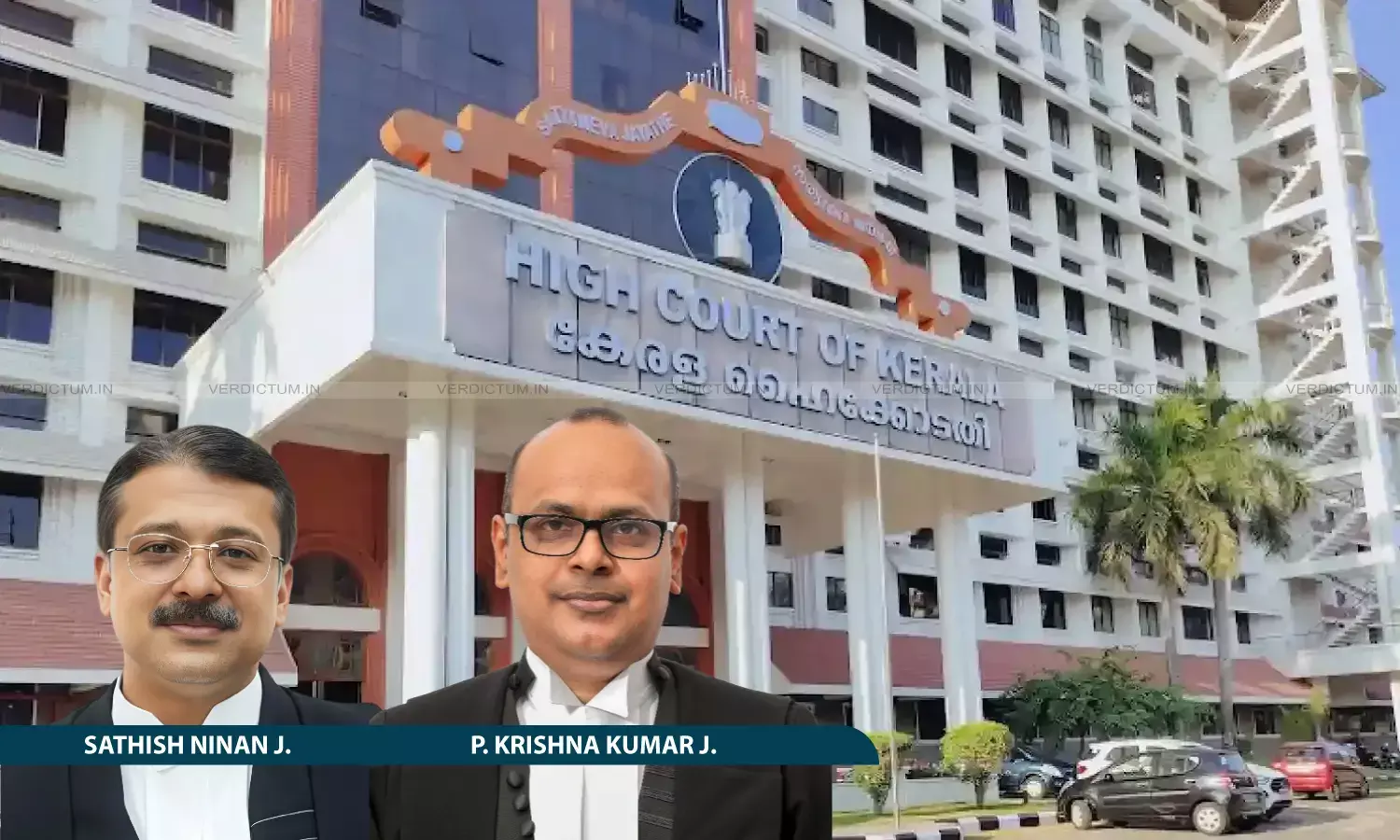
Justice Sathish Ninan, Justice P. Krishna Kumar, Kerala HC
While dismissing an application for the return of a title deed, the Kerala High Court has held that the the inherent jurisdiction of the Court cannot be ordinarily invoked in relation to the custody or return of documents, unless there is an exceptional or unforeseen situation.
The High Court was considering a matter involving the return of a title deed standing in the name of the respondent, which was produced before the court by the petitioner and was never tendered in evidence.
The Division Bench of Justice Sathish Ninan and Justice P. Krishna Kumar held, “At the same time, we do not propose to lay down as an absolute proposition that the inherent jurisdiction of the court can never be invoked in relation to the custody or return of documents. Situations may arise where, owing to exceptional or unforeseen circumstances, a different course might be required to avert manifest injustice or abuse of the process of the Court. As held by the Apex Court, the limitations imposed by construction on the provisions of S.151 of the Code will not control the inherent power of the Civil Court to make a suitable order to prevent the abuse of the process of the Court. For making such deviation, the court must justify why it was necessary to "prevent the abuse of the process of the Court.”
Advocate A.S.Shammy Raj represented the Petitioner.
Factual Background
The matter was referred to the Bench on account of doubts entertained regarding the correctness of the decision of a Single Judge in Vinod Kumar S. v. ICICI Bank (2002) wherein the question was answered in the affirmative.
A suit for declaration of title and possession over the plaint schedule property was dismissed by the Trial Court as “not pressed”, at the instance of the plaintiff-petitioner, purportedly pursuant to a settlement arrived at between the parties. It was alleged in the plaint that, although the property was intended to be purchased in the name of the petitioner, the respondent, who had been entrusted by the petitioner with the task of making arrangements for the execution and registration of the sale deed in his absence, dishonestly caused the sale deed to be registered in her own name, despite the entire sale consideration having been paid by the petitioner. Subsequently, in the year 2022, the respondent-defendant filed an application under Section 151 of the Code of Civil Procedure, 1908, seeking the return of the original sale deed standing in her name, though the same had been produced before the court by the petitioner.
According to the respondent, notwithstanding the fact that the sale deed was registered in her name, the petitioner had fraudulently obtained its possession from the registering authority. It was the petitioner’s case that the sale deed could not be returned to the respondent, as the suit had been withdrawn as not pressed on the expectation that the respondent would act in terms of the settlement. The Trial Court allowed the application, holding that mere production of a document by a party would not confer upon him any superior right over the true owner thereof. Aggrieved by the said order, the petitioner invoked the supervisory jurisdiction of the Court under Article 227 of the Constitution. The Single Judge doubted the correctness of the view taken by another Single Judge who had allowed a similar application and set aside the order of the trial court dismissing a request for return of a title deed produced by the opposite party, which had been rejected on the ground that Rule 132 of the Civil Rules of Practice, Kerala, mandated a contrary course. It was in such circumstances that the matter reached the Division Bench.
Reasoning
Referring to Order XIII Rule 7 of the Code and Rule 132 of the Civil Rules of Practice, Kerala, the Bench held, “The statutory provisions extracted above make it abundantly clear that a document of the nature referred to therein is liable to be returned to the person who produced it and that no application is required to be filed for such return. In the present case, the document sought to be returned is admittedly a title deed standing in the name of the respondent. However, it was produced before the court by the petitioner and was never tendered in evidence.”
The Bench further noticed that the suit itself was disposed of in the year 2017, and the dispute arose several years thereafter when the respondent sought the return of the said title deed by filing an application before the Trial Court.
The Bench stated, “Once the suit is disposed of, the court generally becomes functus officio, and the scope of enquiry in a petition of this nature is necessarily limited.” It was further noticed that the Trial Court proceeded on the premise that abandonment of the suit amounted to a decision against the petitioner and in favour of the respondent, placing reliance on Muhammed Master v. Abu Haji (1981) and Philomina Joseph v. State of Kerala (2009) and directed the return of the document to the respondent, holding that the petitioner could not claim a better right over it. “We are unable to find any such proposition flowing from either of the aforesaid decisions”, the Bench stated.
The Bench was of the view that the Trial Court was not justified in passing the impugned order by resorting to Section 151 of the Code, in the teeth of the specific provisions governing the return of documents. Thus, allowing the original petition and setting aside the order impugned, the Bench dismissed the application for return of the document.
Cause Title: Sambasivan v. Shylaja Kumari (Neutral Citation: 2026:KER:38603)