

Company Restructuring Disputes Cannot Be Decided Through Arbitration; NCLT Has Exclusive Jurisdiction: Kerala High Court
The Court held that High Court can intervene under Article 227 where arbitral tribunal assumes jurisdiction over disputes reserved for a specialised statutory forum like NCLT.

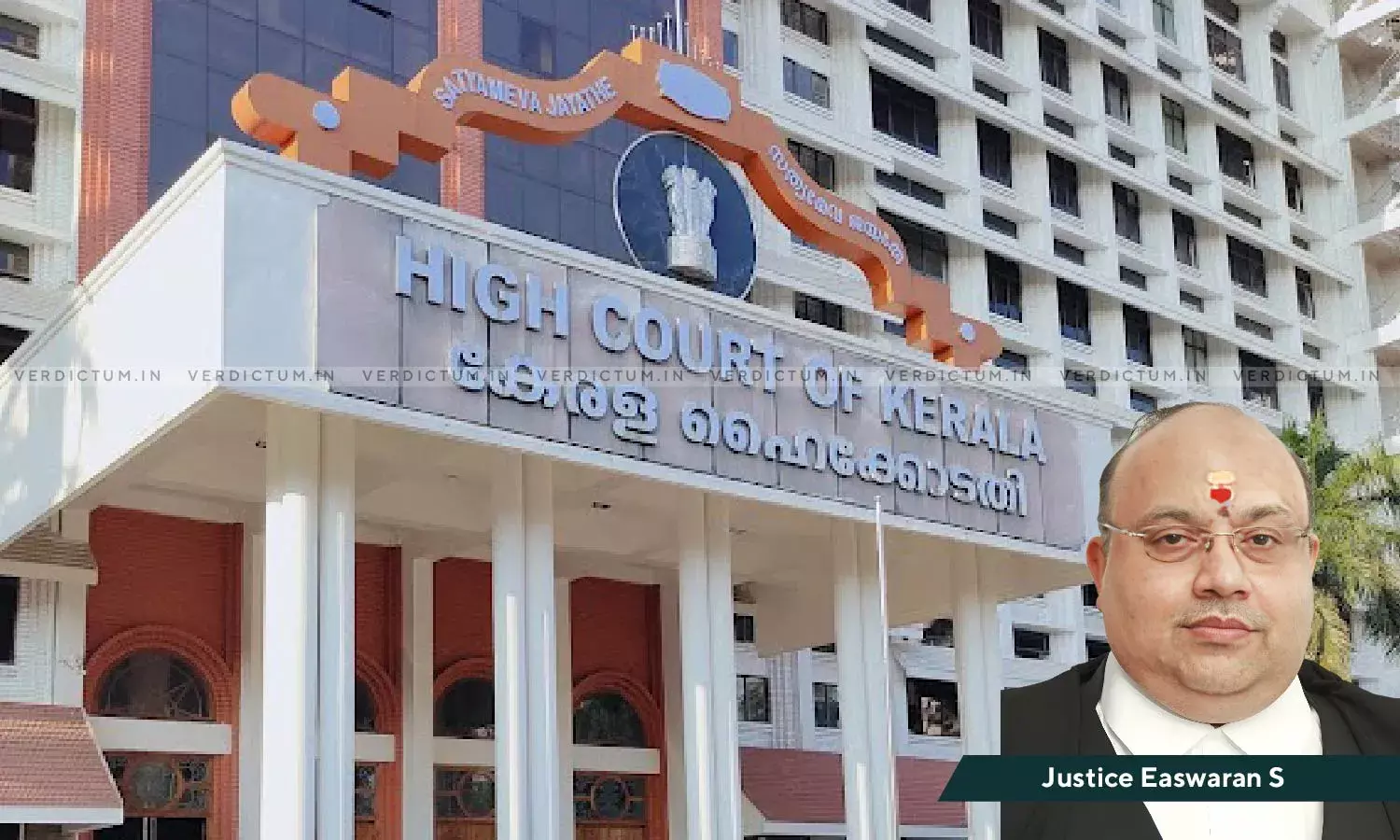
Justice Easwaran S., Kerala High Court
The Kerala High Court has held that disputes involving the restructuring of companies, division of corporate assets and alteration of shareholder rights are statutory matters falling within the domain of the National Company Law Tribunal (NCLT) and cannot be decided through private contractual arbitration.
The Court observed that merely because parties have incorporated an arbitration clause in a Memorandum of Understanding, it does not confer jurisdiction upon an arbitrator to adjudicate issues that affect the company’s structure, shareholders and third-party rights.
While allowing a petition filed under Article 227 of the Constitution of India, the Bench set aside the order of an arbitrator who had rejected a jurisdictional objection under Section 16 of the Arbitration and Conciliation Act, 1996. The Court held that although interference with arbitral proceedings under Article 227 must be exercised sparingly, the High Court can intervene where the arbitral tribunal proceeds to decide disputes that are inherently non-arbitrable or fall within the domain of a specialised statutory forum.
Justice Easwaran S observed, “…when it is evident from records that, the claim before the Arbitrator touches upon functioning and restructuring of the companies, which falls under the exclusive jurisdiction of the National Company Law Tribunal under Section 241 read with Section 242 of the Companies Act, 2013, it is inevitable for this Court to hold that process of restructuring and re-division of the assets of the companies is statutory in nature and cannot be the subject matter of the personal contract.
“…it is undeniable that the disputes raised in the claim petition constitute an action in rem and not in personam…”, the Bench said.
Advocate Jawahar Jose appeared for the petitioner and Advocate Akhil K.M appeared for the respondent.
The dispute arose from a Memorandum of Understanding (MOU) between two brothers concerning division of assets and liabilities of three companies, Pioneer Cars India Private Limited, Pioneer Motors (Kannur) Private Limited and Wayanad Vehicles Private Limited. The claimant had approached the arbitrator seeking division of assets, restructuring of companies and allocation of shares.
The petitioner, a minority shareholder in one of the companies, challenged the arbitral jurisdiction, arguing that disputes relating to corporate restructuring, oppression of shareholders and management of companies could only be adjudicated by the NCLT under Sections 241 and 242 of the Companies Act, 2013.
The Court agreed, observing that the reliefs sought before the arbitrator essentially involved restructuring of companies, division of corporate assets and changes affecting shareholder rights. Such matters, the Court held, were not merely private contractual disputes but constituted actions in rem affecting third-party rights.
The Bench relied on the principles laid down by the Supreme Court in Vidya Drolia and Others v. Durga Trading Corporation (2021) 2 SCC 1 and observed that disputes requiring centralised adjudication or involving statutory mechanisms cannot be resolved through arbitration merely because an agreement contains an arbitration clause.
“…In a given case where the arbitral tribunal or the arbitrator acts beyond its jurisdiction or for that matter a claimant initiates an arbitration on a dispute which is not arbitrable or governed by a separate mechanism provided under a statute, the opposite party is certainly entitled to raise the question of jurisdiction and if it is rejected, can certainly approach this Court under Article 226 and 227 of the Constitution of India as the case may be. In such cases, this Court can examine the case to find out whether the dispute is arbitrable or a separate mechanism to resolve the dispute is provided under a statute. Hence this Court is inclined to hold that the present original petition under Article 227 of the Constitution of India is maintainable”, the Bench observed.
Rejecting the argument that the petitioner should wait until the final arbitral award and challenge it under Section 34 of the Arbitration Act, the Court held that where an arbitrator lacks inherent jurisdiction, parties cannot be compelled to undergo the entire arbitral process.
“…the presence of a specialized statutory forum like National Company Law Tribunal which is given exclusive power to adjudicate on the dispute touching upon the restructuring of the companies and the rights of a minority shareholder, is a clear indication that the subject matter of the dispute is non- arbitrable…Once this Court has concluded that the scope of claim in respect of the three companies is certainly hit by the provisions of the Companies Act, 2013, there is no point in directing the arbitration proceedings to continue”, the Bench further observed.
Accordingly, the Court terminated the arbitral proceedings insofar as they concerned the three companies, while clarifying that the parties were free to pursue appropriate remedies before the NCLT under the Companies Act.
Cause Title: Purushothaman Thitta v. Pothan Rajan & Anr. (Neutral Citation: 2026:KER:37218)
Appearances:
Petitioner: Jawahar Jose, Sanand Ramakrishnan, Augustine P., Cissy Mathews, Gregory Prince Myladi, Thomas Martin K, Advocates.
Respondents: Akhil K.M., T.Ramesh Babu, C.K.Sreejith, Nimisha P. Shanmughan, Resmi S.S. P.V.Vinod, D.Reetha, Anjali Nair, Advocates.