General Abuse Directed At Woman Without Sexually Coloured Remarks Does Not Attract Section 354A(1)(iv) IPC: Kerala High Court
The Court nevertheless found that the specific allegation of a machete threat prima facie disclosed an offence under Section 506 IPC, while holding that the questions arising under Sections 294(b) and 509 IPC required trial.
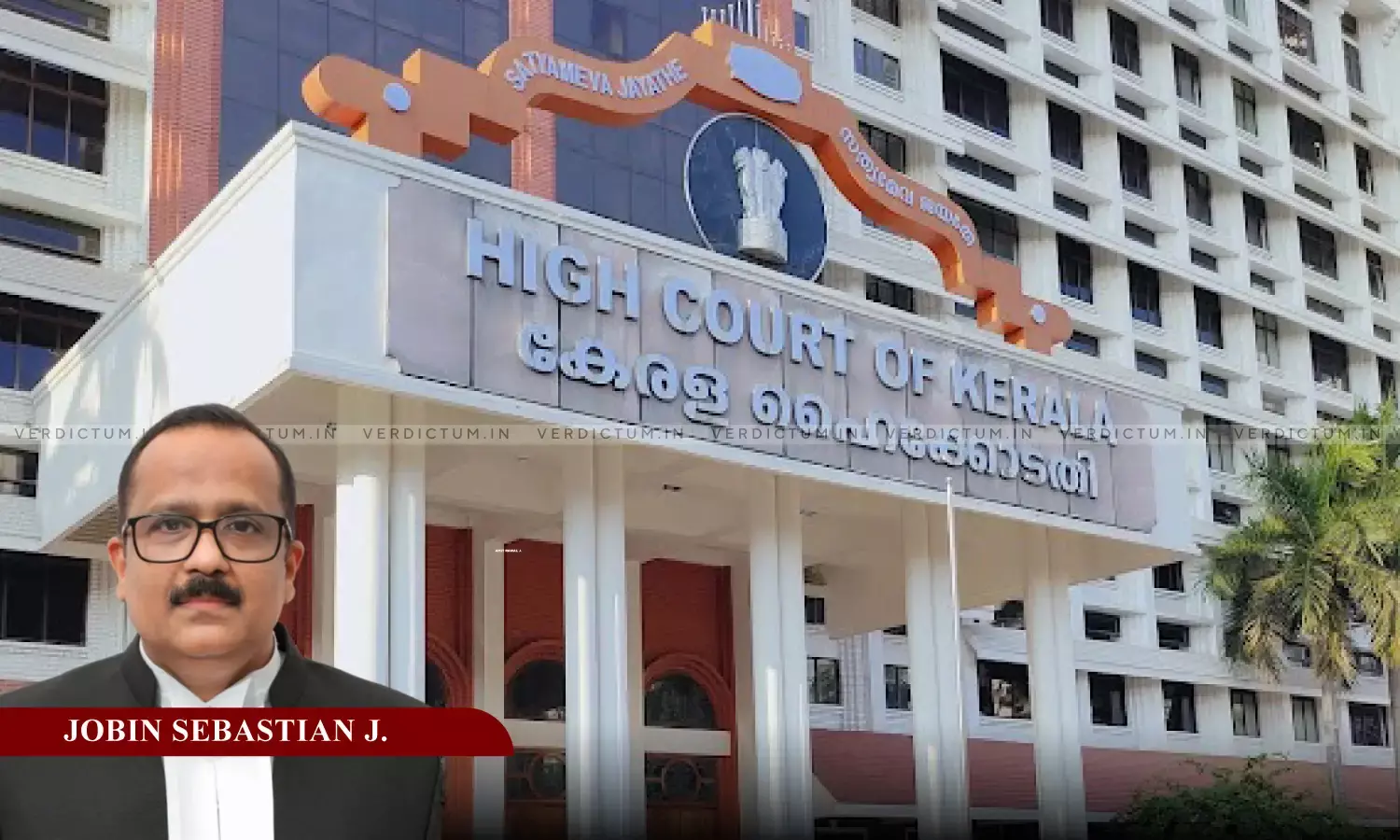
Justice Jobin Sebastian, Kerala High Court
The Kerala High Court has held that general abuse directed at a woman does not, by itself, constitute an offence under Section 354A(1)(iv) of the Indian Penal Code, 1860, unless there is a specific allegation that the accused made sexually coloured remarks.
The Court partly allowed the accused’s plea and quashed the proceedings against him under Section 354A(1)(iv), while permitting the prosecution under Sections 294(b), 506(ii) and 509 IPC to continue.
The Court was hearing a criminal miscellaneous petition seeking the quashing of a final report and all further proceedings pending before the Chief Judicial Magistrate Court against the sole accused under Sections 354A(1)(iv), 294(b), 506(ii) and 509 of the IPC.
A Bench of Justice Jobin Sebastian observed: “… the mere utterance of obscene words would not, by itself, automatically attract an offence under Section 354A(1)(iv) of the IPC. There must be a specific allegation that the accused had made sexually coloured remarks against the de facto complainant. A general abuse directed at a woman does not, by itself, constitute an offence under Section 354A(1)(iv) of the IPC.”
Advocate S. Sabarinadh appeared for the petitioner. Public Prosecutor V.R. Ramlal appeared for the State.
Background
According to the prosecution case summarised by the Court, the accused, owing to prior enmity, allegedly abused one person in filthy language at the premises of a temple. The prosecution further alleged that when the de facto complainant and another person later questioned him on a public road in front of his house, he abused them, made sexually coloured remarks and threatened to kill them while showing a machete.
The petitioner submitted that, even if the allegations in the First Information Statement were accepted in their entirety, they did not disclose the essential ingredients of the alleged offences. The State opposed the plea and submitted that the allegation concerning obscene words directed at the de facto complainant and her daughter, along with the threat to kill them, prima facie made out the offences alleged.
Court’s Observations
The Court observed that its inherent power under Section 482 of the Code of Criminal Procedure, 1973, corresponding to Section 528 of the Bharatiya Nagarik Suraksha Sanhita, 2023, was extraordinary and had to be exercised sparingly and cautiously to prevent an abuse of process or secure the ends of justice.
The Court added: “At the same time, while exercising jurisdiction under Section 528 of the BNSS, this Court is not expected to conduct a meticulous examination of the evidence, assess the probative value of the materials collected during investigation, or undertake a mini-trial.”
The Court stated that the inquiry at the quashing stage was confined to whether the allegations, read plainly with the available materials, disclosed the essential ingredients of the offences. The Court clarified that disputed factual questions requiring evaluation of evidence had to be decided by the trial court.
The Court observed that the First Information Statement specifically alleged that the accused used filthy language against the de facto complainant and her daughter while standing in a public place. The Court held that the applicability of Section 294(b) IPC could be conclusively determined only after trial.
The Court stated: “Whether the words allegedly uttered had the capacity to generate impure thoughts in the minds of the audience, or whether the words uttered amounted to obscene words, etc., can also be considered only after trial.”
The Court found that the First Information Statement contained a specific allegation that the accused came armed with a machete and threatened the de facto complainant and another person. The Court consequently found that the essential ingredients of Section 506 IPC were prima facie disclosed.
The Court observed: “Therefore, prima facie, it appears that the essential ingredients to attract an offence under Section 506 of the IPC are also made out.”
The Court held that the mere use of obscene words did not automatically attract Section 354A(1)(iv) IPC. The Court found that the provision required a specific allegation that sexually coloured remarks had been made against the de facto complainant, whereas general abuse directed at a woman was insufficient by itself.
The Court consequently held that the ingredients of the offence under Section 354A(1)(iv) IPC were not made out in the case.
The Court held that using filthy language against a woman, without intending to insult her modesty, was insufficient to constitute an offence under Section 509 IPC. The Court explained that an intention to insult the modesty of a woman was an indispensable ingredient of the offence.
The Court observed: “The use of filthy language against a woman, without an intention to insult her modesty, is not sufficient to constitute an offence under Section 509 of the IPC. On the other hand, to attract Section 509, it must be established that the accused uttered any word, made any sound or gesture, or exhibited any object, with the intention of insulting the modesty of a woman.”
The Court added that whether the accused intended to insult the modesty of the de facto complainant was a matter of evidence that could be decided only after trial.
Conclusion
The Court partly allowed the petition and quashed the proceedings against the petitioner insofar as the offence under Section 354A(1)(iv) IPC was concerned. It directed that the criminal proceedings under Sections 294(b), 506(ii) and 509 IPC would continue in accordance with law.
The Court clarified that its observations were confined to deciding the quashing petition and would not influence the trial court while adjudicating the case on its merits.
Cause Title: Prasad Mahendragiri v. State of Kerala and Another (Neutral Citation: 2026:KER:71105)
Appearances
Petitioner: Advocates S. Sabarinadh, A. Jayasankar and Indulekha Joseph
Respondents: Public Prosecutor V.R. Ramlal