

Proceedings Converted Into Suit U/S 295 Succession Act Retain Limited Probate Scope; Court Can Examine Validity Of Will U/S 71: Kerala High Court
The Court clarified that conversion of probate proceedings into a suit enables a full-fledged evidentiary process, but does not expand the jurisdiction beyond determining the validity and due execution of the Will.
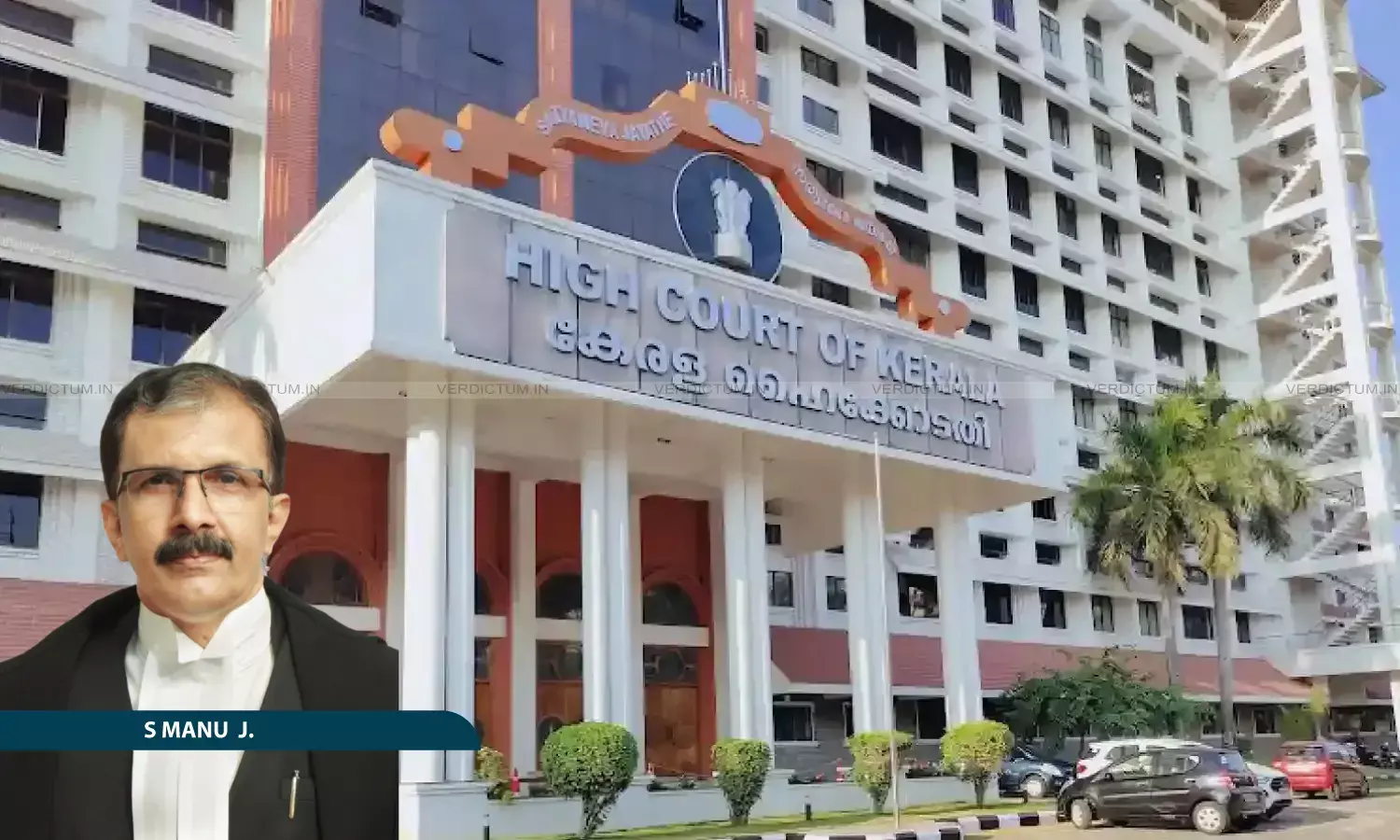
Justice S. Manu, Kerala High Court
The Kerala High Court held that even when probate proceedings are converted into a suit under Section 295 of the Indian Succession Act, 1925, the scope of enquiry continues to remain confined to that of a probate court and does not assume the character of a regular civil suit under the Code of Civil Procedure.
The Court further held that such proceedings are limited to examining whether the Will is genuine, duly executed and attested, and whether any alterations therein are valid in terms of Section 71 of the Act.
The Court was hearing an appeal under Section 299 of the Indian Succession Act challenging the judgment of the Additional District Judge, whereby a contentious probate proceeding, converted into a suit, was adjudicated upon after full trial.
A Single Bench of Justice S. Manu observed: “When a proceeding is converted as a suit under Section 295 of the Act, such a suit would not assume the character of a regular suit under the Code of Civil Procedure, … The scope of enquiry by the Court remains constricted as of a probate court even if the proceeding is converted as a suit”.
However, the Bench explained, “it cannot be forgotten that the purpose of converting a proceeding into a suit, when there are conflicting contentions, is to enable the parties to place their respective cases before the Court through pleadings, to adduce evidence in support of their rival contentions, and to bring the relevant facts and circumstances on record”.
“It is well within the authority of the probate court to find out as to whether the Will is the last testament of the testator and it was properly executed and attested”, the Bench added.
Senior Advocate T. Krishnanunni appeared for the appellants, while Advocates B. Krishnan and T.D. Susmith Kumar appeared for the respondents.
Background
The proceedings originated as an original petition seeking a grant of probate of a Will allegedly executed by the deceased testator. The petitioner contended that the Will bequeathed the property exclusively in her favour and asserted that certain alterations appearing in the document were either invalid or not binding.
Upon contest by the defendants disputing the nature and validity of the Will and alleging improper alteration, the probate proceeding was converted into a suit under Section 295 of the Indian Succession Act.
Following such conversion, the matter proceeded as a contentious case, with parties filing pleadings, framing of issues, and leading of evidence, including examination of attesting witnesses and expert evidence relating to the alleged alterations in the Will.
The trial court, upon appreciation of the evidence, rendered findings regarding the validity of the Will and the effect of the alterations therein. Aggrieved by the same, the appellants contended that the trial court had exceeded the limited jurisdiction of a probate court by undertaking a detailed examination akin to a regular civil suit.
Court’s Observation
The Court undertook a detailed examination of the nature and scope of proceedings under Section 295 of the Indian Succession Act. It reiterated that the conversion of a probate proceeding into a suit does not enlarge the jurisdiction of the court beyond its probate functions.
It was observed that when a proceeding is converted into a suit under Section 295 of the Act, such a suit would not assume the character of a regular suit under the Code of Civil Procedure. The scope of enquiry by the Court remains constricted as that of a probate court.
At the same time, the Court clarified that the purpose of such conversion is to facilitate a comprehensive adjudicatory process where parties are enabled to present their respective cases through pleadings and evidence.
The Court emphasised that once such materials are placed on record, the probate court is required to adjudicate upon the issues necessary to determine whether probate can be granted, including examining the genuineness of the Will and compliance with statutory requirements.
“To arrive at such a conclusion, the Court is necessarily required to address the issues raised and render appropriate findings thereon, … Such an exercise is not beyond the scope of probate proceedings, though, as pointed out above, the suit cannot be treated as a regular suit under the Code of Civil Procedure”, the Bench remarked.
Rejecting the contention that such detailed examination amounts to transgression of jurisdiction, the Court held that such an exercise is not beyond the scope of probate proceedings.
The Court further clarified that examination of alterations in the Will, including obliterations, interlineations or insertions, and determination of their legal effect in accordance with Section 71 of the Act, squarely falls within the permissible scope of probate enquiry.
It observed: “Examining whether there is any obliteration, interlineation, or alteration and deciding its effect… is necessarily a matter falling within the scope of enquiry by the probate court. Such an exercise cannot be equated with the examination of rights under the will.”
Applying these principles, the Court found that the trial court had confined its enquiry to the validity of the Will and the effect of alterations and had not ventured into the adjudication of substantive rights under the Will.
Conclusion
The Court held that the trial court had acted within the permissible limits of probate jurisdiction even after conversion of the proceedings into a suit under Section 295 of the Indian Succession Act.
Finding no jurisdictional error in the approach adopted by the trial court, the Court dismissed the appeal and affirmed the judgment of the Additional District Judge.
Cause Title: P. Lakshmikutty Amma & Ors. v. V.K. Indira & Anr.
Appearances
Appellants: T. Krishnanunni, Senior Advocate; B. Premnath, Advocate
Respondents: B. Krishnan; T.D. Susmith Kumar; R. Parthasarathy, Advocates
