

Transitory Provisions Prevent Complete Cessation Of Judicial Functions: Kerala High Court Upholds Validity Of 2026 Industrial Relations Code Amendment Act
It was observed that validating the challenge would cause a complete cessation of judicial functions and create a virtual "cryonic freeze" to the extreme prejudice of litigants.

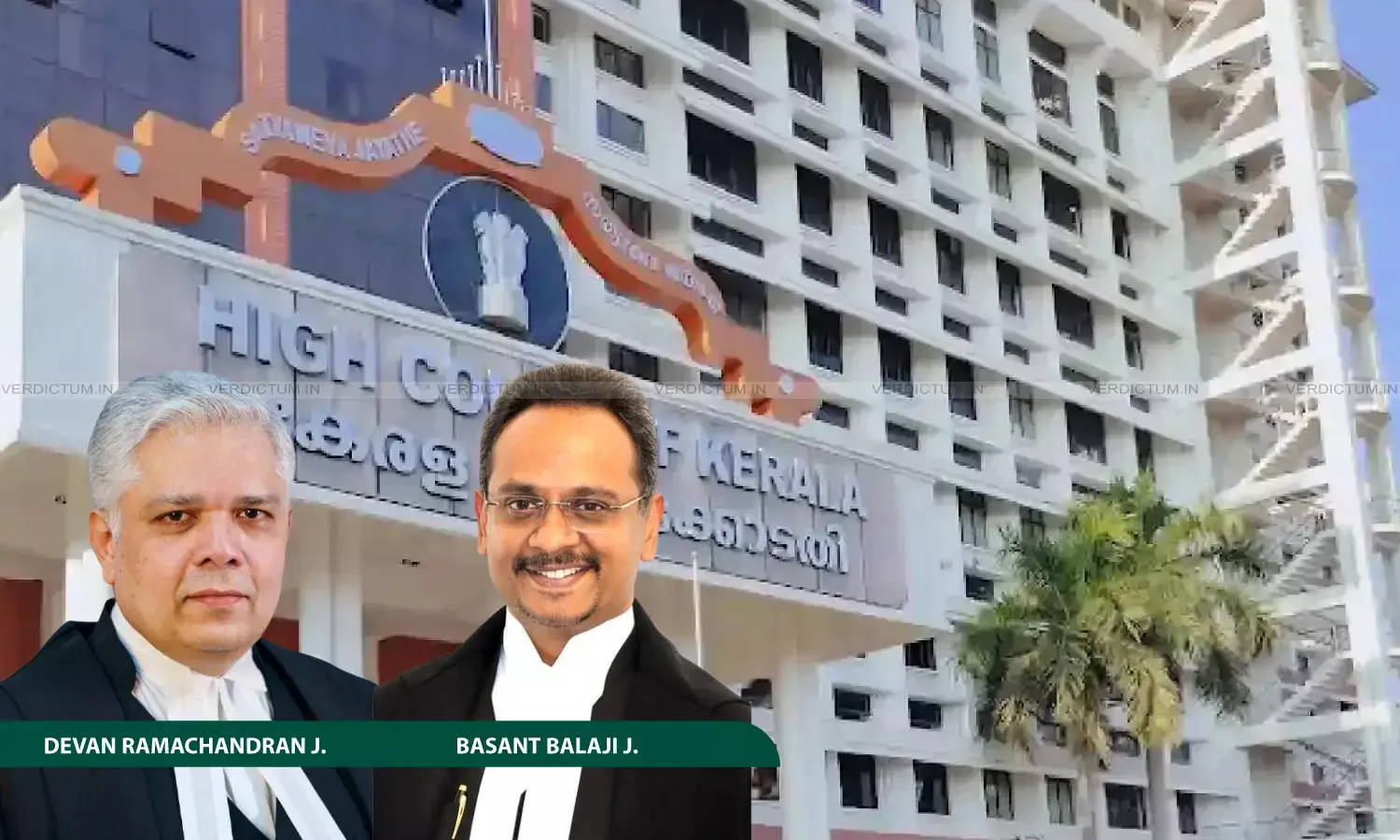
The Kerala High Court ruled that transitory provisions enabling existing statutory tribunals to continue functioning during a legislative transition are essential to prevent a complete cessation of judicial functions.
While dismissing a writ appeal that challenged the constitutional validity of the Industrial Relations Code (Amendment) Act, it was observed that allowing older, single-member forums to temporarily operate until new multi-member authorities are formally established creates a vital stop-gap mechanism.
The Court emphasized that striking down such transitional measures would cause a virtual "cryonic freeze" in the dispute resolution machinery, creating an operational vacuum that would ultimately result in severe prejudice and disservice to both the litigants and the State.
The Bench of Justice Devan Ramachandran and Justice Basant Balaji observed, "As per the impugned sub-section, it merely enables the existing Tribunals and statutory Authorities to continue. Far from being arbitrary and shocking, this creates a transitory mechanism, for the period until new Tribunals and statutory Authorities are brought into existence; thus removing any event to cause prejudice to litigants and claimants. If it is to be seen otherwise, then, as also rightly pointed out by Sri.P.Sreekumar – learned ASGI, a situation would surely present itself, where there would be a complete cessation of the judicial functions as required either under the repealed Acts or under the new 'Code'; and this would certainly not behoove any interest – be that of the litigant, or that of the State."
Advocate A Abdul Nabeel appeared for the Petitioners, while ASGI P Sreekumar appeared for the Respondents.
Brief Facts of the Case
The appellants preferred a Writ Appeal before the High Court, calling into question the correctness of the judgment rendered by a learned Single Judge. Through the underlying writ petition, the appellants challenged the constitutional validity of the Industrial Relations Code (Amendment) Act, 2026. Specifically, they sought a declaration that the newly introduced sub-section (1A) to Section 104 of the Industrial Relations Code, 2020, was unconstitutional, arbitrary, and ultra vires (beyond the legal power of) the Code, as well as violative of Articles 14 and 21 of the Constitution of India. Consequently, they sought a writ of prohibition to restrain the existing Labour Courts and Industrial Tribunals from adjudicating disputes under the new Code. The learned Single Judge repelled all contentions and dismissed the writ petition, prompting this appeal.
Contention of the Parties
The Appellants argued that Section 104(1A) of the Code was manifestly illegal as it permitted defunct forums and tribunals to continue functioning, even though the parent statutes under which they were originally constituted stood expressly repealed.
It was contended that the continuation of single-member tribunals violated the mandatory provisions of Sections 44(7) and 51(1) of the Code, which contemplated the transfer of cases to newly envisioned multi-member forums. It was further argued that the amendment created severe legal anomalies by curtailing the statutory powers vested in the respective State Governments.
The Union of India countered that the impugned sub-section was merely a transitory or stop-gap provision designed to ensure the uninterrupted adjudication of labor disputes pending the formal establishment of new tribunals under the Code. It was argued that striking down the provision would result in a virtual "cryonic freeze" or absolute cessation of judicial functions, which would cause severe prejudice and disservice to litigants. The respondents maintained that the provision did not suffer from any constitutional infirmity or manifest arbitrariness, rendering the challenge a mere misadventure.
Observations of the Court
The Court observed that the learned Single Judge appropriately relied upon the celebrated dictum of the Hon’ble Supreme Court in Shayara Bano v. Union of India to test whether the challenged provision could be labeled as "manifestly arbitrary" so as to invite constitutional invalidation.
The Court noted that Section 104(1A) operated as a non-obstante clause, enabling old functionaries to act until the new machinery under the Code became fully operational. It further took judicial notice of the fact that the constitution of the new tribunals was already underway and monitored by the Apex Court.
"Be that as it may, when a statutory provision is challenged, the appellants will indubitably have to bring it within the purlieus of either an imputation that the legislature did not have the power to legislate under the Doctrine of Pith and Substance, or that the provision is so arbitrary that it shocks the constitutional conscience", the Court said.
The Court reiterated the settled position of law that to successfully challenge a statutory provision, the challenger must establish either a lack of legislative competence or show that the law is so shockingly arbitrary that it offends the constitutional conscience.
The Court held that far from being arbitrary, the impugned provision served a vital public interest by creating a transitional bridge. It observed that striking it down would paralyze the labor adjudication machinery, an outcome that would benefit neither the litigants nor the State.
The Court rejected the argument regarding the internal conflict within the statute, holding that Sections 44(7) and 51(1) apply to the permanent transfer and constitution of new tribunals, whereas the impugned provision operated strictly in the interregnum (the intervening period).
Finding no merit in the appeal, the Division Bench affirmed the findings of the learned Single Judge and dismissed the Writ Appeal.
Cause Title: MK Suresh Kumar & Anr. v. The Union Of India and Anr. [WA NO. 1051 OF 2026]
Appearances:
Petitioners: Advocate A Abdul Nabeel
Respondents: ASGI P Sreekumar, CGC Amal Parathasaradhy