

Mere Delay In Approaching Magistrate Not A Ground For Quashing Domestic Violence Act Proceedings: Kerala High Court
The Bench noted that the timing of domestic violence complaint filed after Family Court notice does not, by itself, establish it is retaliatory, while dismissing husband and mother-in-law's quashing plea.

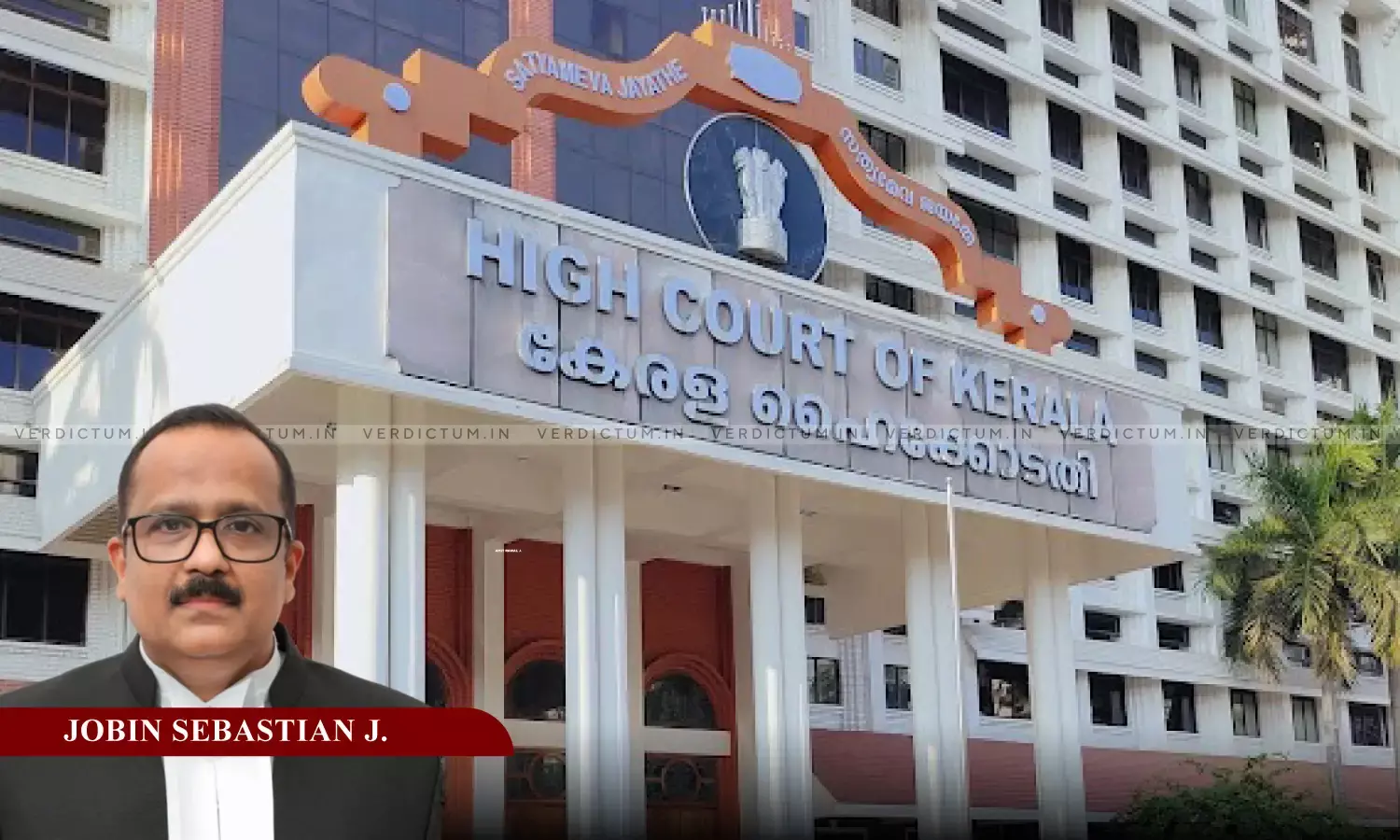
Justice Jobin Sebastian, Kerala High Court
The Kerala High Court has held that a delay of several years in invoking the jurisdiction of the Magistrate under Section 12 of the Protection of Women from Domestic Violence Act, 2005, cannot by itself justify quashing proceedings, particularly where the allegations include acts of domestic violence said to have occurred at a later point in time.
Dismissing a plea to quash proceedings, the Court held that the fact that the domestic violence complaint was filed only after the husband initiated compensation proceedings before the Family Court concerning an earlier POCSO case does not, without more, establish that the present proceedings are retaliatory or malicious, though such timing may be a relevant circumstance for the trial court to weigh while appreciating the evidence.
A Single Judge Bench of Justice Jobin Sebastian observed, “…it is to be noted that there is no provision under the PWDV Act prescribing a specific period within which an aggrieved person must approach the Magistrate under Section 12 seeking the reliefs contemplated under the Act. Therefore, mere delay in approaching the Magistrate cannot, by itself, constitute a ground for quashing the proceedings, particularly when the allegations are stated to include acts of domestic violence committed at a later point of time”.
Advocate Shibin K.F. appeared for the petitioners and Advocate Dinesh Mathew J. Muricken appeared for the respondent.
The petitioners, the husband and mother-in-law of the respondent, sought quashing of proceedings under Section 12 of the PWDV Act before the Judicial First Class Magistrate Court-III, Thrissur. They contended that the allegations were false and frivolous, with no specific acts of domestic violence beyond bald allegations of threat, and pointed to the absence of a police complaint and an unexplained six-year delay after her alleged ouster from the matrimonial home.
They also relied on a POCSO case registered against the husband on the couple's child's complaint, which resulted in a refer report finding the allegations false even after further investigation. They argued that the present proceedings were instituted only after the husband sought compensation before the Family Court in relation to that case, making the complaint a pressure tactic.
The respondent contended that the allegations disclosed a continuing cause of action, including a specific incident of domestic violence in May 2025, and that the PWDV Act prescribes no limitation period. She submitted that delay could be explained by concerns for the children's welfare and hope of reconciliation. She also pointed out that her challenge to the POCSO refer report remained pending.
On the inherent jurisdiction under Section 528 of the BNSS, corresponding to Section 482 CrPC, the Court held that such extraordinary power must be exercised sparingly and not merely because the respondent is accused of making a false complaint. Relying on Shaurabh Kumar Tripathi v. Vidhi Rawal 2025 KHC Online 6517, it reiterated that interference with Section 12 proceedings is ordinarily warranted only in cases of gross illegality or manifest injustice. The Court held that the PWDV Act prescribes no limitation period and that delay, the POCSO proceedings and timing of the complaint concerned the credibility of the allegations, which fell within the Magistrate's domain. The High Court could not conduct a mini-trial at the quashing stage.
Cause Title: M & Another v. A (Neutral Citation: 2026:KER:68865)
Appearances:
Petitioners: Shibin K.F. and Renjitha B., Advocates.
Respondent: Dinesh Mathew J. Muricken, Vinod S. Pillai, Nayana Varghese, N.R. Sangeetharaj, Jerry Peter and Navas V.A., Senior PP, Advocates.