

For Endorsement Of Extrajudicial Divorce Of Khula, Detailed Inquiry Is Not Essential: Kerala High Court
The Bench noted that the validity of 'khula' does not depend upon the acceptance or consent of the husband; rather, it constitutes a right available to the wife for dissolution of the marriage.

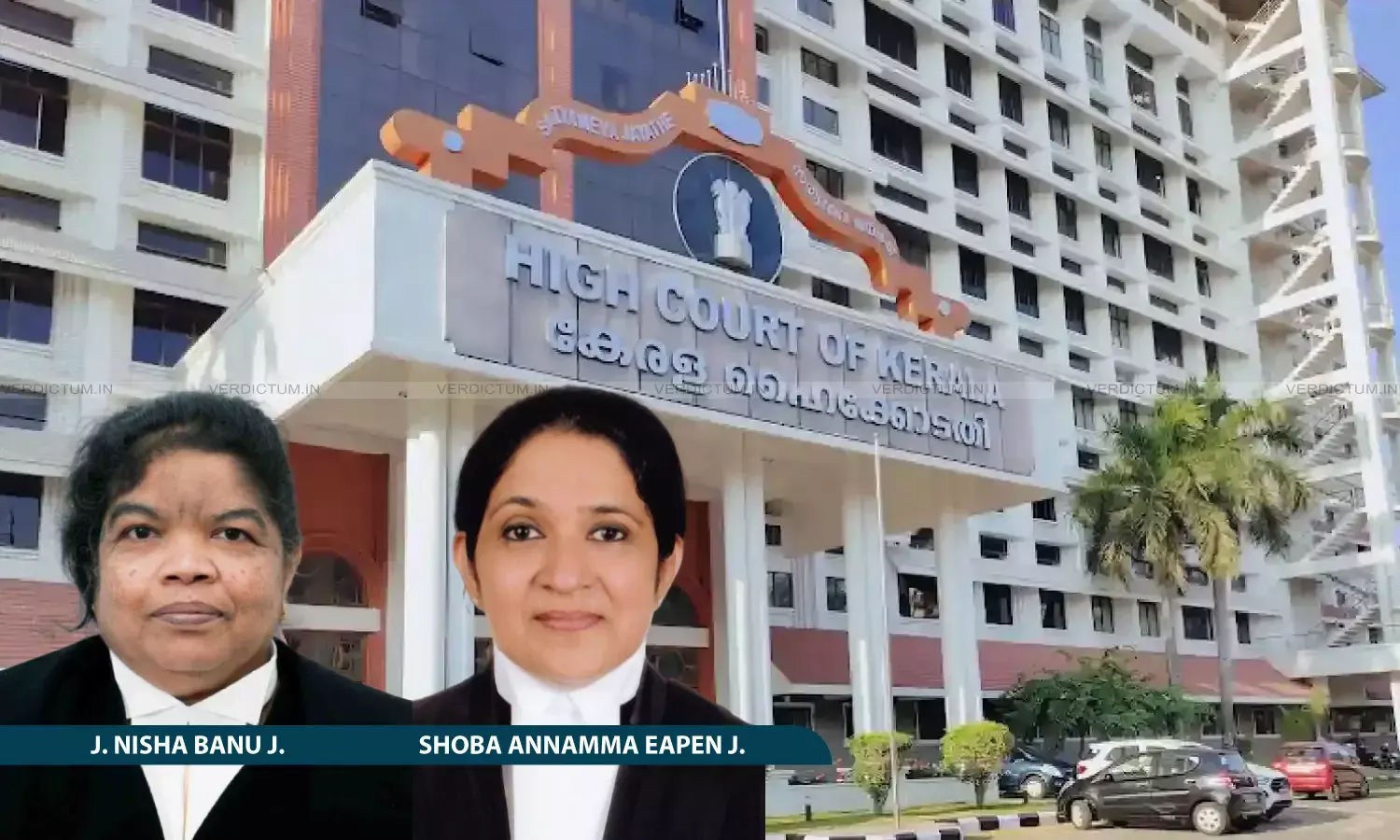
Justice J. Nisha Banu, Justice Shoba Annamma Eapen, Kerala High Court
The Kerala High Court has held that a detailed inquiry is neither essential nor desirable in a proceeding for endorsement of an extrajudicial divorce. The Court said the Family Court is required only to consider whether the three ingredients of a valid khula, laid down in X and Others v. Y and Others 2021 (2) KLT 967, have been complied with.
The Court dismissed a husband's petition against Family Court orders refusing to hear the validity of khula as a preliminary issue, to let him produce documents and witnesses, and to keep the wife's petition in abeyance. The Bench held that a husband cannot convert a wife's petition for declaration of khula into a full trial, and that his remedy is to contest its effectiveness in an appropriate manner known to law.
A Division Bench of Justice J. Nisha Banu and Justice Shoba Annamma Eapen observed, “…we are inclined to follow the judgments in X (supra), Asbi (supra), Sudheer (supra) and Muhammed Ashar K. (supra), and hold that a detailed inquiry is neither essential nor desirable in a proceeding initiated by either of the parties for endorsement of an extrajudicial divorce. The Family Court is required only to consider whether the three ingredients stated in X (supra) have been complied with. Accordingly, we hold that the impugned Exts.P9 to P11 orders are in order and do not warrant any interference by this Court”.
“…The validity of ‘khula’ does not depend upon the acceptance or consent of the husband; rather, it constitutes a right available to the wife for dissolution of the marriage. The significance of invoking ‘khula’ is absolute. Hence, the Family Court need only look into whether the ingredients mentioned in paragraph No.75 of the judgment in X (supra) have been complied with…”, the Bench further noted.
Advocate Jamsheed Hafiz appeared for the petitioner and Advocate K. Jayesh Mohankumar appeared for the respondent.
The parties married on December 25, 2023 by nikah. In 2025, the wife filed a plaint before the Family Court, Malappuram, for a declaration of khula. The husband filed another before the Family Court, Tirur, seeking a declaration that the khula is void, return of a diamond ornament and compensation for mental agony.
In the Malappuram proceedings, the husband filed an IA seeking a preliminary hearing on the validity of khula, permission to lead evidence, and abeyance of the petition. The Family Court dismissed all three by orders dated March 16, 2026. The husband then approached the High Court, arguing that mahar return and mediation attempts require evidence, and that Asbi K. N. v. Hashim M. U. [2021 (6) KLT 292 misread X and was per incuriam, or should be referred to a larger Bench.
The Court noted that the husband's reliance on Shamim Ara and Shayara Bano was misplaced, as those concern instantaneous or triple talaq, while khula "stands on an entirely different footing." It held that Asbi neither misread X nor was per incuriam, having considered X and been authored by one of the judges in X.
It recorded that two other Division Benches, in Sudheer v. Surumiya and Muhammed Ashar K. v. Muhsina P.K., had followed the same view. It reproduced the three conditions in X, namely a declaration by the wife, an offer to return dower or other material gain, and an effective attempt at reconciliation, and the seven-step procedure in Asbi. It observed that the validity of khula does not depend on the husband's consent and that the Family Court need only examine the three ingredients. It also noted that the husband had not filed his sworn statement despite several postings before filing the applications.
Cause Title: K v. I (Neutral Citation: 2026:KER:72743)
Appearances:
Petitioner: Jamsheed Hafiz, T.S. Sreekutty and Fathima Nasreen S., Advocates.
Respondent: K. Jayesh Mohankumar, Pushparajan Kodoth, Vandana Menon and Vimal Vijay, Advocates.