

Government Can Invoke Section 100 Of Patents Act To Manufacture Unaffordable Patented Medicines: Kerala High Court
The Court also directed the Central Government to collate the data to decide whether a particular medicine is affordable or not.

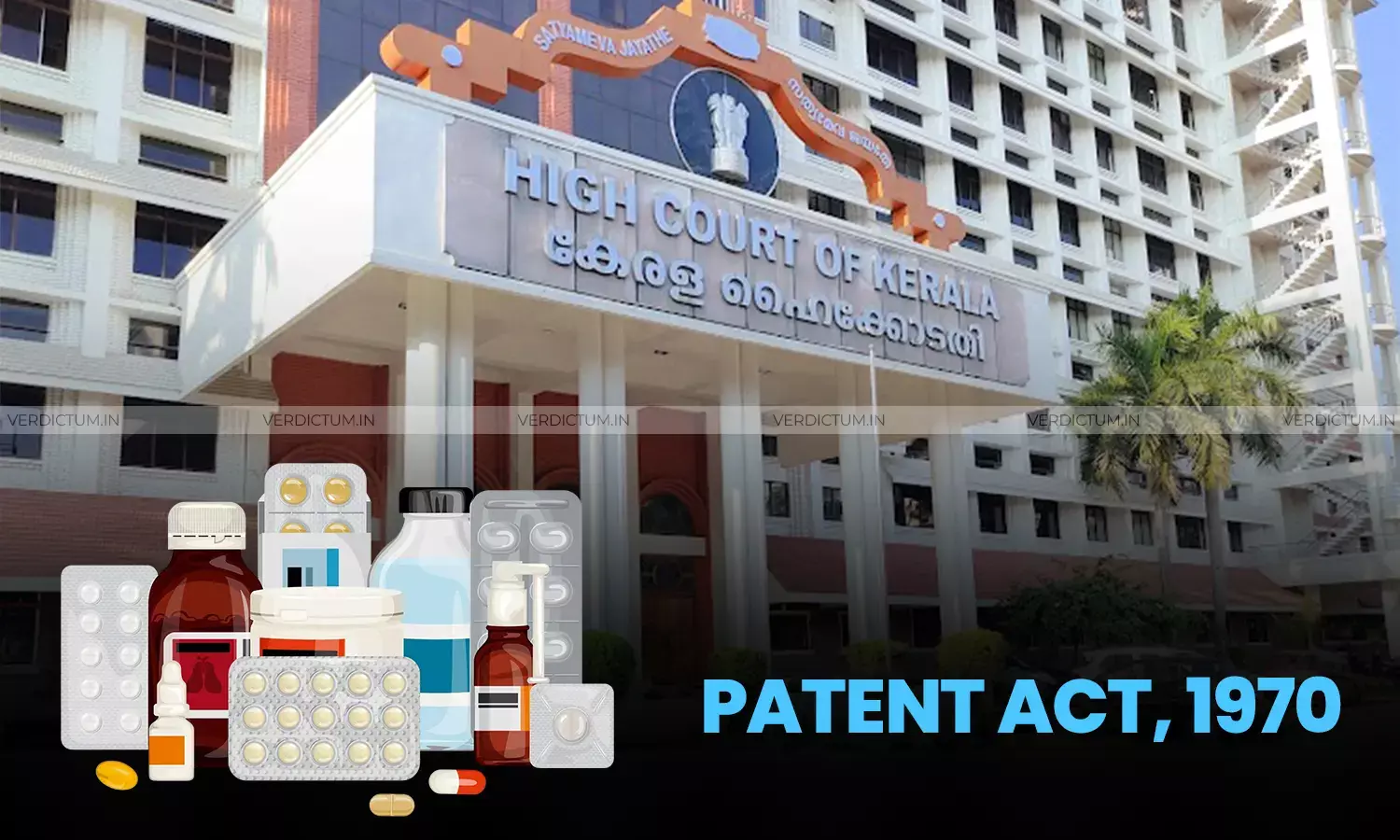
The Kerala High Court has held that Section 100 of the Patents Act, 1970 includes the Government's entitlement to use a patented invention to manufacture the medicine and sell it on a non-commercial basis to a needy patient. The Court read the phrase "purposes of Government" to cover vending and non-commercial sale, and to include the State's duty to improve public health under Article 47 of the Constitution of India.
The Judgment has been passed in a case pertaining to unaffordability of breast cancer medicines, which was continued suo motu by the High Court after the Petitioner passed away. Earlier, the Supreme Court had directed the High Court to expedite the proceedings after it took cognizance of a letter that the High Court has adjourned the case multiple times after the Petitioner passed away.
The petition filed on June 02, 2022 was by a retired bank employee with HR+/HER2- metastatic breast cancer. She sought action under Section 92 or 100 to make Ribociclib affordable, along with a free-treatment scheme. However, unfortunately, she passed away during the pendency of the petition.
The Court did not direct the Centre to invoke Section 100 of the Act for Ribociclib, however, it held that the provision is to be invoked where a patented medicine is sold at an exorbitant price, but that whether to do so is a policy decision for the Central Government, to be taken after collating data on affordability.
A Bench of Justice Harisankar V. Menon while noting various sub-sections under Section 100 of the Act, observed, “…subsection (6) also makes it clear that the right to make, use, exercise and vend an invention shall include the right to sell, on non-commercial basis, the goods which have been made in exercise of that right. In view of the afore provisions, this Court is of the opinion that the term ‘for the purposes of Government’ requires to be interpreted also taking into account the right to vend/sell the goods made using the patent and invention on a non-commercial basis to a purchaser. The provisions of Section 100 impose no restriction on who the purchaser could be. When that be so, the provisions under Section 100 would include the entitlement of the Government to use the patent or invention for manufacturing the medicine covered by the patent and sell the same on a non-commercial basis to a person who can be none other than the needy patient. This position is made further clear by the specific inclusion of ‘medicines or drugs’ under sub-section (4)”.
Advocate Maitreyi Sachidananda Hegde appeared as amicus curiae while P. Sreekumar, ASGI, O. M. Shalina, DSGI, Senior Advocates G. Shrikumar, Joseph Kodianthara, T. A. Shaji appeared for the respondents.
On September 16 2022, the Court continued the matter suo motu as "In Re Exorbitant Pricing of Life Saving Patented Medicines" and appointed Advocate Maitreyi Sachidananda Hegde as Amicus Curiae. Eli Lilly and Novartis, the patentees of Abemaciclib and Ribociclib, were impleaded. Cancer institutes and the Drug Controller General were added in July 2026. Only Section 100 was pressed at the hearing.
The Court first held, on expert affidavits, that Palbociclib, a cheaper off-patent drug, is not interchangeable with Ribociclib. Rejecting the argument that Section 100 is limited to the Government's own use, it relied on sub-sections (4) and (6), which permit authorisation of any person and non-commercial sale, and on the express mention of "medicine or drug". It distinguished the Bombay High Court's ruling in Garware Wall Ropes and drew on Articles 21 and 47, Section 83 and the Supreme Court's decision on essential supplies during the pandemic.
The Court said patentees are protected and that even the Government is bound by a patent under Section 156. The record lacked data on affordability, so the decision to invoke Section 100 rested with the Centre.
Earlier, the Court had passed an interim order directing the DPIIT to consider compulsory licensing of Ribociclib
The Court disposed of the petition with three findings: Section 100 includes manufacture and non-commercial sale to needy patients; it is to be invoked where a patented medicine is sold at an exorbitant price; and the Government must collate data on affordability and proceed under Section 100 if found necessary.
Cause title: In Re Exorbitant Pricing of Life Saving Patented Medicines v. Union of India & Ors. (Neutral Citation: 2026:KER:74251)
Appearances:
Petitioner: Advocate Maitreyi Sachidananda Hegde, Amicus Curiae.
Respondent: ASGI P. Sreekumar, DSGI O. M. Shalina, Senior Panel Counsel T. C. Krishna, Senior Advocate G. Shrikumar with Advocates Arun Kumar P. and Praveen Anand, Senior Advocate Joseph Kodianthara with Advocates John Vithayathil and Hemanth Singh, Senior Advocate T. A. Shaji with Advocate Athul Shaji, Advocate K. M. Gopakumar, Rahul Bajaj appeared in person.