

Emergency Medical Reimbursement Under CGHS Cannot Be Denied Solely Because Treatment Was Availed At A Non-Empanelled Hospital: Kerala High Court
The Court upheld CAT's order directing full medical reimbursement under the Central Government Health Scheme (CGHS).

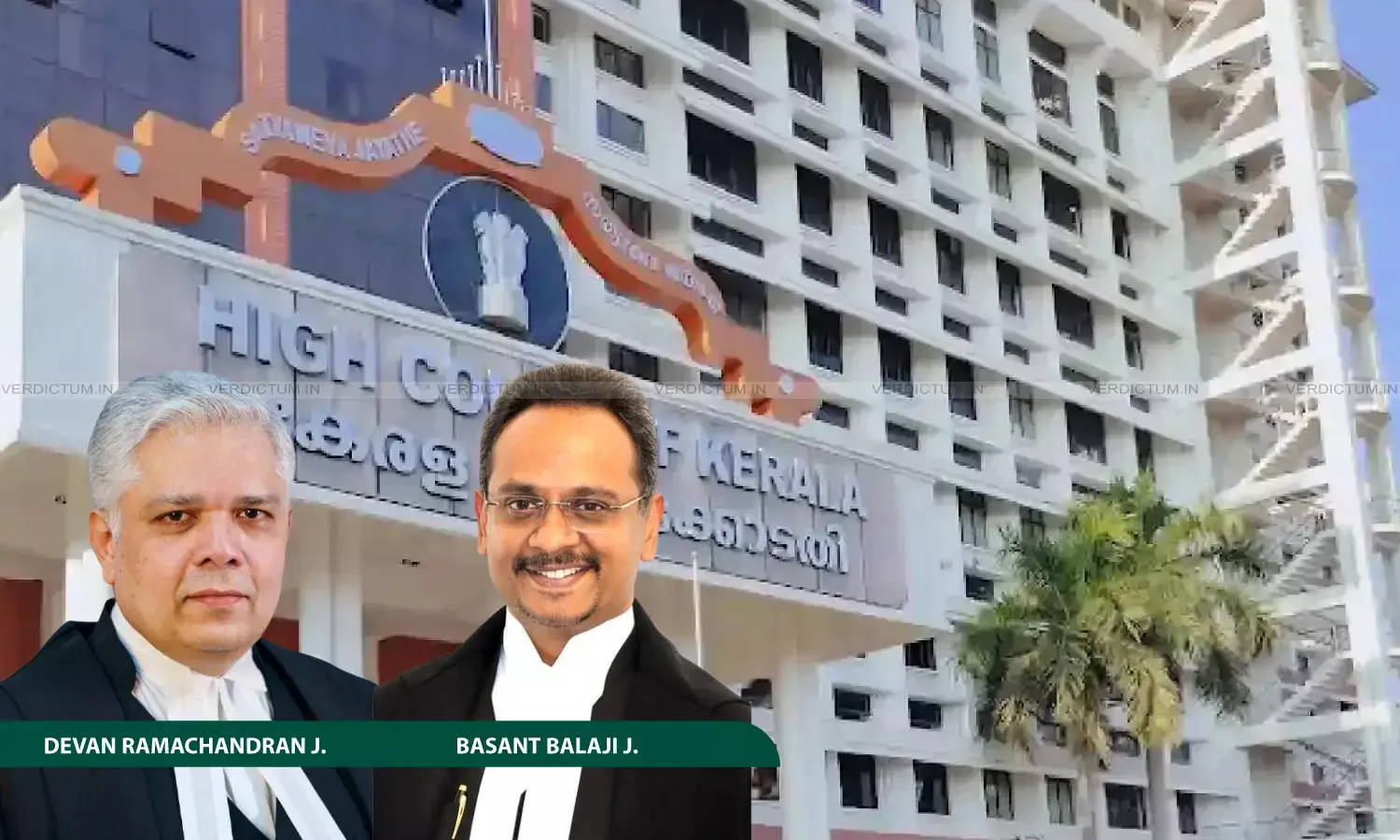
The Kerala High Court dismissed a petition filed by the Union of India challenging a Central Administrative Tribunal's (CAT) order that directed full medical reimbursement under the Central Government Health Scheme (CGHS) to a respondent whose wife underwent emergency life-saving surgery at a non-empanelled hospital.
The Court reaffirmed the settled legal position that the right to a medical claim cannot be denied solely because an emergency treatment for a grave ailment—such as a suspected advanced malignancy—was availed of at an unrecognized private institution, as the ultimate decision regarding the urgency and mode of treatment rests entirely with the expert medical professionals rather than the patient.
The Division Bench comprising Justice Devan Ramachandran and Justice Basant Balaji observed, "It then concludes clarifying that the right to medical claim cannot be denied solely because the hospital is not an empanelled one...In fact, the spirit of the afore judgment is available in Annexure A27, which is the Office Memorandum issued by the Government of India on 22.05.2018, which specifies that “treatment obtained in a private unrecognised hospital under emergency for treatment of advanced malignancy” would not disentitle a patient or applicant from the benefits under the CGHS...Applying the afore into the facts of this case, we obtain no reason to disbelieve the respondent, that his wife was suffering gravely even when she had been admitted to “V.G.Saraf Memorial Hospital” on 13.01.2021 because, its certificate, namely Annexure A8, records that she was having bleeding."
Senior Panel Counsel TC Krishna appeared for the Appellants, while Advocate Sudeep Aravind Panicker appeared for the Respondents.
Brief Facts
The respondent’s wife suffered from severe rectal bleeding and was initially admitted to a non-empanelled private hospital where a biopsy was performed under the suspicion of advanced malignancy. Following a temporary discharge, her clinical condition deteriorated rapidly, necessitating an emergency admission to another medical institution. She was subsequently subjected to a major laparoscopic colorectal surgery on an urgent, life-saving basis.
The respondent sought full medical reimbursement under the Central Government Health Scheme (CGHS), which led the appellants to contest the claim. The learned Central Administrative Tribunal, Ernakulam Bench, allowed the original application filed by the respondent, prompting the appellants to challenge the final order before the High Court.
Contentions of the Parties
The Appellants vehemently argued that the impugned order of the learned Tribunal was based purely on surmises and conjectures. It was submitted that the patient's ailment was not grave enough to constitute a medical emergency, and the fact that she moved between multiple hospitals indicated that the surgery was merely elective. Consequently, the appellants contended that the benefit of the landmark precedent in Shiva Kant Jha v. Union of India could not inure to the respondent.
Per contra, the Respondent strenuously refuted these allegations, pointing out that the medical certificates clearly established the precarious health condition of the patient. It was contended that the patient was in dire need of immediate medical intervention to manage a suspected advanced malignancy, which left the family with absolutely no time to search for a CGHS-empanelled facility.
Observations and Findings of the Court
The High Court observed that the medical certification issued by the treating hospital, which stood unchallenged, incontrovertibly established that the surgery was performed on an emergency, life-saving basis.
The Court placed strong reliance on the settled legal position that the ultimate decision regarding the mode and urgency of treatment vests solely with the medical experts, leaving little to no choice for the patient or their relatives.
The Court further observed that under the relevant Office Memorandum and prevailing jurisprudence, the right to medical reimbursement cannot be denied solely because the treatment was availed of at a non-empanelled private hospital during an emergency, particularly for advanced malignancies.
Finding no infirmity or illegality in the rationale adopted by the learned Tribunal, the High Court rejected the appellants' plea that the surgery was elective and dismissed the petition.
Cause Title: Union of India and Ors. v. KJ Joseph and Ors. [OP (CAT) NO. 53 OF 2025]
Appearances:
Petitioners: Senior Panel Counsel TC Krishna
Respondents: Advocate Sudeep Aravind Panicker, Advocate A.S. Dileep, Advocate P. Binod, Advocate K.Y. Sudheendran, Advocate Suseela Dileep, Advocate Srividya K, Advocate K.N. Harishankar
Click here to read/download the Judgment