

Kerala Administrative Tribunal Must Entertain Challenges To Vires Of Statutory Recruitment Rules As Court Of First Instance: Kerala High Court
The Court held that the Kerala Administrative Tribunal is bound to function as the court of first instance even in cases involving a challenge to the vires of statutory rules, except where the parent legislation creating the Tribunal itself is under challenge.
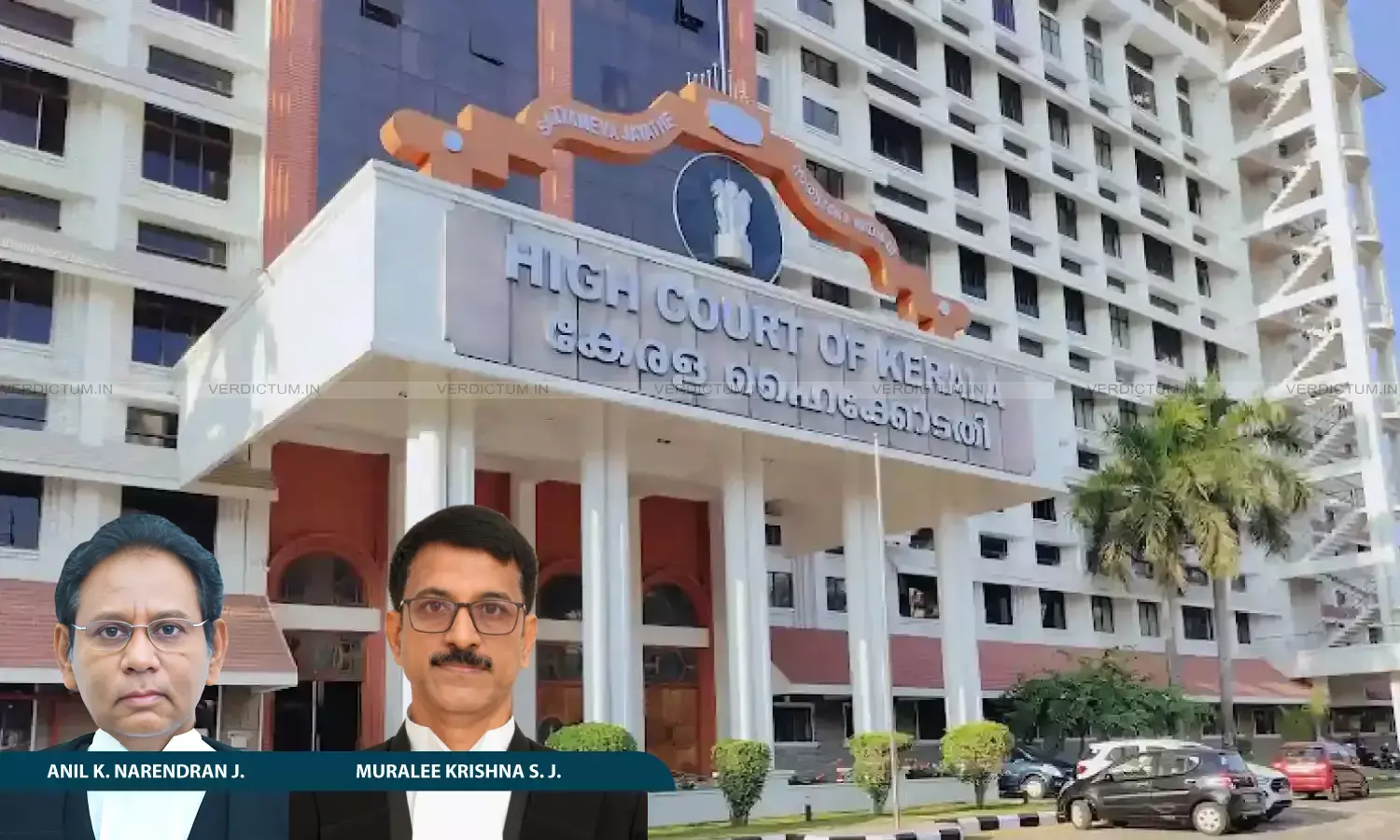
Justice Anil K. Narendran, Justice Muralee Krishna S., Kerala High Court
The Kerala High Court has held that the Kerala Administrative Tribunal cannot refuse to entertain original applications challenging the constitutional validity of statutory rules relating to recruitment and service matters on the ground of lack of jurisdiction.
The Court held that in view of the law laid down by the Constitution Bench in L. Chandra Kumar v. Union of India (1997), the Kerala Administrative Tribunal is required to act as the court of first instance in all matters falling within its jurisdiction, including cases involving a challenge to the vires of statutory legislation other than the Administrative Tribunals Act, 1985 itself.
The Court was hearing an original petition filed under Article 227 of the Constitution challenging an order of the Kerala Administrative Tribunal refusing to entertain a challenge against the constitutional validity of recruitment rules governing appointment to the post of Medical Officer (Manasik) in the Department of Indian Systems of Medicine.
A Division Bench of Justice Anil K. Narendran and Justice Muralee Krishna S. observed, “In view of the law laid down as above, the Kerala Administrative Tribunal will act like courts of first instance in respect of the areas of law for which it has been constituted. Therefore, even in cases where the vires of statutory legislation (except that of the Administrative Tribunals Act) is under challenge, litigants have to approach the Kerala Administrative Tribunal.”
Advocate T.C. Govindaswamy appeared for the petitioners. Princy Xavier, Senior Government Pleader, appeared for the respondents.
Background
The petitioners were applicants before the Kerala Administrative Tribunal in O.A.(EKM) No.613 of 2025, challenging the non-inclusion of the qualification of Postgraduate Diploma in Manasik Swasthya Vigyan (Ayurveda) as an eligible qualification for appointment to the post of Medical Officer (Manasik) in the Department of Indian Systems of Medicine.
The applicants sought declarations that the exclusion of the said qualification from the Kerala Public Service Commission notification and from the relevant Special Rules was arbitrary, discriminatory, unreasonable and unconstitutional. Consequential reliefs seeking quashing of the notification and amendment rules to that extent were also sought.
The Kerala Public Service Commission filed a reply statement before the Tribunal opposing the claims. Thereafter, the Tribunal considered the matter along with another connected original application and dismissed both matters through a common order dated 28.07.2025.
The Tribunal held that questions relating to the prescription of qualifications under Special Rules fell within the policy domain and legislative wisdom of the State Government. It further held that constitutional challenges against subordinate legislation could not be entertained by the Tribunal under Section 15(1)(a) of the Administrative Tribunals Act.
The Tribunal additionally observed that even if the applicants possessed a right to challenge the constitutional validity of the rules, such a challenge could only be pursued like “pro bono publico” before another appropriate forum and not before the Tribunal.
Aggrieved by the refusal of the Tribunal to entertain the challenge, the applicants approached the High Court, invoking supervisory jurisdiction under Article 227 of the Constitution.
Court’s Observation
The High Court first examined the statutory framework governing the Administrative Tribunals Act, 1985 and the constitutional scheme underlying Articles 323A and 323B of the Constitution.
The Court traced the legislative history of the Administrative Tribunals Act and noted that the enactment was intended to provide adjudication of disputes relating to recruitment and conditions of service of persons appointed to public services and posts under the Union and the States.
The Bench thereafter extensively referred to the Constitution Bench judgment in L. Chandra Kumar v. Union of India (1997).
The Court observed that the Constitution Bench had declared unconstitutional those portions of Article 323A, Article 323B and Section 28 of the Administrative Tribunals Act which excluded the jurisdiction of the High Courts under Articles 226 and 227 of the Constitution.
At the same time, the Constitution Bench had specifically held that Administrative Tribunals would continue to function as courts of first instance in service matters falling within their jurisdiction, and litigants could not bypass the Tribunal merely because they intended to challenge the vires of statutory rules.
The Bench observed: “It will not, therefore, be open for litigants to directly approach the High Courts even in cases where they question the vires of statutory legislation (except where the legislation which creates the particular Tribunal is challenged) by overlooking the jurisdiction of the Tribunal concerned.”
The High Court thereafter referred to the decision of the Supreme Court in Kendriya Vidyalaya Sangathan v. Subhas Sharma (2002), wherein the Apex Court reiterated that service disputes falling within the jurisdiction of Administrative Tribunals must first be adjudicated by the Tribunal and that High Courts should not directly entertain such matters.
The Court also relied upon the Division Bench judgment of the Kerala High Court in Sadhiq M.M. v. State of Kerala (2025, wherein it had already been held that both the Central Administrative Tribunal and the Kerala Administrative Tribunal are competent to examine vires of statutory legislation other than their parent enactment.
The Bench observed: “The Central Administrative Tribunal, Ernakulam Bench and the Kerala Administrative Tribunal will act like courts of first instance in respect of the areas of law for which they have been constituted.”
The Court clarified that the only exception recognised in law is where the vires of the Administrative Tribunals Act itself is challenged, since a Tribunal created under the statute cannot adjudicate upon the constitutional validity of its own parent legislation.
Applying these principles to the facts of the case, the High Court held that the reasoning adopted by the Tribunal for refusing to entertain the original application was legally unsustainable and directly contrary to binding precedents.
The Court found that the challenge raised by the petitioners related to recruitment rules governing appointment to a public post and squarely fell within the jurisdiction of the Kerala Administrative Tribunal under the Administrative Tribunals Act.
The Bench also noted that in an earlier connected matter arising from O.A.(EKM) No.595 of 2025, the High Court had already set aside an identical order passed by the Tribunal and remanded the matter for fresh consideration on merits.
Conclusion
The Kerala High Court allowed the original petition and set aside the order dated 28.07.2025 passed by the Kerala Administrative Tribunal in O.A.(EKM) No.613 of 2025.
The matter was remanded to the Tribunal for consideration on the merits in accordance with the law after notice to all parties.
Cause Title: Dr Sumith S. Pillai & Ors. v. State of Kerala & Ors. (Neutral Citation: 2026:KER:34420)
Appearances
Petitioners: Advocates T.C. Govindaswamy, Kala T. Gopi, Kailesh T. Gopi, Nishitha Balachandran, Akhila S.
Respondents: Princy Xavier, Senior Government Pleader, Advocates P.C. Sasidharan & S. Ganesh
