

Offence U/S 324 IPC Can’t Be Regarded As Minor Offence To Offence U/S 332 IPC Within Meaning Of Section 222 CrPC: Kerala High Court
The Kerala High Court was considering a criminal revision petition filed under Sections 397 and 401 of the Code of Criminal Procedure.

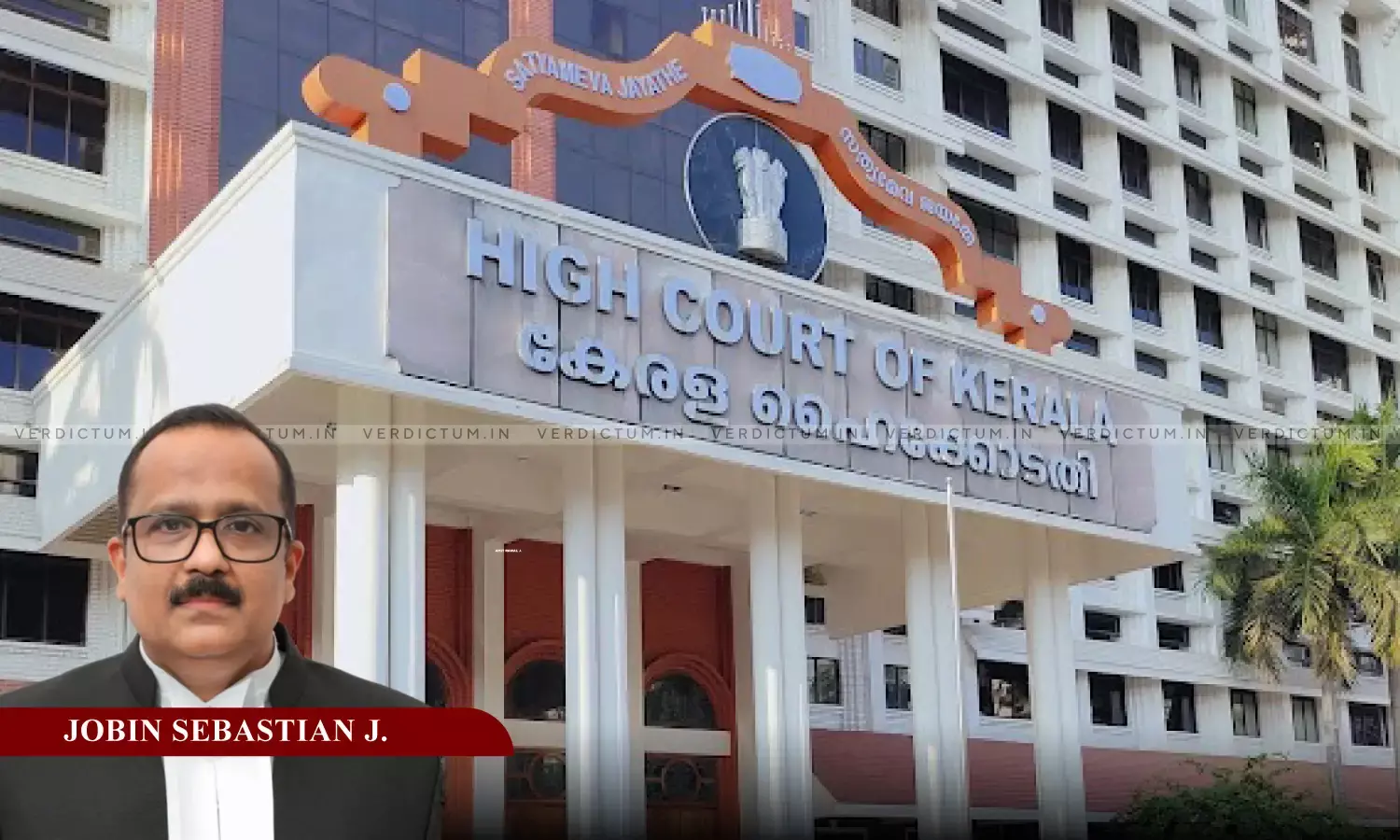
Justice Jobin Sebastian, Kerala High Court
While observing that Section 324 of the Indian Penal Code IPC cannot be regarded as a minor offence of Section 332 within the meaning of Section 222 of the CrPC (Code Of Criminal Procedure), the Kerala High Court has held an accused guilty under Section 323 of the Indian Penal Code for voluntarily causing hurt to a Police Constable while he was discharging his duties.
The High Court was considering a criminal revision petition filed under Sections 397 and 401 of the Code of Criminal Procedure, challenging the judgment of conviction passed against the revision petitioner for the offence punishable under Section 324 of the Indian Penal Code by the Judicial First Class Magistrate Court-II, Ernakulam, which was confirmed in appeal by the Additional Sessions Court.
The Single Bench of Justice Jobin Sebastian held, “Therefore, a conviction for a minor offence in the absence of a specific charge would be legally sustainable only if the ingredients necessary to constitute the minor offence are already embedded in the offence charged.”
“Therefore, the offence punishable under Section 324 IPC cannot be regarded as a minor offence of Section 332 of the IPC within the meaning of Section 222 of the Cr.P.C. Consequently, in the absence of a specific charge under Section 324 of the IPC, the judgment of conviction and the order of sentence passed by the trial court, which was affirmed in appeal, for the said offence cannot be legally sustained”, it added.
Advocate C. P. Udayabhanu represented the Petitioner, while Public Prosecutor U. Jayakrishnan represented the Respondent.
Factual Background
The three accused persons were employees on a private bus. The first accused drove the bus at an overspeed, which was questioned by a Police Constable. Infuriated by the same, all the accused, in furtherance of their common intention, showered abuses against the Constable and the first accused, stabbed him on the neck with a screwdriver, thereby voluntarily causing hurt. The second and third accused also assaulted him by fisting and beating him repeatedly. According to the prosecution, at the relevant time, the Constable (PW1) was in the discharge of his official duties, and the accused acted with an intention to deter him from discharging the said duty. Thus, the accused was alleged to have committed the offences punishable under Sections 294(b) and 332 read with Section 34 of the IPC.
Reasoning
The Bench took note of the allegation that a police officer was attacked by the accused while he was engaged in the discharge of his official duties. It was noticed by the Bench that there was a specific allegation that in the said unfortunate incident, the said police officer had sustained injuries. On a perusal of the evidence of the Constable, the Bench noted that he had given evidence in a convincing manner and the same was free from omissions and contradictions of even a minor nature. “Moreover, the trial court as well as the appellate court had correctly found that PW1, being an injured witness, his evidence has to be accorded a special status in law”, it added.
Coming to the charges imposed upon the accused, the Bench explained that the accused was charged for the offence punishable under Section 332 of IPC and to attract Section 332 of IPC, the prosecution must establish that the accused voluntarily caused hurt to a public servant while such public servant was acting in the discharge of his official duty, or with intent to deter or prevent him from discharging such duty. However, Section 324 IPC contains an additional and distinct ingredient, namely, that the hurt should have been caused by means of a dangerous weapon or means.
Noting that the use of a dangerous weapon or means is an essential constituent of the offence under Section 324 of the IPC, the Bench held that the ingredients necessary to constitute an offence under Section 324 of the IPC are not inherently included in the ingredients of Section 332.
Considering that both Sections 324 and 332 of the IPC prescribe the same maximum punishment, namely, imprisonment of either description for a term which may extend to three years or with fine or with both, the Bench held that the offence punishable under Section 324 IPC cannot be regarded as a minor offence of Section 332 of the IPC within the meaning of Section 222 of the Cr.P.C. “Consequently, in the absence of a specific charge under Section 324 of the IPC, the judgment of conviction and the order of sentence passed by the trial court, which was affirmed in appeal, for the said offence cannot be legally sustained”, it clarified.
The Bench was of the view that the act of the accused would undoubtedly constitute an offence punishable under Section 323 of the IPC for voluntarily causing simple hurt. Taking all such aspects into consideration, the Bench held that Section 324 IPC was unsustainable in the absence of a specific charge and the materials on record established the commission of an offence punishable under Section 323 IPC.
Thus, allowing the revision in part, the Bench set aside the conviction and sentence imposed on the revision petitioner for the offence punishable under Section 324 IPC. “Instead, the revision petitioner is found guilty and convicted for the offence punishable under Section 323 IPC”, it ordered while also directing, “Accordingly, the revision petitioner is sentenced to undergo imprisonment till the rising of the Court and to pay a fine of Rs.1,000/- (Rupees One Thousand only). In default of payment of fine, he shall undergo simple imprisonment for a period of seven days.”
Cause Title: Babu Avarachan v. State of Kerala (Neutral Citation: 2026:KER:35293)