

Directly Recruited District Judges With Postgraduate Law Degree Entitled To Three Advance Increments From July 01, 1996: Kerala High Court
The Bench quashed prospective-only operation of Government Order, holding the benefit was “not a new benefit” but an adjunct of the Shetty Commission recommendations, and that the State and High Court must act “in the spirit of collaboration” on judicial pay.

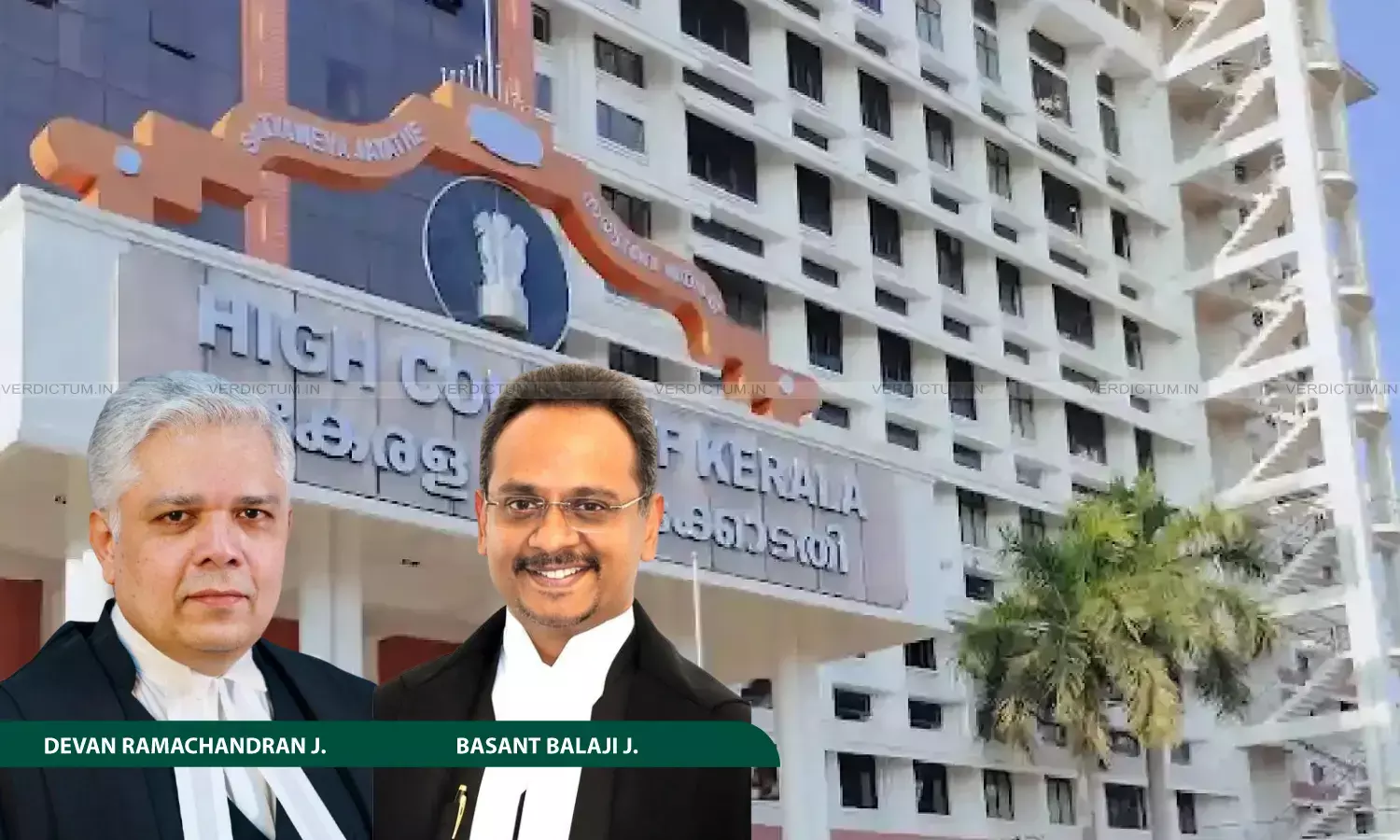
The Kerala High Court has held that the State Government could not have rejected the High Court’s request to extend three advance increments to directly recruited District Judges holding a postgraduate degree in law, particularly after it had accepted the Shetty Commission recommendations for Munsiffs/Magistrates and granted them the benefit from July 01, 1996.
The Division Bench set aside a Single Judge’s ruling that the Government could fix a cut-off date for a fresh benefit. It held that the benefit was not a new one but an adjunct of the Shetty Commission Report, and that the Government’s description of it as “leniency” could not be approved. The Court quashed the prospective-only operation of the Government Order and directed that the appellant and similarly placed officers receive the benefit from July 01, 1996.
A Bench of Justice Devan Ramachandran and Justice Basant Balaji observed, “Admittedly, the ‘Shetty Commission Report’ has ordered the monetary benefits flowing from its recommendations, to be with effect from 01.07.1996. This is why the High Court, in Exts.P7, P9, P11 and P13, made specific request that the directly recruited District judges with Post Graduation in Law be granted the benefits of the three advance increments with effect from the afore date, namely 01.07.1996. 38. In our firm view, the Government could not have rejected this request, particularly after it had accepted the recommendations of the ‘Shetty Commission’ with respect to Munsiff/Magistrates, then granted benefits with effect from 01.07.1996 as stipulated in the said report”.
Senior Advocate George Poonthottam appeared for the appellant and K.C. Vincent, Additional Advocate General appeared for the respondent.
“Even when the Government says that the grant of benefits as mentioned in Ext.P8 order is “in leniency and not as a matter of right”, it requires to be adverted to that, what the High Court requested vide Ext.P7 was nothing but a corollary of the recommendations in the “Shetty Commission Report.” As recorded by the Finance Committee of Judges in Annexure D minutes,the Shetty Commission never intended to exclude District Judges at the entry cadre and that any such can only be seen to be hostile discrimination”, the Bench noted.
The Shetty Commission, the First National Judicial Pay Commission, recommended three advance increments for Civil Judges (Junior Division) with higher qualifications, such as a postgraduate degree in law. The Supreme Court approved the recommendations in 2002, though not this one. The Government of Kerala accepted them through an order dated March 28, 2007, and, after litigation by Judicial Officers, extended the increments to Munsiffs/Magistrates from July 01, 1996.
The appellant, Justice A.V. Ramakrishna Pillai, was recruited as a District Judge from the Bar in 1995 with a postgraduate law degree. He was elevated to the High Court on January 18, 2012 and retired on November 24, 2015. At the High Court’s request, the Government issued Ext.P8 order dated November 22, 2013, extending the benefit to such District Judges, but only prospectively. The High Court’s repeated requests for retrospective operation were rejected, the Government stating that the benefit was “not as a matter of right but leniency”.
The Registrar had pointed out that fewer than ten officers were affected, a “vanishing group”. The Single Judge dismissed the writ petition on November 13, 2018, leading to this appeal.
The Court noted that the Finance Committee of Judges had found that the Commission never intended to exclude District Judges at the entry cadre, as exclusion would be hostile discrimination. It recorded that, following Kauser Edappagath v. State of Kerala 2017 (2) KHC 703, accepted by the Government, every directly recruited District Judge with a postgraduate law degree was entitled to the benefit irrespective of the date of entry, leaving only the question “from when”.
Referring to State of Rajasthan v. Ramesh Chandra Mundra 2019 (4) SCT 360 (SC), it held that on pay and allowances of Judicial Officers the two institutions must act cohesively. Since the benefit was not new, the finding that a cut-off could be fixed was untenable.
The Court allowed the appeal, set aside the Single Judge’s judgment, and quashed Ext.P8 to the extent it operates only prospectively. It also quashed the Government’s contrary communications in Exts.P10, P12 and P14, and directed that the appellant and similarly placed officers be entitled to the benefit from July 01, 1996.
Cause Title: A.V. Ramakrishna Pillai v. State of Kerala & Ors. (Neutral Citation: 2026:KER:75152)
Appearances:
Appellant: Senior Advocate George Poonthottam, Advocates Nisha George and A.L. Navaneeth Krishnan.
Respondent: Additional Advocate General K.C. Vincent and Senior Government Pleader P.M. Rafeek, Advocate M.R. Anison.