

Information Passed By ED To DGP Would Show Sufficient Materials: Kerala High Court While Ordering FIR Against Pinarayi Vijayan & Family Members
The Court set aside special team formed by State Police Chief for preliminary enquiry, said that ED information is an adequate substitute, and noted the obligation is subject to an exemption where the information lacks material to register FIR.

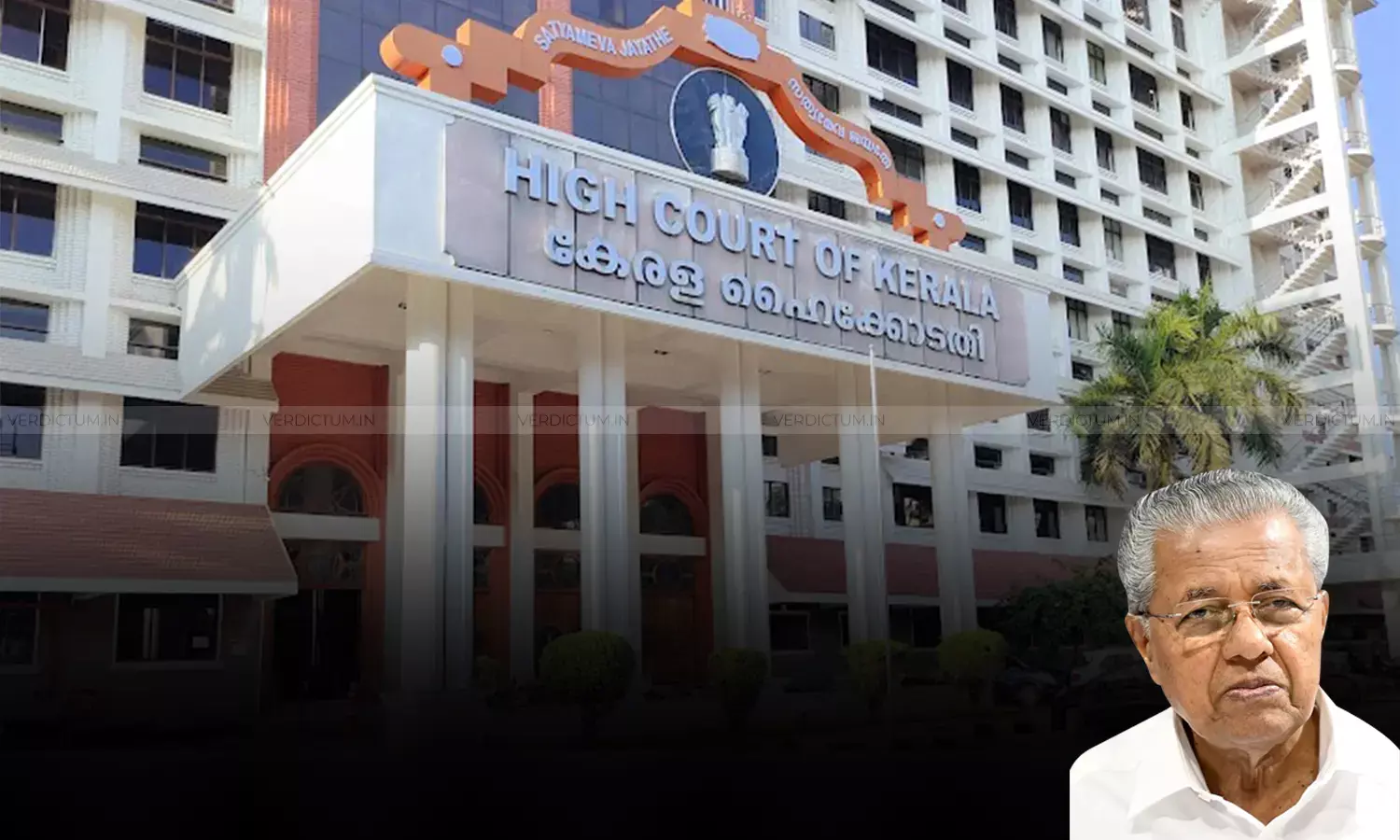
The Kerala High Court has observed that the information passed by the Enforcement Directorate to the State Police Chief shows sufficient materials, including statements of many witnesses and the suspected persons, to register an FIR in CMRL Bribery Case. It directed the Director, Vigilance and Anti-Corruption Bureau, to register an FIR forthwith against the suspected persons named in the ED’s information under Section 66(2) of the Prevention of Money Laundering Act, 2002. They include former Chief Minister Pinarayi Vijayan, his daughter Veena T and former Minister Mohammed Riyas, for offences under the Prevention of Corruption Act, 1988.
Setting aside the State Police Chief’s order constituting a nine-member special team for a preliminary enquiry, the Court held that such information is an adequate substitute for a preliminary enquiry report. The obligation is subject to an exemption: where the information lacks material to register an FIR, an independent evaluation remains open. The Court also held that the State Police Chief cannot constitute a Special Investigation Team without a Government decision under Section 21(1) of the Kerala Police Act, 2011. The allegations are the ED’s, and the Court has recorded no finding on them.
A Bench of Justice A. Badharudeen observed, “…apart from the note books and diaries, the information passed by the E.D. to the DGP, would show sufficient materials including statements of many witnesses and the suspected persons and other materials referred in the information, as extracted hereinabove. Most importantly, many materials referred to in the information have been collected after dismissal of the above revision petitions and the same, in fact, led to passing of an information under Section 66(2) of the PMLA for registering FIR. Therefore, above proceedings and order of this Court or by the Hon’ble Apex Court would not stand in the way of an effective investigation based on sufficient materials disclosed in the information under Section 66(2) of the PMLA”,
Advocate V. Sethunath appeared for the petitioner and Advocate General K. Jaju Babu appeared for the respondent.
“…when an information under Section 66(2) of the PMLA is forwarded for registering FIR based on the inputs in the investigation initiated by the E.D. disclosing commission of a scheduled offence or offences for which State Police is only having competence to register FIR, it is obligatory (must do) for the State Police to register FIR for the offences disclosed in the information passed under Section 66(2) of the PMLA. But, this obligation is subject to an exemption. That is to say, the disclosure by the Enforcement Directorate would not exempt the notified government agencies from undertaking an independent evaluation to ascertain whether the accused has contravened any statutory provisions, when the information passed under Section 66(2) of the PMLA lacks materials to register FIR; i.e. which did not disclose inputs for registering FIR. Thus, exemption comes into play only on the basis of the facts and circumstances of each case and the scope for addition to the information communicated under Section 66(2) of the PMLA by way of another enquiry without registering FIR is too remote and trivial”, it noted further.
The petitioner, an advocate and social activist, sought directions on his applications (Exts. P1 and P2) for registration of an FIR on information passed by the ED. The ED’s 25-page communication of September 07, 2026 arose from its PMLA investigation based on an SFIO complaint concerning Cochin Minerals and Rutile Limited. It sought registration of an FIR under the Prevention of Corruption Act, 1988 against several persons, including a former Chief Minister and a former Minister.
Instead of registering an FIR, the State Police Chief issued Ext. P9 in September 2026, constituting a nine-member special team to conduct a preliminary enquiry. The petition was heard on admission on September 29, 2026, and the Court framed the question of whether the State Police has any option other than registering the FIR. The Advocate General argued that a preliminary enquiry remained available and also challenged the petitioner’s locus standi.
The Court rejected the locus objection, holding that the petitioner could sue as a citizen and whistle-blower aggrieved by the rejection of his petitions. On the merits, it relied on Vijay Madanlal Choudhary, Lalita Kumari, Charan Singh and Pradeep Nirankarnath Sharma. It held that the ED’s information contained sufficient material to register an FIR and that no further enquiry could add to it. It noted that earlier revision petitions concerning private complaints were no bar, as the considerations differ when a competent agency finds offences on investigation. It also held that the State Police Chief cannot constitute a Special Investigation Team without a Government decision under Section 21(1) of the Kerala Police Act, 2011.
The Court allowed the petition and set aside Ext. P9. It directed the Director, Vigilance and Anti-Corruption Bureau, to register an FIR forthwith on the ED information against the suspected persons named in it, investigate through competent VACB officers and file the final report without much delay. The State Police Chief or the head of the special team must hand over the information to the Director, and the ED must forward all necessary documents.
Cause Title: Adv. K.M. Shajahan v. State of Kerala & Ors. (Neutral Citation: 2026:KER:78014)
Appearances:
Petitioner: V. Sethunath, Thomas Abraham and Shamnas S., Advocates.
Respondents: Advocate General K. Jaju Babu, Rema R., Special Public Prosecutor, and Sajeevan P.K., Special Public Prosecutor, Jaishankar V. Nair, Standing Counsel.