

Family Court Can’t Deny Divorce On Ground That Couple Was Residing Separately For No Reason When There Is Mutual Consent: Kerala High Court
The appeal before the Kerala High Court was filed by the wife challenging the judgment disallowing the prayer for dissolution of marriage.

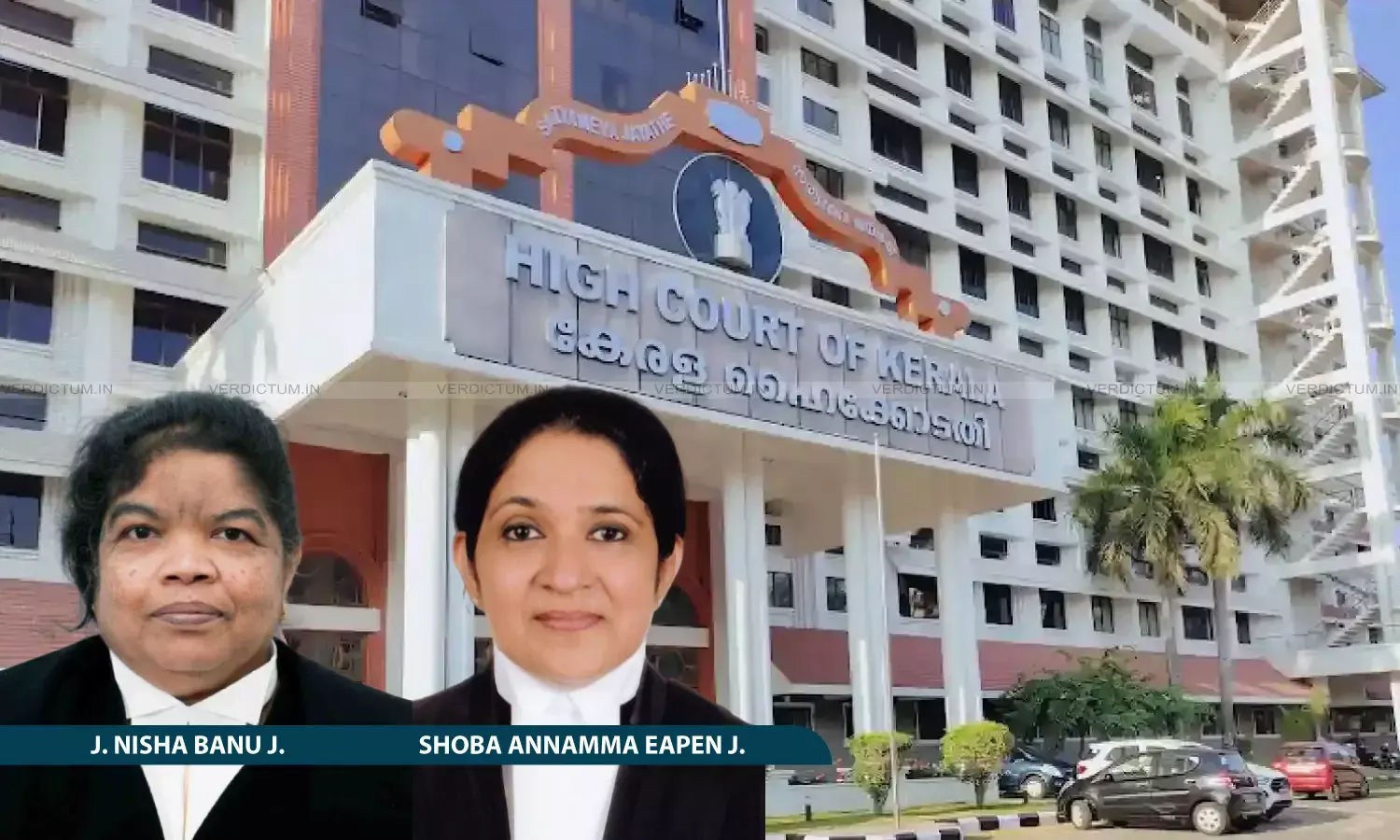
Justice J. Nisha Banu, Justice Shoba Annamma Eapen, Kerala High Court
Taking note of the fact that a couple had mutually consented to divorce, the Kerala High Court has set aside an order of the Family Court dismissing a petition for dissolution of marriage under the Divorce Act on the ground that the couple was residing separately for no reason.
The appeal before the High Court was filed by the wife challenging the judgment and decree disallowing the prayer for dissolution of marriage under Section 10-A of the Divorce Act, 1869.
The Division Bench of Justice J. Nisha Banu and Justice Shoba Annamma Eapen held, “In a petition filed under Section 10A, the Family Court is required to make such inquiry as it thinks fit, that a marriage has been solemnised and that the averments in the petition are true and to pass a decree declaring the marriage to be dissolved with effect from the date of decree. Admittedly, Annexure A1 joint petition was filed by the appellant and the respondent. During examination, the respondent had categorically stated that he wants divorce. The Family Court ought to have looked into the aspects of whether there was a valid marriage, a mutual consent petition is filed by the parties and whether they are agreeable for a divorce.”
“In the present case, there is no withdrawal of any consent as seen from the depositions of PWs.1 and 2. Hence, the Family Court ought not have dismissed the petition for divorce. Considering the aforesaid facts of the case, we are inclined to grant a decree of divorce”, it added.
Advocate Gisa Susan Thomas represented the Appellant.
Factual Background
The marriage between the parties was solemnised in the year 2023 at the Church as per the rites and rituals prevailing in the Roman Catholic Christian Community. Subsequently, their marriage was also registered before the Local Registrar. After marriage, the appellant and respondent resided together as husband and wife in the matrimonial home. Thereafter, owing to differences between the parties, the appellant left the matrimonial home. Despite conciliation efforts undertaken by both families, the couple mutually decided to separate, as they were unable to lead a harmonious married life.
The original petition was filed seeking divorce by mutual consent before the Family Court. After the cooling period of six months, the parties underwent counselling, and the attempt for reunion was not materialised. The Family Court dismissed the original petition, observing that the respondent had stated that they were living separately without any valid reason, and further finding that there was no mutual consent between the parties. Aggrieved thereby, the wife filed the appeal.
Reasoning
On a perusal of the facts of the case, the Bench noted that the witness had deposed before the Trial Court that they were living separately for no reason.
The Bench held that both the wife and the husband, who are the appellant and the respondent respectively, had clearly stated before the Family Court that both of them wanted a divorce. As per the Bench, there was thus no reason for the Family Court to conclude that there was no mutual consent.
“Hence, the finding that one of the parties had withdrawn consent, and that a decree of divorce by mutual consent could not be granted, is unwarranted”, it added.
In the absence of withdrawal of any consent as seen from the depositions of the parties and taking note of the aforementioned aspects, the Bench allowed the appeal and ordered the dissolution of the marriage.
Cause Title: A v. B (Neutral Citation: 2026:KER:28555)
Appearance
Appellant: Advocates Gisa Susan Thomas, G.Ashwini, A.R. Divya