

Police Cannot Restrict Extended Bar Hours On Mere Apprehension Of Law & Order Problem: Kerala High Court Sets Aside Notice Barring DJ Parties After 11 PM
The High Court set aside police notices barring DJ parties after 11 p.m. at a five-star hotel, holding that the mere possibility of criminal activities cannot justify curbing hours permitted under the Foreign Liquor Rules.

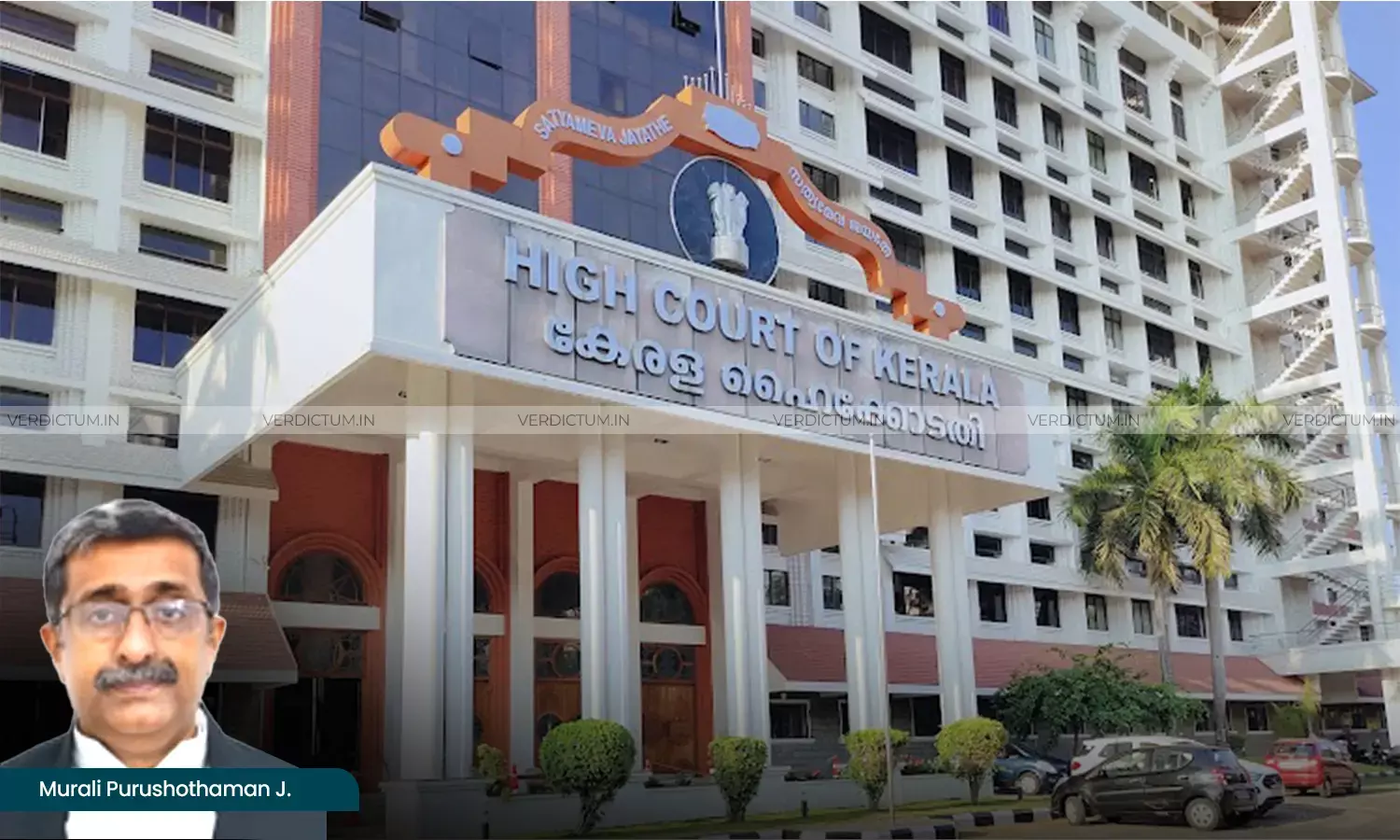
Justice Murali Purushothaman, Kerala High Court
The Kerala High Court has held that the Police cannot interfere with the business of an FL-3 licensed five-star bar hotel and curtail the extended operating hours permitted under the Foreign Liquor (Amendment) Rules, 2026, merely because of an apprehension that a law and order problem may arise.
The Court set aside the notices issued by the Station House Officer, Kadavanthra, and the Assistant Commissioner of Police, Ernakulam Central, which restrained the hotel from conducting DJ parties beyond 11:00 p.m. and from functioning beyond midnight.
The Court further held that the Police Commissioner remains empowered to issue preventive directions against noise pollution under Section 77 of the Kerala Police Act or Rule 8 of the Noise Pollution (Regulation and Control) Rules, 2000, subject to the procedures contemplated therein, and that where criminal activities are suspected, it is the responsibility of the Police to take stringent action in accordance with law.
The Bench of Justice Murali Purushothaman observed, “The Police cannot, merely on the basis of an apprehension that a law and order problem may arise, interfere with the petitioner’s business and compel the closure of the hotel before the permissible closing time stipulated in Ext. P4. If any offence is committed by any person, it is the responsibility of the police to take stringent action against anti-social elements who indulge in illegal activities, use narcotic substances, or facilitate any other unlawful activities that create law and order problems.”
Advocate Anand Kalyanakrishnan appeared for the Petitioner, while Additional Advocate General P.A. Mohammed Shah appeared for the Respondents.
Brief Facts
The petitioner, Mahadevan, is the licensee of an FL-3 bar hotel at Ernakulam having five-star classification. By Ext. P3 notification, the Government of Kerala amended Rule 28(1) of the Foreign Liquor Rules, 1953, permitting FL-3 licensed bar hotels with five-star classification and above to function for an additional three hours after the permissible closing time on payment of an additional annual rental of ₹5,00,000, in the interest of promoting MICE tourism, destination weddings and international conferences.
The petitioner alleged that the SHO was constantly harassing him and his staff by issuing repeated notices against conducting DJ parties. The notice directed the hotel not to function beyond midnight and to stop celebrations using loudspeakers after 10:00 p.m. It stated that DJ parties were being regularly conducted with lots of young men and women participating, that quarrels occurred under consumption of narcotic substances, and directed the petitioner to refrain from conducting DJ parties until further orders.
The Assistant Commissioner of Police issued another notice directing all bars in the Central Sub-Division to stop operations by midnight and to stop DJ parties by 11:00 p.m. Then an FIR was registered against the petitioner under Section 223 of the Bharatiya Nyaya Sanhita, 2023 for conducting a DJ party till 3:00 a.m., in violation of Exts. P6 and P7.
Contentions of the Parties
The petitioner contended that the allegation of conducting DJ parties was untrue and that he only ran the bar till the time permitted by the Excise Department’s order. He argued that the harassment by the police officials infringed his fundamental right under Article 19(1)(g) of the Constitution and that an extension granted by the Excise Department on payment of additional rental could not be curtailed by police officers. He also pointed out that theatres and places of worship drew large crowds late into the night, and contended that restrictions in the guise of law and order were not permissible.
The Commissioner of Police, Ernakulam City, who was impleaded as the additional sixth respondent, contended that an FL-3 licence was confined to the service of liquor and meals within the licensed premises and did not authorise high-decibel DJ events or large-scale gatherings.
He submitted that the amendment to the Foreign Liquor Rules did not override the statutory powers of the police under the Kerala Police Act, 2011, and that Sections 4(d), (e) and (g) and Sections 77 to 79 justified the restrictions as preventive measures. He relied on incidents and cases registered at Kadavanthra Police Station involving narcotic drugs, assault, rioting and damage to property, and produced a list of 27 criminal cases in Kochi City related to late-night events.
Observations/Findings of the Court
The Court noted that the petitioner’s entitlement to keep the premises open for an additional three hours, until 3:00 a.m., except on the eve of a statutory dry day, was not disputed in the statement filed by the additional 6th respondent. The question, therefore, was whether restrictions could be imposed on entertainment activities, including DJ programmes, after 11:00 p.m. and during the additional three hours.
On the nature of the activity, the Court observed, “DJing, whether regarded as a technical craft or a form of performance art, is neither a prohibited craft nor a prohibited art.”
It held that persons participating in a DJ party have the fundamental right under Article 19(1)(b) to assemble peaceably and without arms, subject to reasonable restrictions under Article 19(3), and that the petitioner has the fundamental right under Article 19(1)(g), subject to Article 19(6). The Court added that the right of every person living in the vicinity to live free from noise pollution is an integral part of the right to life and personal liberty under Article 21.
Turning first to the concern of noise pollution, the Court examined Section 77 of the Kerala Police Act and Rules 5 to 8 of the Noise Pollution Rules, noting that “night time” is defined as the period between 10:00 p.m. and 6:00 a.m. and that Rule 5(2) prohibits the use of loudspeakers and sound-producing instruments at night, except in closed premises for communication within or during a public emergency.
It held that Article 19(1)(g) does not guarantee a fundamental right to carry on any trade, occupation or business in a manner that causes pollution or adversely affects public health, peace and tranquillity, and observed, “The willingness of an audience to listen to the playing of high-decibel DJ music does not, by itself, justify exposing person who dwells or lives in the vicinity to such sound against their wishes.”
Relying on Jacob v. Superintendent of Police [1992] and Forum, Prevention of Environmental and Sound Pollution v. Union of India [AIR 2005], the Court held that where high-decibel music at DJ parties violates the night-time restrictions or the prescribed ambient noise standards, the Police Commissioner is empowered to issue preventive directions under Section 77 of the Kerala Police Act or Rule 8 of the Noise Pollution Rules.
Since the Police themselves permit such parties until 11:00 p.m., it observed, “If criminal activities are indeed taking place in connection with such parties, it is difficult to understand how merely restricting their operation after 11:00 p.m. would prevent such activities. There is no apparent rationale for presuming that the possibility of criminal activities would cease to exist before midnight or that the incidence of crime would necessarily increase after midnight.”
The Court held that if the Government intends to impose restrictions on such activities on grounds of public peace and order, it is for the Government to frame appropriate rules carving out the necessary exceptions to the extended hours permitted under the Foreign Liquor (Amendment) Rules, 2026.
The Court cautioned, “To borrow a proverb, ‘Burn not your house to fright away the mice." On the concern of traffic disruption, it observed, “If the congregation of large crowds in connection with DJ parties results in traffic disruption, it is the duty of the Police to regulate and control traffic under Section 61 of the Kerala Police Act, rather than compelling the hotel to close before the permissible closing time.”
The Court held that the notices issued by the SHO were without jurisdiction. As regards Section 79, it observed that the provision confers “a power to permit, control and regulate, and not a power to impose an indefinite prohibition,” and held that an order issued by the Commissioner under that provision can remain in force for a period not exceeding fifteen days from the date of its proclamation and cannot be permanent in nature, it being for the Government to extend the validity of such a notification under Section 79(1).
The Court disposed of the writ petition and set aside the impugned notices. It held that, in light of the Foreign Liquor (Amendment) Rules, 2026, and the order of the Deputy Commissioner of Excise, the petitioner’s hotel was entitled to function for an additional three hours after the permissible closing time, that is, until 3:00 a.m., for the relevant financial year, except on the eve of a statutory dry day, when the hotel had to stop operations at midnight.
The Court directed that, until the Government framed appropriate rules prescribing exceptions to the extended hours of operation, the Police could not curtail or restrict the operating hours of hotels contrary to the permission granted under those Rules in the absence of sufficient grounds justifying such restrictions.
It added that “the mere possibility of criminal activities cannot, by itself, constitute sufficient justification for imposing restrictions under the Kerala Police Act on the extended operating hours of the FL-3 hotel permitted under the Foreign Liquor (Amendment) Rules, 2026.”
On noise pollution, the Court held that where high-decibel music played at DJ parties or other entertainment events involving sound-producing instruments violated the night-time restrictions, except in circumstances expressly exempted under Rule 5(2) of the Noise Pollution Rules, or where the prescribed ambient noise standards for the area were violated, the Police Commissioner was empowered to issue preventive directions under Section 77 of the Kerala Police Act or Rule 8 of the Noise Pollution Rules. Such directions could prohibit, control or regulate the occurrence or continuance of noise pollution, subject to compliance with the procedures contemplated therein.
The Court further directed that if the Police had reason to believe that criminal activities, including the use of narcotic substances, were taking place under the guise of DJ parties or other entertainment programmes in hotels, it was their responsibility to take stringent action in accordance with law to curb the same.
Finally, it clarified that an order issued under Section 79 of the Kerala Police Act could remain in force for a period not exceeding fifteen days from the date of its proclamation and could not be permanent in nature, and that it was for the Government to extend the period of validity of a notification issued under Section 79(1).
Cause Title: Mahadevan v. State of Kerala & Ors. [Neutral Citation: 2026:KER:85771]
Appearances:
Petitioner: Advocates Anand Kalyanakrishnan, S. Rajeev, C. Dheeraj Rajan, V. Vinay, M.S. Aneer and Libin Varghese
Respondents: Additional Advocate General P.A. Mohammed Shah, Government Pleader Renoy Vincent