

Distant Relatives Not Related To Husband By Blood, Marriage Or Adoption Cannot Be Prosecuted In Dowry Death Cases: Karnataka High Court
The Bench noted that "soon before death" not synonymous with "immediately before death", directed proceedings against husband, in-laws and brother-in-law to continue.

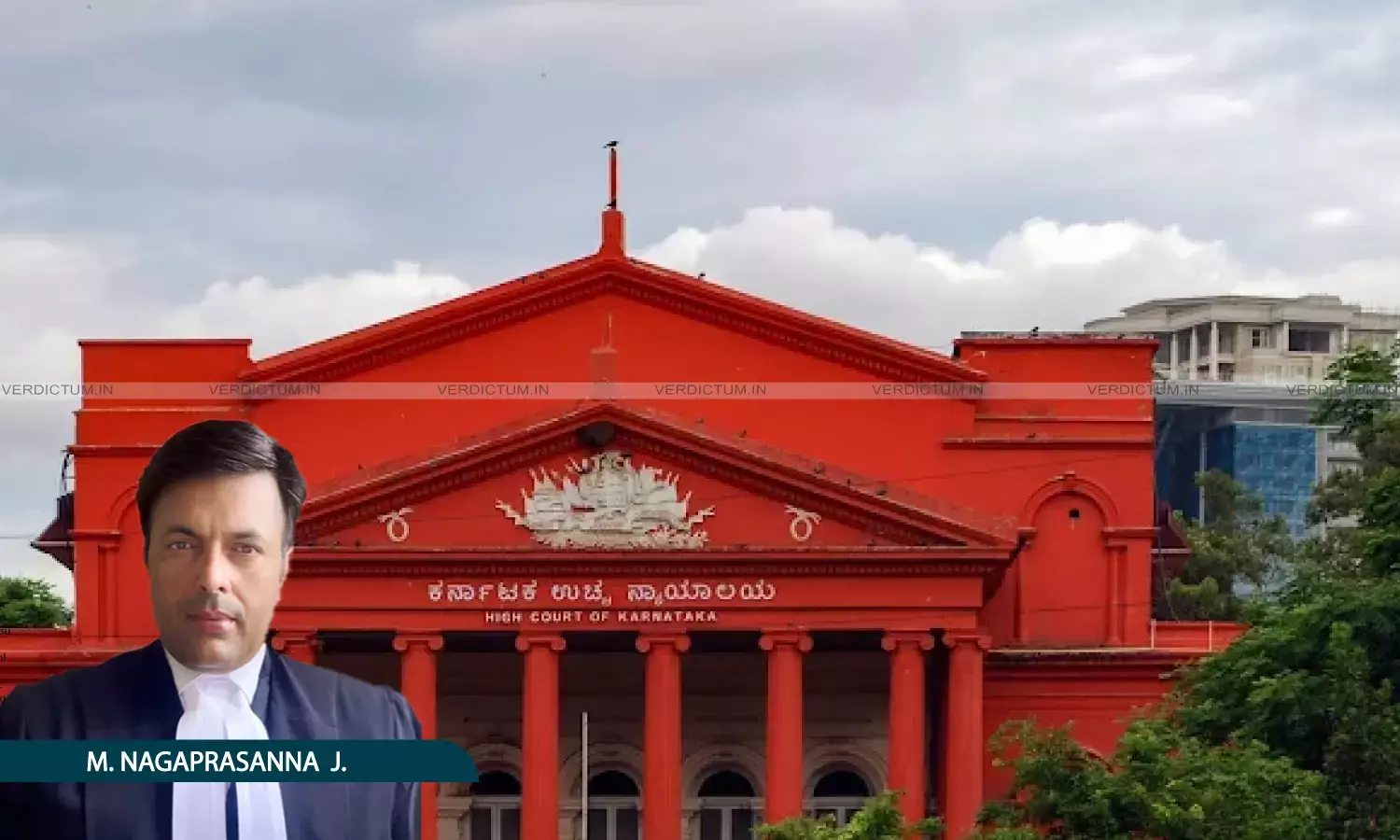
Justice M. Nagaprasanna, Karnataka High Court
The Karnataka High Court has reiterated that persons who are not relatives of the husband by blood, marriage or adoption cannot be proceeded against for offences under Sections 80 and 85 BNS, the provisions corresponding to Sections 304B and 498A IPC, in cases involving dowry death or cruelty.
The Court partly allowed the quashing petitions filed by six accused in a dowry death case arising from the tragic suicide of a young bride within five months of her marriage, quashing proceedings against two distant relatives while refusing to quash them against the husband, father-in-law, mother-in-law and brother-in-law.
The Court also held that a settlement between the complainant's family and the accused cannot be accepted as grounds for closing proceedings under Section 80 BNS, which corresponds to the offence of dowry death, as it is a non-compoundable offence of serious public consequence particularly where the death occurred within five months of marriage.
Justice M. Nagaprasanna while referring to State of Punjab v. Gurmit Singh (2014) 9 SCC 632, noted, “…a person who is not a relative of the husband in terms of the definition as found in Section 304B or 498A of the IPC, which is now 80 and 85 of the BNS, cannot be proceeded against in a case of dowry death. Therefore, permitting proceedings against accused nos.5 and 6 who had no role to play in the lives of accused no.1 to 4 or the deceased or the complainant, permitting proceedings against accused nos.5 and 6 would become an abuse of the process of the law. Insofar as the allegations against the father of the deceased are concerned, it is always open to the prosecution to draw him as an accused, if the evidence so warrants, strictly in consonance with law”.
Senior Advocate Hashmath Pasha appeared for the petitioner and B.N. Jagadeesha, Additional State Public Prosecutor appeared for the respondent.
For the facts, the deceased, a 33-year-old woman, married accused No. 1, a software engineer based in the United States, on November 10, 2024. Within days of the marriage, accused No. 1 returned to the US, leaving his bride in India, she joined him in the US later on February 05, 2025.
Within barely two months of her arrival, she returned to her parents' home in Bengaluru on April 19, 2025, carrying allegations of persistent mental and physical cruelty by her husband. Four days later, on April 23, 2025, accused Nos. 2 to 6, the in-laws and distant relatives of the husband, visited the complainant's residence ostensibly for reconciliation.
What followed was a bitter confrontation in which the deceased was allegedly publicly humiliated, accused of illicit relationships, and told that persons like her ought not to live. The next day, April 24, 2025, the deceased wrote a death note and ended her life by hanging.
The death note, written in Kannada and English, denied any affair and narrated persistent emotional neglect, absence of physical intimacy, surveillance by the husband of her phone calls and friendships in the US, and mental cruelty by the in-laws.
A chargesheet was filed against all six accused under Sections 80, 85, 352 read with Section 3(5) of the BNS.
The Court on the question of settlement, declined to accept it as a basis for closure, holding that the offence of dowry death under Section 80 BNS is a grave public wrong, particularly when death occurs within five months of marriage, and cannot be compounded by private arrangement.
Further, on the question of the ingredients of dowry death and cruelty, the Court held that a conjoint reading of the complaint, the death note and the chargesheet disclosed sufficient material requiring trial.
“‘Soon before death’ is not synonymous with ‘immediately before death’. The proximity test is to be evaluated not with mathematical precision, but with pragmatic realism. The judgment of the Apex Court in SURINDER SINGH V. STATE OF HARYANA reiterates that the statutory presumption under Section 113B of the Evidence Act operates against the accused unless rebutted by cogent evidence”, the Bench noted.
Consequentially, the writ petition filed by the husband was dismissed, while the petitions by the remaining accused was partly allowed. Proceedings against accused Nos. 5 and 6 were quashed while those against accused Nos. 1 to 4 were allowed to continue. Accused Nos. 1 to 4 were granted liberty to avail such remedies as are available in law, with the clarification that the observations in this order would not bind the concerned Court in deciding such remedies on merits.
Cause Title: Vinay Kumar S. v. State of Karnataka and Ors. Writ Petition No.18828 Of 2025 (Gm – Res)
Appearances:
Petitioner: Hashmath Pasha, Senior Advocate, Kariappa N.A., Advocate.
Respondents: B.N. Jagadeesha, Additional State Public Prosecutor, Manu B.P., Advocate.