

"Subordinate Legislation Carries Presumption Of Validity": Karnataka High Court Sets Aside Stay On Excise Rules
The Court held that subordinate legislation carries a presumption of constitutional validity and cannot be stayed unless a strong prima facie case of invalidity is made out.
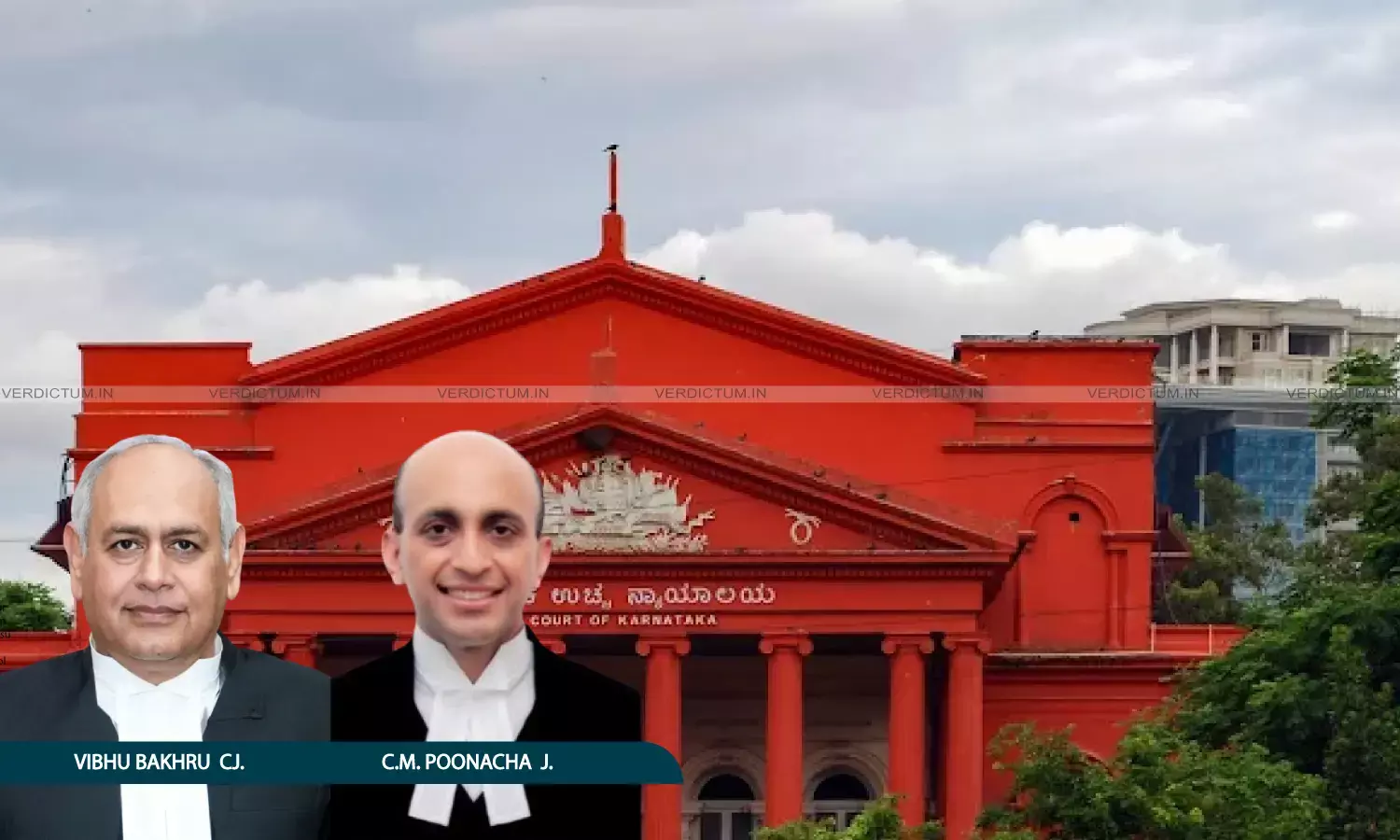
The Karnataka High Court set aside an ad interim order of a Single Judge staying the operation of amended excise rules governing certain liquor licences, holding that legislation, including subordinate legislation, is presumed to be valid and cannot be interdicted lightly at the threshold.
The Court was hearing a writ appeal filed by the State of Karnataka challenging the interim order dated 25.11.2025 passed in a writ petition that assailed amendments introduced to Rules 5, 5-A and 12 of the Karnataka Excise (Sale of Indian and Foreign Liquor) Rules, 1968 by the Karnataka Excise (Sale of Indian and Foreign Liquors) (Second Amendment) Rules, 2025.
A Division Bench of Chief Justice Vibhu Bakhru and Justice C.M. Poonacha observed: “… there is a presumption of constitutional validity of the legislative instruments unless it is established that a particular piece of legislation is ultra vires of the Constitution of India, … It must be presumed that the same is Constitutional.”
In the present case, the Bench further added, “…it does not appear that the learned Single Judge had examined the rival contentions, … the impugned order is based mainly on an observation that, prima facie, the rules travel beyond the rule-making, which requires examination, … legislation, including subordinate legislation, is presumed to be valid, … thus, unless a very strong case of invalidity of the legislation is made out, its operations cannot be stayed”.
The State was represented by Advocate General Shashi Kiran Shetty K., while the respondents were represented by Senior Advocate D.R. Ravishankar
Background
The writ petitioners were CL-9 licensees or persons claiming renewal of discontinued CL-9 licences in different districts of Karnataka. Some of the licences had long stood discontinued, while some renewal applications had been rejected by the Deputy Commissioner of Excise. They challenged the 2025 amendments on multiple grounds, including that the amended provisions enabled grant of licences through e-auction, introduced reservation-based norms, treated certain licences as lapsed and forfeited if not renewed within the stipulated time, and excluded certain licences from the quota restrictions under Rule 12.
The amendments were introduced through three notifications issued on 03.11.2025. The impugned notification amended the 1968 Rules by inserting definitions connected with auction, introducing new forms of licences such as CL-2A and CL-9A, amending Rule 5 to allow grant of CL-2A and CL-9A licences to successful bidders in e-auction subject to reservation norms fixed by the Government, amending Rule 5-A concerning renewal, and adding a proviso to Rule 12 excluding CL-2A licences from the quota regime.
The learned Single Judge stayed the operation, implementation and enforcement of amended Rules 5 and 5-A, primarily observing that the amended provisions introduced fresh conditions, including reservation-based eligibility and automatic forfeiture, which prima facie appeared to travel beyond the enabling provisions of the Karnataka Excise Act, 1965.
Court’s Observation
The Division Bench first examined whether the earlier Division Bench decision in State of Karnataka v. B. Govindraj Hegde supported the writ petitioners’ case. According to the Court, that decision dealt with the relaxation of restrictive conditions for reserved categories in hotel and boarding house licences, and not with the reservation of a quota of licences as such. The Court noted that B. Govindraj Hegde itself recognised that reserving a particular percentage of licences for a class of persons could be permissible.
The Court then turned to the statutory scheme of the Karnataka Excise Act, 1965. It traced the provisions concerning the Excise Commissioner, the licensing framework, the levy of licence and privilege fees, cancellation and withdrawal of licences, and, crucially, the State Government’s rule-making power under Section 71.
The Bench emphasised that Section 71(1) is couched in wide terms and that Section 71(2), particularly clauses (e), (f) and (h), expressly empowers the State Government to make rules regulating the periods, localities, and persons or classes of persons to whom licences may be granted, the procedure to be followed before granting licences, and the terms and conditions of licences.
On the Single Judge’s prima facie view that the amended rules provided for “forfeiture” beyond the Act, the Division Bench held that a plain reading of the proviso to Rule 5-A did not show forfeiture of the licence itself. Instead, it curtailed the right of renewal in respect of certain categories of licences. The Court underscored that the Excise Act does not provide any perpetual right of renewal.
On the contrary, Section 26(1) contemplates licences being granted “for such period as may be prescribed.” It was observed that if the rules could confer a right of renewal, they could also curtail or limit that right.
The Court also rejected, prima facie, the view that providing for the grant of licences by e-auction or prescribing reservation norms was beyond the rule-making power. It held that the State Government clearly has the power to frame rules regulating the persons or classes of persons to whom licences may be granted and to prescribe the terms and conditions of such grants.
It further held that an auction is simply one permissible mode of grant and that it is not necessary for every term and condition of the auction to be expressly contained in the Rules. As the Court put it, the State Government has “ample elbow room” to determine auction conditions.
On the challenge of excessive delegation, the Bench noted that the petitioners were, in substance, invoking the principle delegata potestas non potest delegari. However, the Court held that the question required fuller examination and could not be considered in isolation from the nature of the licence and the extent of the State’s power. Importantly, it noted that the rule-making authority and the authority fixing the reservation norms were both the State Government.
The Court then dealt with the nature of liquor licences. Referring to decisions including Cooverjee B. Bharucha, Nashirwar, Har Shankar, and Panna Lal, the Bench held that the State is entitled to determine the terms and conditions on which this privilege is parted with and may raise revenue through the grant of such privileges.
The Bench also rejected the plea that the writ petitioners had acquired vested rights in renewal merely because they had applied before the notification of the amended rules. Referring to Supreme Court decisions on the meaning of “vested right,” the Court held that no indefeasible right to renewal existed.
Having addressed the substantive challenges, the Court turned to the standards for staying subordinate legislation. It stressed that there is a presumption of constitutional validity of the legislative instruments unless it is established that a particular piece of legislation is ultra vires of the Constitution of India. It must be presumed that the same is Constitutional.
The Court held that the petitioners had not, at least prima facie, displaced the presumption of constitutionality. It observed that it was unable to readily accept that the impugned rules were ex facie invalid or that the writ petitioners had made out a case warranting a stay of their operation. On that reasoning, it concluded that the interim order disregarded settled principles governing stays of subordinate legislation.
Conclusion
The Division Bench held that the ad interim order staying the operation of amended Rules 5 and 5-A could not be sustained. It set aside the impugned stay order, observing that a very strong case of invalidity had not been made out to justify staying subordinate legislation at the threshold.
Cause Title: State of Karnataka & Anr. v. Sri Guruswamy & Ors.
Appearances
Appellants: Advocate General Shashi Kiran Shetty K.; Prathima Honnapura, AAG; Namitha Mahesh B.G., AGA; Adoorya Harish, Advocate.
Respondents: Senior Advocate D.R. Ravishankar; Mohan Mahabaleshwara Bhat, Advocate.
