

Safeguards U/S 223(2) BNSS Must Be Followed Before Notice Is Issued On Private Complaint Against Police Officer: Karnataka High Court
The Bench noted that the sanction under Section 218 is needed only at the stage of cognizance; it set aside notice issued to Head Constable without superior officer’s report and hearing, and remitted the matter to Magistrate.

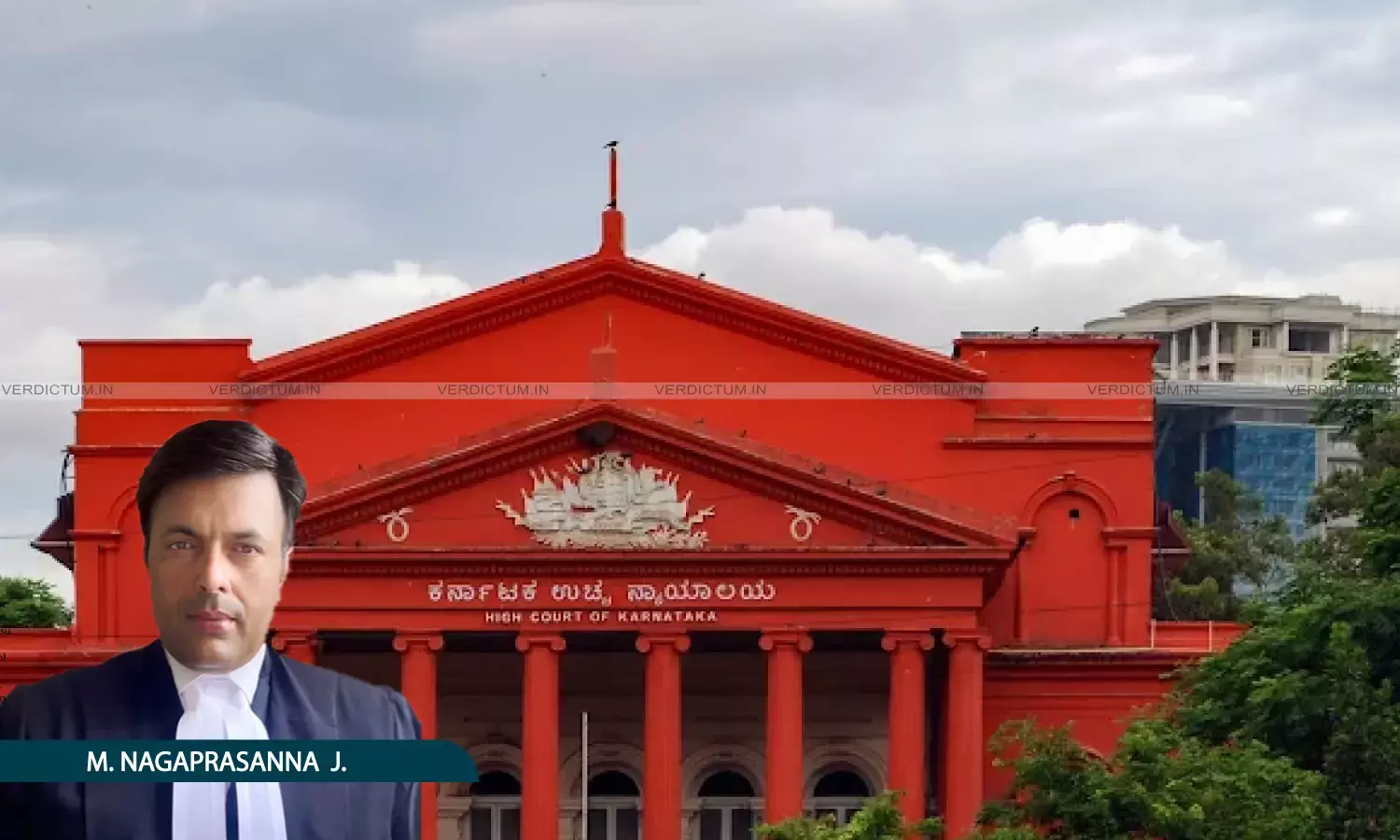
Justice M. Nagaprasanna, Karnataka High Court
The Karnataka High Court has held that the requirement of previous sanction under Section 218 of the Bharatiya Nagarik Suraksha Sanhita, 2023 (BNSS) arises only when a Magistrate takes cognizance, and does not bar preliminary steps such as recording a complainant’s sworn statement. However, in a private complaint against a public servant for acts in the course of official functions, the Court held that the Magistrate must first follow the safeguards in Section 223(2) BNSS.
The Court held that the general procedure in Section 223(1) cannot override the specific procedure in Section 223(2). It set aside an order issuing notice to a Head Constable because the Magistrate had not called for a report from the officer superior to him or given him an opportunity to state his version. The Court remitted the matter to the Magistrate to redo the procedure.
A Single Judge Bench of Justice M. Nagaprasanna observed, “The generality of sub-section (1) of Section 223 cannot be permitted to eclipse the specificity of sub-section (2) of Section 223. When the legislature has consciously carved out a distinct procedure for complaints against public servants arising out of acts connected with their official functions, the Magistrate cannot proceed as though, the special prescription were absent from the statute book. To countenance such a course would be to render sub-section (2) a dead letter and reduce a substantive legislative safeguard to a mere ornamental appendage”.
“…A statutory safeguard that becomes operative at the threshold of cognizance cannot be invoked to invalidate proceedings that have not yet reached that threshold. To hold otherwise would be to advance the stage of the statutory embargo beyond what the legislature has ordained and transform a protection against unauthorised cognizance into an impediment against even preliminary judicial consideration”, the Bench has also noted.
Advocate Ranganath Reddy R appeared for the petitioner and B.N. Jagadeesha, Public Prosecutor appeared for the respondent.
The petitioner, a Head Constable at Bandepalya Police Station, Bengaluru, is accused No. 3 in a private complaint filed by the second respondent under Section 223 BNSS. The complaint alleged offences under Sections 61, 109, 115(1), 115(2), 118(1), 126(2) and 130 read with Section 3(5) of the Bharatiya Nyaya Sanhita, 2023. It claimed that police personnel deployed for law and order during the Karaga Mahotsava, organised by the complainant, used abusive language against participants.
The IX Additional Chief Metropolitan Magistrate, Bengaluru, directed recording of the complainant’s sworn statement on September 25, 2025. After recording it, the Magistrate issued notice to the accused under the first proviso to Section 223(1) on December 12, 2025. The petitioner invoked Section 528 BNSS to challenge that order, contending that notice could not issue without sanction under Section 218.
The Court relied on the Supreme Court’s decision in Anumandala Rajesh Reddy v. State of Karnataka. It held that the embargo of Section 218 operates only when a Magistrate takes cognizance, and that issuing notice at this stage was not taking cognizance. The sanction challenge therefore failed. The Court clarified that the protection was neither extinguished nor prematurely attracted, and the question of sanction would have to be considered if the Magistrate proceeds to take cognizance.
However, the Court found that the complaint, on its face, alleged acts committed during official deployment, which attracted Section 223(2). The record showed no report from a superior officer and no opportunity to the petitioner to state his version. The Bench referring to its earlier decision in Basanagouda R. Patil v. Shivananda S. Patil (2024) and on rulings of the Kerala and Gujarat High Courts, it set out a four-step procedure, running from sworn statements, through the superior officer’s report and the accused’s hearing, to cognizance.
The Court allowed the petition in part. It sustained the proceedings up to the order of September 25, 2025, and set aside the December 12, 2025 order. The matter was remitted to the Magistrate to redo the procedure after recording the sworn statement, keeping in mind the Court’s observations.
Cause Title: Shiva Shankar v. State of Karnataka & Anr. (Criminal Petition No. 3641 of 2026)
Appearances:
Petitioner: Advocate Ranganath Reddy R.
Respondent: State Public Prosecutor-I B.N. Jagadeesha.