

Exposing Advocates To Criminal Prosecution & Trauma Merely For Appearing For Litigant Produces Chilling & Paralysing Effect On Bar: Karnataka High Court
While quashing three FIRs, the Bench said that the Police ought not to investigate matters purely civil in character; criminal law cannot be permitted to degenerate into a weapon of oppression in aid of a civil contest.

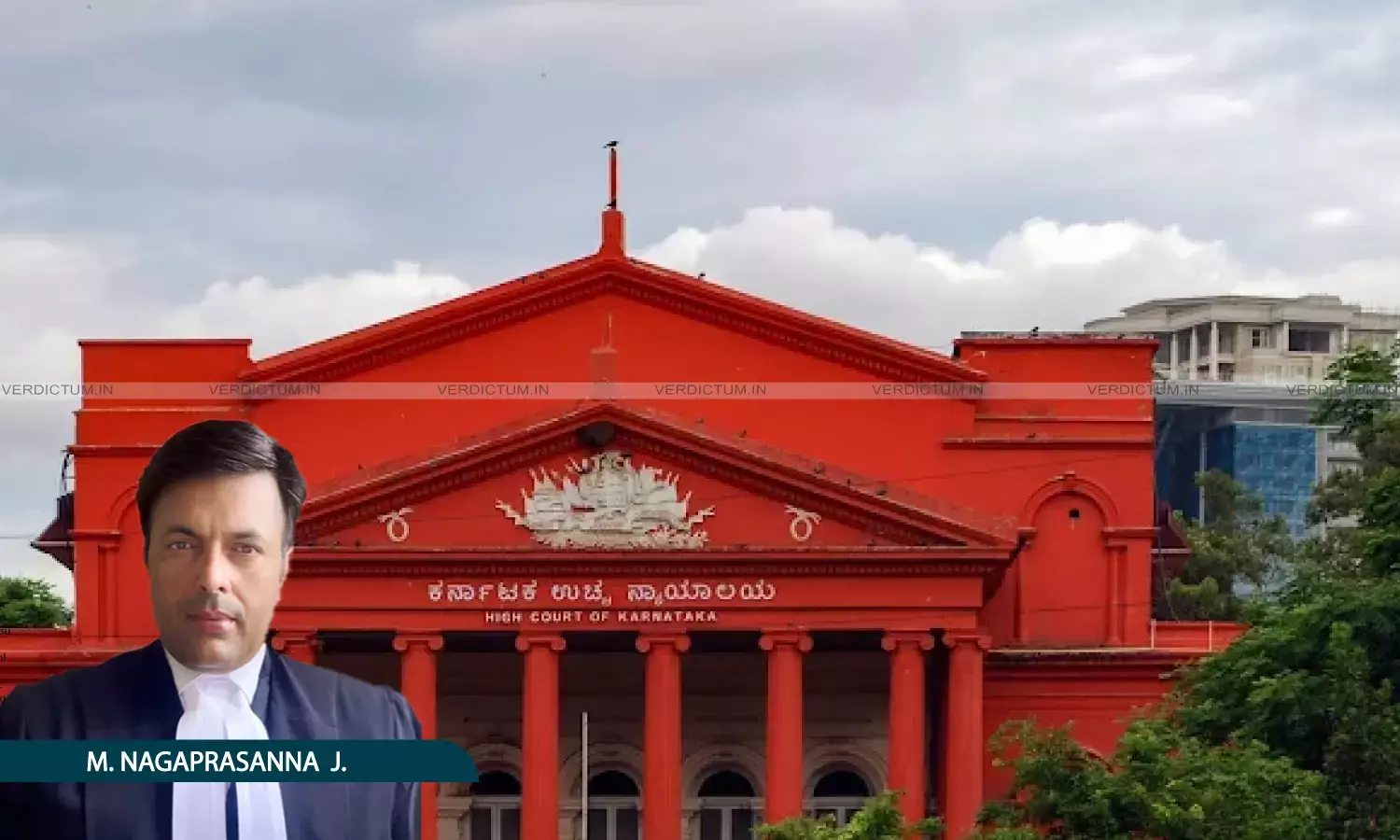
Justice M. Nagaprasanna, Karnataka High Court
The Karnataka High Court has held that an advocate cannot be made the fulcrum of a criminal prosecution merely because he represented parties before courts of law in the discharge of his professional obligations, and that such a tendency strikes at the very heart of the independence of the bar and the purity of administration of justice. The Court expressed deep disquiet over an increasingly disturbing trend of advocates being dragged into criminal proceedings solely for appearing for their clients and articulating their cause before judicial forums.
The Court further held that a simmering land dispute artfully clothed in the robes of criminal prosecution, with no iota of criminality disclosed on the face of the material, cannot be permitted to survive and must be obliterated at its very inception. Three FIRs registered on a solitary incident arising from a decades-old civil dispute over title, revenue entries and partition deeds were quashed in their entirety.
Justice M. Nagaprasanna observed, “…This Court is encountering plethora of cases, wherein Advocates, who merely represent parties before Courts of law in the discharge of their professional obligations, are themselves being dragged into criminal proceedings and arrayed as accused…If every Advocate, merely by a reason of appearing for a litigant is exposed to criminal prosecution and trauma of investigative proceedings, the inevitable consequence would be a chilling and paralyzing effect upon fearless discharge of professional responsibilities. The majesty of legal profession cannot be permitted to be diminished by disgruntled litigants to wield criminal law as a weapon of intimidation against the members of the bar…”.
Advocate Satyanarayana Chalke S. appeared for the petitioner and B.N. Jagadeesha, Additional State Public Prosecutor appeared for the complainant-respondents.
In the matter, a long-running civil dispute over land in Nagarbhavi village, Bengaluru, tracing back to 1980, culminated in three criminal cases being registered between August 21 and 24 for offences under Sections 102, 420, 468 and 506(B) read with Section 34 IPC.
The complainants were Chandramma and T. Rajanna, abutting landowners in a long-standing property dispute. The accused included an advocate, S. Rajendra, who had been representing the opposing parties in various civil proceedings arising from the same dispute. The sole allegation against the advocate was that he had represented his clients before courts and revenue authorities against the complainants' interests.
The Court applied the twin-filter principle drawn from a line of Supreme Court decisions holding that police must exercise investigative restraint in disputes concerning title deeds, revenue entries, powers of attorney or sale deeds unless allegations unmistakably disclose overwhelming criminality.
“…the unmistakable legal position that emerges is, that the police ought not to be permitted to investigate matters which are purely civil in character. Investigative restraint must be exercised in disputes concerning title deeds, revenue entries, powers of attorney, or sale deeds unless, the allegations unmistakably exude overwhelming criminality. Equally, criminal Courts, even at the stage of framing of charge, are duty-bound to scrutinize whether the material placed before them genuinely discloses strong suspicion and a reasonable prospect of conviction. The pendency of civil proceedings cannot be ignored while assessing whether criminal prosecution is being employed as a weapon of harassment. The criminal justice system, therefore, must operate through these twin filters—first, at the stage of investigation and filing of charge sheet, and next, at the stage of framing of charge by the concerned Court. At both stages, the law vests ample power in the Courts to terminate proceedings that amount to abuse of process, subject always to the peculiar facts of each case”, the Bench observed.
Criminal courts at the charge-framing stage are equally duty-bound to act as filters ensuring only cases with strong suspicion and a reasonable prospect of conviction proceed to trial.
“…what emerges with crystalline clarity is, the complete absence of even an iota of criminality. A simmering land dispute between the parties has been artfully clothed in the robes of criminal prosecution…The gravamen of the accusation is merely that the petitioners threatened the respondents. How, from such bald assertions, a cognizable offence has suddenly sprung into existence remains an inscrutable mystery…The criminal law cannot be permitted to degenerate into a weapon of oppression in aid of a civil contest. Therefore, on this solitary yet substantial ground, the impugned crime deserves to be obliterated at its very inception”, the Bench further observed.
On the advocate's implication, the Court held that while no straitjacket formula bars an advocate from being prosecuted if genuine criminal ingredients exist, an advocate's mere representation of a litigant can never become the fulcrum of a crime.
Accordingly, all the three writ petitions were allowed, and clarified that its observations were confined to the Section 482 CrPC jurisdiction and would not affect other pending proceedings between the parties.
Cause Title: S. Rajendra v. State Of Karnataka And Ors. Writ Petition No.20336 Of 2023 (Gm - Res)
Appearances:
Petitioners: Satyanarayana Chalke S., Advocate.
Respondents: B.N. Jagadeesha, Additional State Public Prosecutor, K.N. Dayalu, Advocate.