Court Cannot Modify Arbitral Award: Karnataka High Court Sets Aside District Court’s Revised Compensation Order In NHAI Land Acquisition Case
The Court held that a District Court exercising jurisdiction under Section 34 of the Arbitration and Conciliation Act can either confirm, set aside, or remit an arbitral award, but cannot review and modify the award on merits.
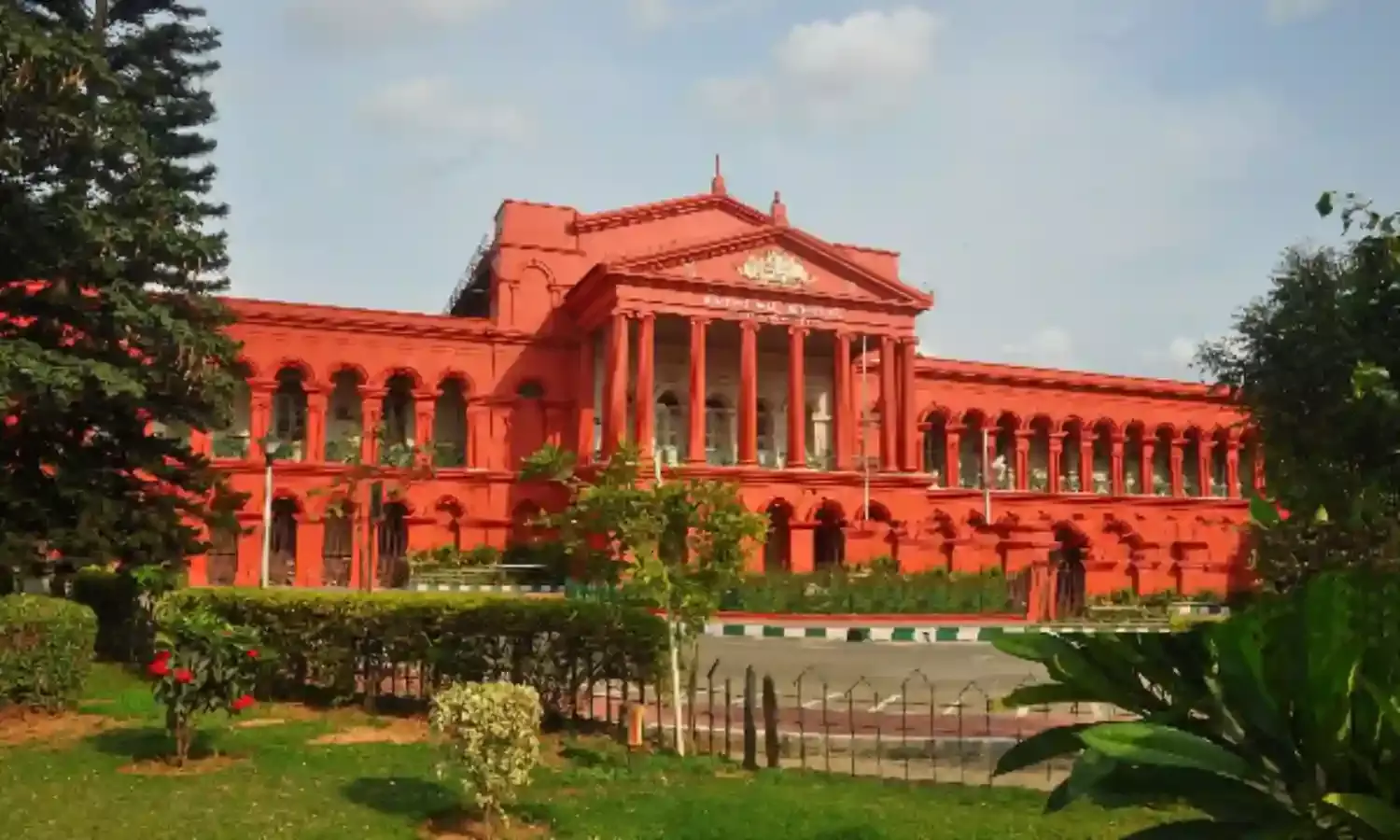
The Karnataka High Court has held that a court exercising jurisdiction under Section 34 of the Arbitration and Conciliation Act, 1996, cannot modify an arbitral award, while setting aside a District Court order which had reviewed its earlier judgment and altered compensation awarded in a National Highways Authority of India land acquisition dispute.
The Court was hearing appeals filed by the NHAI against revised orders passed by the Principal District and Sessions Judge, Haveri, in arbitration petitions arising from the acquisition of land for a four-lane national highway project.
A Bench of Justice S. Sunil Dutt Yadav and Justice K.G. Shanthi, while holding that the trial court had exceeded its jurisdiction under Section 34, observed:
“In the case on hand the trial Court reviewed and modified its own judgment which is not sustainable. This is when the law is clear that the Court has no jurisdiction to modify the award under Section 34 of the Act. Hence this Court is of the opinion that the impugned judgment and award passed by the trial Court in a case filed u/S 34 of the Act, is not proper and correct.”
Advocate B.P. Mathapati appeared for NHAI, while Advocate Laxman T. Mantagani appeared for the land losers.
Background
The dispute arose after lands were acquired for a four-lane NHAI project. The competent authority fixed compensation, after which the land losers pursued claims before the Arbitrator.
The Arbitrator enhanced the compensation. NHAI challenged the arbitral award before the District Court under Section 34 of the Arbitration and Conciliation Act. The District Court initially confirmed the award of the Arbitrator.
Thereafter, the land losers filed review petitions before the same court. Acting on those review petitions, the District Court modified the arbitral award. NHAI then approached the High Court under Section 37 of the Act, contending that the District Court had no jurisdiction either to review its own judgment in that manner or to modify an arbitral award under Section 34.
Court’s Observations
The High Court accepted NHAI’s contention that the District Court had acted beyond the limited jurisdiction available under Section 34. The Court noted that the law is clear that a Section 34 court cannot rewrite or modify an arbitral award.
The Court stated: “The principle and law is very clear that the District Court has the power either to confirm or set aside the award of the Arbitrator and remand the matter to the Arbitrator. However, in the case on hand the trial Court has modified the award of the Arbitrator passed u/S 34 of the Act which is not sustainable in law.”
The High Court referred to Project Director, National Highways Authority of India v. M. Hakeem (2021), where the Supreme Court had held that Section 34 provides a limited remedy and does not include a power to modify, revise or vary an arbitral award.
The Court quoted the Supreme Court’s ruling: “It can therefore be said that this question has now been settled finally by at least 3 decisions of this Court. Even otherwise, to state that the judicial trend appears to favour an interpretation that would read into Section 34 a power to modify, revise or vary the award would be to ignore the previous law contained in the 1940 Act; as also to ignore the fact that the 1996 Act was enacted based on the UNCITRAL Model Law on International Commercial Arbitration, 1985 which, as has been pointed out in Redfern and Hunter on International Arbitration, makes it clear that, given the limited judicial interference on extremely limited grounds not dealing with the merits of an award, the ‘limited remedy’ under Section 34 is co-terminus with the ‘limited right’, namely, either to set aside an award or remand the matter under the circumstances mentioned in Section 34 of the Arbitration Act, 1996.”
The Bench also relied on the Supreme Court’s warning in the same decision: “Quite obviously if one were to include the power to modify an award in Section 34, one would be crossing the Lakshman Rekha and doing what, according to the justice of a case, ought to be done.”
The High Court also referred to McDermott International Inc. v. Burn Standard Co. Ltd. (2006), where the Supreme Court held that courts under the 1996 Act exercise a limited supervisory role and cannot correct errors of arbitrators.
The Court noted the principle in the following terms: “The Court cannot correct the errors of Arbitrator. It can only quash the award leaving the parties free to begin the arbitration again if it is so desired”.
The Bench further referred to S.V. Samudram v. State of Karnataka (2024), where the Supreme Court reiterated that a Section 34 court has no jurisdiction to modify an arbitral award and that any such attempt would amount to crossing the “Lakshman Rekha”.
The High Court also considered Gayatri Balaswamy v. ISG Novasoft Technologies Ltd. (2025), where the Supreme Court held that courts exercising powers under Section 34 and appellate courts under the Act have no power to modify an award, except for correction of computational, clerical, typographical or similar errors.
The Court quoted the relevant conclusions: “(a) The Courts exercising power under Section 34 and Courts hearing appeals thereunder have no power to ‘modify’ an award; (b) The power to modify is not a lesser power to that of the power to set aside, as the two operate in separate spheres and are not of the same genus.”
Since the District Court had reviewed and modified the substance of the award, the High Court held that the impugned order could not be sustained.
Conclusion
The Karnataka High Court allowed the appeals, set aside the revised order passed by the Principal District Judge, and remanded the matter for fresh consideration in accordance with law.
The Court also disposed of the pending applications.
Cause Title: National Highways Authority of India v. Iravva and connected matter (Neutral Citation: 2026:KHC-D:9208-DB)
Appearances
Appellants: Advocates B.P. Mathapati and S.G. Hiremath
Respondents: Advocate Laxman T. Mantagani; AGA Praveen K. Uppar