Condition To Maintain Senior Citizen Need Not Be Expressly Recorded In Gift Deed But Must Be Proved To Seek Its Cancellation: Karnataka High Court
The Court nevertheless sustained the setting aside of cancellation order because the deceased senior citizen’s claim did not squarely fall within Section 23(1) of the 2007 Act.
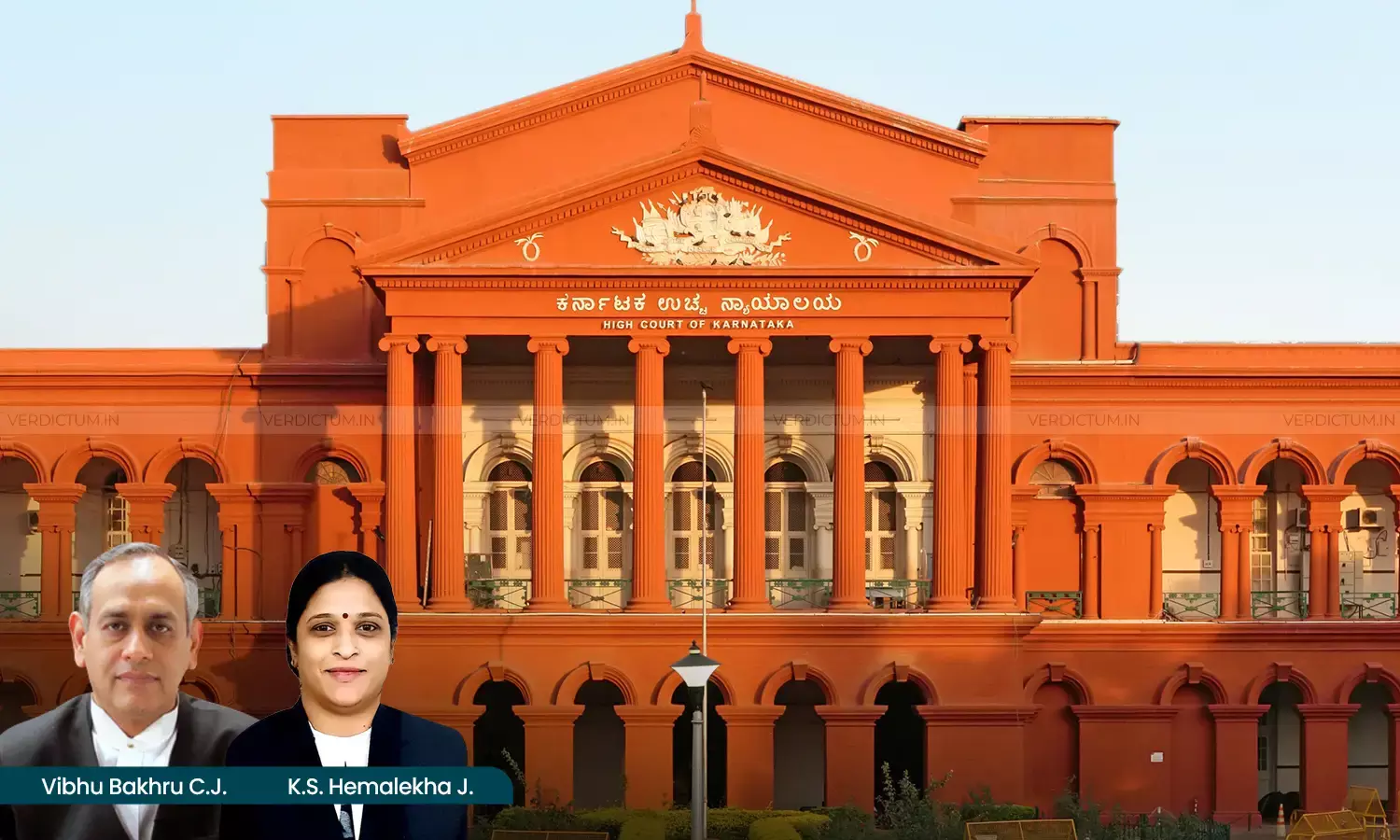
The Karnataka High Court has held that a senior citizen seeking cancellation of a gift deed under Section 23(1) of the Maintenance and Welfare of Parents and Senior Citizens Act, 2007, must establish that the transfer was made on the condition that the transferee would provide for the senior citizen’s basic needs.
The High Court clarified that the condition need not be expressly recorded in the gift deed, but its existence must be established through sufficient evidence.
The Court was hearing a writ appeal against a Single Judge’s order setting aside the Assistant Commissioner’s decision to cancel a gift deed executed by a senior citizen in favour of two of his grandsons.
A Bench of Chief Justice Vibhu Bakhru and Justice K.S. Hemalekha observed: “It is clear from the above that the Senior Citizen seeking cancellation of a gift deed under Section 23(1) of the Act has to establish that the gift deed was executed on the condition that the transferee will take care of the basic needs of the Senior Citizen. However, it is not necessary that the same would be expressly recorded in the gift deed. The Senior Citizen would have to establish the same by providing sufficient evidence in that regard.”
Advocate N.S. Bhat appeared for the appellants. Additional Government Advocate Niloufer Akbar appeared for the State authorities, while Advocate Thimmanna Bhat Devathe appeared for the private respondents.
Background
The senior citizen had executed a registered gift deed transferring a residential property to two of his grandsons. He later approached the Assistant Commissioner under Section 23 of the Act, alleging that they had misled him into signing documents to obtain a senior-citizen certificate and government benefits.
He alleged that he later discovered the registered gift deed and an attempt to alienate the property. He sought a declaration that the deed was null and void. The Assistant Commissioner allowed the petition and cancelled it in ex parte proceedings.
After the senior citizen’s death, the grandsons challenged the cancellation before the High Court. The Single Judge set it aside on the grounds that the senior citizen had not sought cancellation and that the gift deed contained no condition requiring the donees to provide for his basic amenities and physical needs.
The senior citizen’s other family members appealed and informed the Division Bench that a previously instituted partition suit concerning the property remained pending.
Court’s Observations
Maintenance Condition Need Not Appear In Gift Deed
The Court referred to Sudesh Chhikara v. Ramti Devi (2022), in which the Supreme Court identified two requirements for invoking Section 23(1) of the Act: the transfer must have been made subject to a condition that the transferee would provide the transferor’s basic amenities and physical needs, and the transferee must have refused or failed to fulfil that condition.
The judgment reproduced the Supreme Court’s explanation: “If both the aforesaid conditions are satisfied, by a legal fiction, the transfer shall be deemed to have been made by fraud or coercion or undue influence. Such a transfer then becomes voidable at the instance of the transferor and the Maintenance Tribunal gets jurisdiction to declare the transfer as void.”
The Supreme Court had explained that transfers to close relatives were often made out of love and affection without any expectation in return. Where a maintenance condition was alleged, its existence had to be established before the Tribunal.
However, Sudesh Chhikara did not require the conveyance itself to record the condition. Relief had failed there because the senior citizen had neither pleaded nor proved such an understanding.
Petition Was Founded On Alleged Fraudulent Procurement
The Court found that the Single Judge had incorrectly stated that the senior citizen’s petition contained no prayer for cancellation. The petition had expressly sought a declaration that the gift deed was null and void.
It observed: “Although the petition also mentioned that respondent Nos. 4 and 5 (donees) had misrepresented that they would look after the Senior Citizen, it was not premised on that basis. As noted above, the petition was premised on the basis that the Senior Citizen had executed the gift deed on a fraudulent representation that he was signing documents for availing Senior Citizen's benefit from the Government.”
The Court held that the condition contemplated by Section 23(1) had not been established in the present case. The claim therefore did not squarely fall within that provision. It added that an Assistant Commissioner might, in an appropriate case, possess power to pass orders protecting a senior citizen’s property, but found it unnecessary to examine that question in the present proceedings.
Single Judge’s Reasons Rejected But Result Sustained
The Court noted that the proceedings before the Assistant Commissioner had been conducted ex parte and that the grandsons had not participated in them. It therefore found that the cancellation order could not be sustained.
The Bench held: “In view of the above, the order passed by the Assistant Commissioner cannot be sustained. The same is liable to be set aside.”
Although the Division Bench rejected both reasons given by the Single Judge, it did not disturb the setting aside of the Assistant Commissioner’s order.
Fraud And Property Claims Reserved For Civil Court
The Court clarified that its decision and the Assistant Commissioner’s order would not prevent the parties from raising their claims concerning the gift deed in the pending civil proceedings.
It observed: “In this regard, we clarify that all rights and contentions of the parties regarding the gift deed, including whether the same was executed fraudulently are reserved. Neither the order dated 03.03.2023 passed by the Assistant Commissioner, Chikkaballapura nor the orders passed by this Court would preclude the parties from agitating the said issue in the said civil proceedings.”
Conclusion
The High Court disposed of the appeal without interfering with the result reached by the Single Judge, which had set aside the Assistant Commissioner’s cancellation of the gift deed. It clarified that an express maintenance covenant in the deed was not indispensable under Section 23(1) of the Act, although the senior citizen had to establish through sufficient evidence that the transfer was subject to such a condition.
All rights and contentions concerning the gift deed, including the allegation that it had been fraudulently procured, were reserved for adjudication in the pending civil suit. The pending interlocutory applications were also disposed of.
Cause Title: Narasimhamurthy N and Others v. The Assistant Commissioner and Others (Neutral Citation: 2026:KHC:60916-DB)
Appearances
Appellants: N.S. Bhat, Advocate
Respondents: Niloufer Akbar, Additional Government Advocate; Thimmanna Bhat Devathe, Advocate