

Criminal Process Cannot Be Converted Into A Retaliatory Weapon: Karnataka High Court Quashes FIRs Against Doctor Who Reported Illegal Immigrants
The Bench directed the State to operationalise district level committees under MHA SOP within three months.

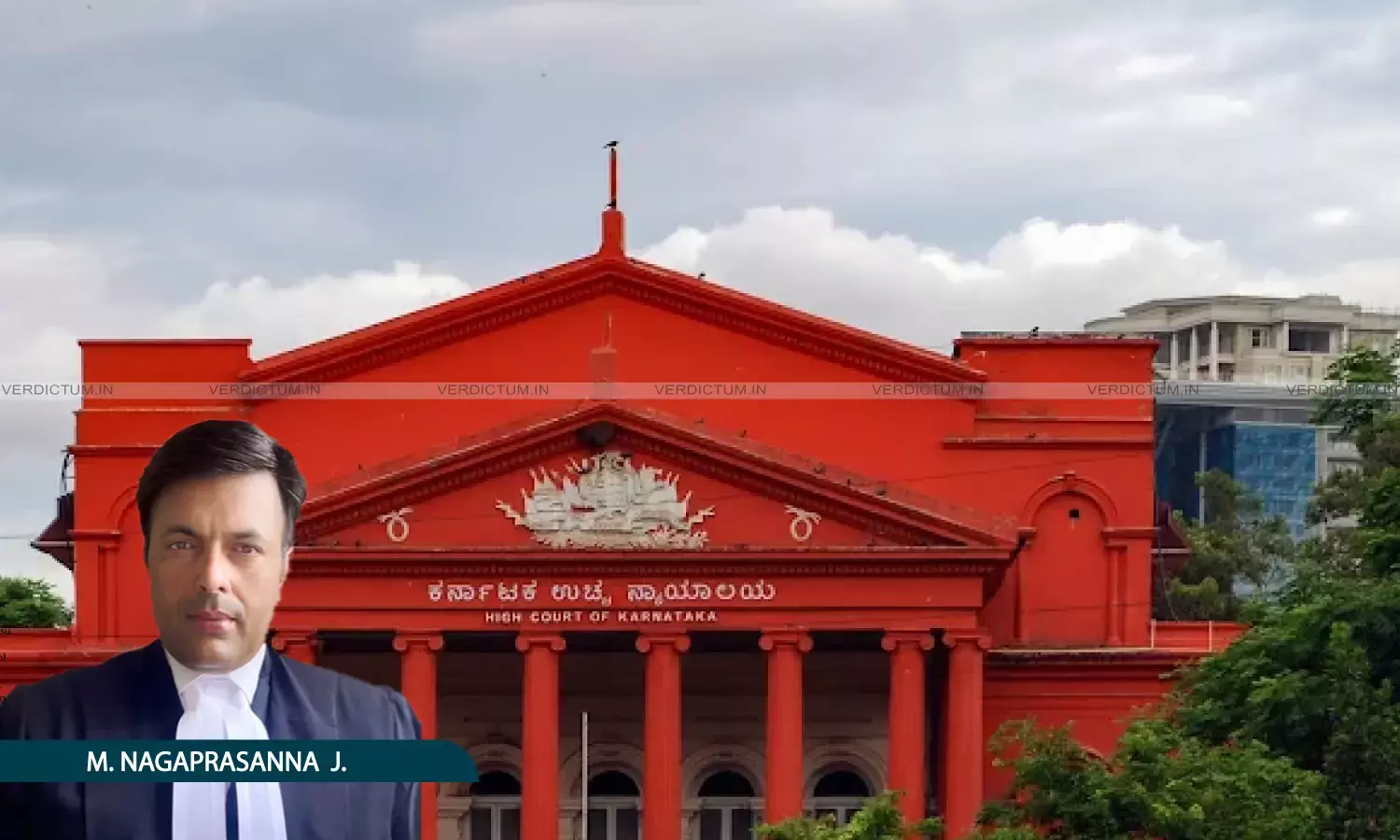
Justice M. Nagaprasanna, Karnataka High Court
The Karnataka High Court has quashed two FIRs registered against a medical practitioner who had alerted the police to the alleged presence of illegal Bangladeshi immigrants in Bengaluru. The Court held that the complaints, lodged by persons against whom unauthorised-stay proceedings had begun, bore the unmistakable imprint of retaliation, and it declared both crimes obliterated.
The Court observed that the criminal process cannot be converted into a retaliatory weapon to silence the informant merely because the information he furnished has set immigration enforcement in motion. While clarifying that immigration status alone does not strip a person of the protection of law, it directed the State to constitute and operationalise District Level Committees under the Ministry of Home Affairs’ Standard Operating Procedure of May 02, 2025 within three months.
A Bench of Justice M. Nagaprasanna observed, “…The criminal process, solemn as it is, cannot be converted into a retaliatory weapon to silence the informant, merely because the information furnished by him has set the machinery of immigration enforcement in motion. The Court is conscious that the police cannot decline registration merely because the informant happens to be a foreign national or is alleged to be unlawfully staying in India. Where information discloses commission of a cognizable offence, the law governing registration of an FIR must take its course. But registration is not the terminus of judicial scrutiny. When contemporaneous official records, the chronology of events and the attendant circumstances together demonstrate that the prosecution is manifestly actuated by vengeance, the constitutional Court cannot remain a mute spectator and permit the criminal process itself to become the punishment”.
Advocate Girish Bharadwaj appeared for the petitioner and Arvind Kamath, ASGI appeared for the respondent.
The petitioner, a doctor engaged in social causes, dialled the emergency helpline on July 18, 2026 to report labour sheds allegedly housing Bangladeshi nationals at Kodathi Village, Sarjapur Main Road. He accompanied the police to the spot, where several persons fled. A resident of the sheds then lodged a complaint at Varthur Police Station alleging assault. On July 22, another complainant approached Bellanduru Police Station, and a case was registered with additional offences under Sections 74 and 79 of the BNS. The petitioner was arrested on July 23 and released the next day.
On July 28, 2026, the Court stayed investigation in both crimes and impleaded the FRRO. Thereafter, the Union placed on record that the complainants were staying illegally, as per a preliminary FRRO finding, and were under movement restriction orders. The interim order was continued, with a caution against any assault by the petitioner. The petitioner’s writ petition sought compensation for his arrest and directions for deportation of illegal immigrants. The matter was reserved on September 22.
The Court found the chronology telling, it noted that the Investigating Officer recommended detention of the complainant at 11.30 a.m. on July 22, and she lodged her complaint fifteen minutes later. Neither the complaint was supported by any contemporaneous medical or injury record. Applying State of Haryana v. Bhajan Lal, the Court held that the prosecutions bore the indicia of mala fides and were maliciously instituted for wreaking vengeance. It added that police cannot decline registration merely because the informant is a foreign national.
“The circumstances obtaining in both crimes, viewed cumulatively, reveal a pattern too stark to be ignored. The persons against whom proceedings relating to unauthorised stay had commenced almost contemporaneously set the criminal law in motion against the very petitioner who had complained of their presence. The criminal justice system cannot be allowed to be turned on its head - where the person who reports an alleged illegality finds himself pursued by the criminal process at the instance of those against whom his information was directed. 16. It is precisely such misuse of criminal process that falls within the principles enunciated by the Apex Court in the case of State Of Haryana v. Bhajan Lal…”, the Bench said.
The criminal petitions were allowed and both crimes were obliterated, and the writ petition was disposed of with a direction to constitute District Level Committees in all districts where mandated, within three months of receipt of the order. A district-wise compliance report must then be filed before the Registry.
Cause Title: Nagendrappa T. v. State of Karnataka & Ors., W.P. No. 24641 of 2026
Appearances:
Petitioner: Advocate Girish Bharadwaj.
Respondent: B.N. Jagadeesha, SPP-I, Arvind Kamath, ASGI with Vinay Venugopal, CGSC.