

Consequence Alone Cannot Metamorphose Negligence Into Culpable Homicide: Karnataka High Court
The Court said that the knowledge attributable to the driver cannot be transplanted on father by relationship alone; allegation of repeated entrustment of vehicle to minor makes it a matter for evidence, not discharge.

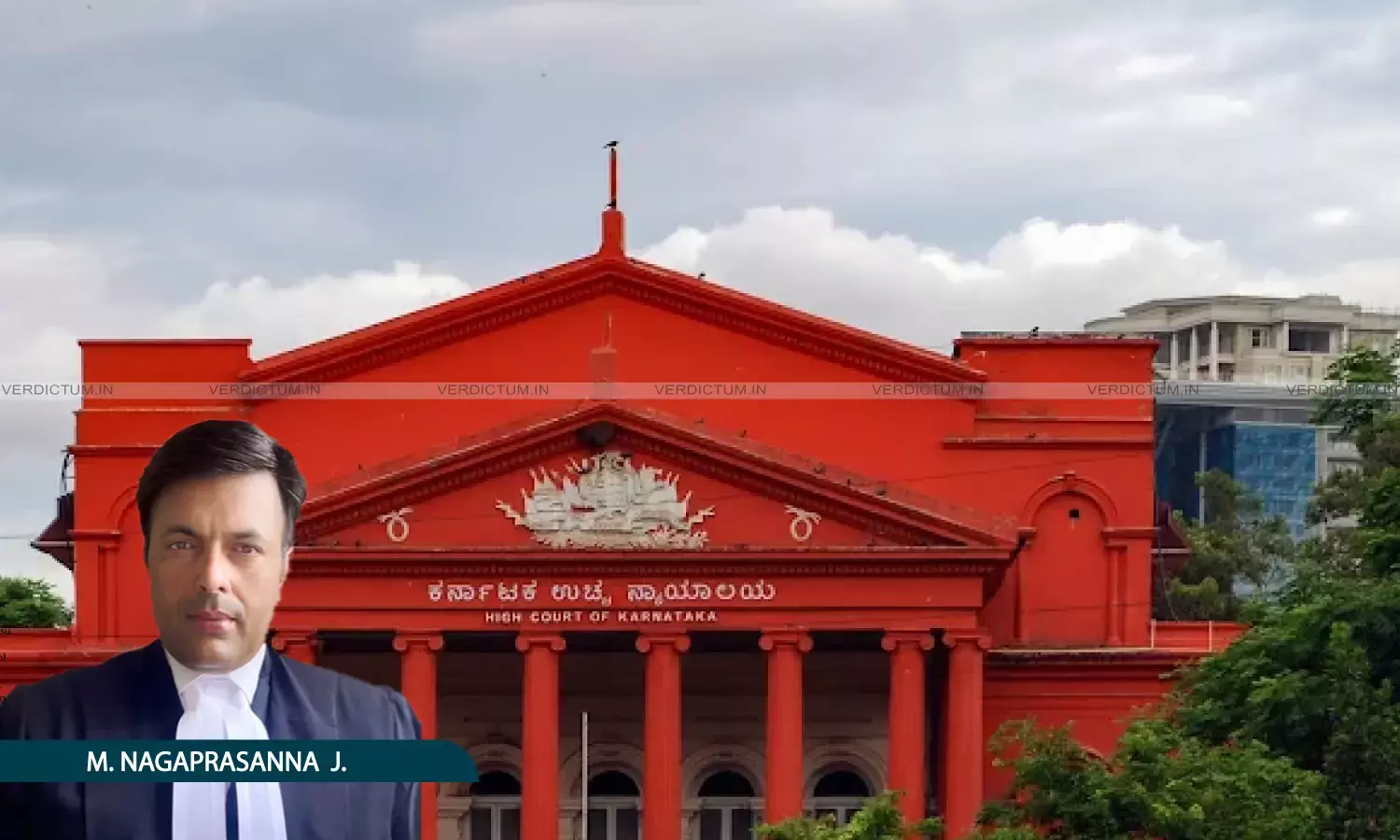
Justice M. Nagaprasanna, Karnataka High Court
The Karnataka High Court has held that the gravity of a tragic consequence cannot by itself turn negligence into culpable homicide, as there must be material showing the requisite knowledge on the part of the accused. It nevertheless refused to quash the charge under Section 304 Part II of the IPC against a father whose 14-year-old son drove a car into a two-wheeler, killing three people.
The Court held that the knowledge of the driver cannot be attributed to the father merely because of their relationship. Since the charge sheet alleges that the father himself handed over the keys, and had done so on earlier occasions, whether he had knowledge of the likely fatal consequences is a question for trial. Rejecting the petition, the Court said the charge must face the test of evidence rather than suffer a premature burial.
A Bench of Justice M. Nagaprasanna observed, “…the line that separates Section 304 Part-II from Section 304A of the IPC emerges with considerable clarity. The distinction does not lie merely in the enormity of the consequence, for death may unfortunately be the consequence under either provision; the distinction lies in the mental element that precedes the act. Section 304A inhabits the realm of rashness and negligence, whereas Section 304 Part-II enters the graver territory of culpable homicide, when the act is accompanied by the conscious knowledge that death is its likely consequence. Thus, consequence alone cannot metamorphose negligence into culpable homicide; there must be material demonstrating the requisite knowledge attributable to the person whose criminal liability is sought to be fastened”.
“…The petitioner was not behind the wheel; his 14-year-old son was. Therefore, the knowledge attributable to the driver cannot, merely by reason of the relationship of father and son, be transplanted upon the petitioner. Equally, however, the petitioner cannot seek discharge merely by asserting that the child clandestinely took away the vehicle. The charge sheet material, as noticed, contains statements indicating that the petitioner himself handed over the keys to his minor son and that this was not an isolated occurrence but had allegedly happened on earlier occasions as well. Whether those statements are ultimately worthy of acceptance is a matter of evidence; at the stage of discharge, they cannot be wished away by accepting the defence version as established fact”, the Bench noted.
Advocate Pallava R. appeared for the petitioner and B.N. Jagadeesha, SPP-I appeared for the respondent.
On December 10, 2020, the petitioner’s 14-year-old son allegedly took a Volkswagen Vento, entrusted to the petitioner by his employer, for a drive on the Mysuru-Bengaluru Road. The car allegedly hit a two-wheeler, killing three members of a family and injuring a child. The complainant is the father of one of the deceased.
A case was registered at N.R. Traffic Police Station, Mysuru, initially under Sections 279, 304A and 337 of the IPC and provisions of the Motor Vehicles Act. With the Sessions Court’s permission, Section 304 Part II was added. The petitioner, arraigned as accused No. 2 sought discharge, which the II Additional District and Sessions Judge, Mysuru, rejected. He challenged only the Section 304 Part II charge.
The Court said the distinction between Sections 304A and 304 Part II lies in the mental element, not the enormity of the outcome. Referring to precedents on the subject matter, it held that Part II requires a positive act accompanied by knowledge that death is likely. It found that the prosecution alleged a positive act of entrustment, and that the petitioner’s defence that the minor took the car without his knowledge contradicted the charge sheet material. A discharge proceeding, it said, cannot become a mini-trial. It also cautioned that not every parent whose minor child causes an accident becomes liable under Part II.
“…Three precious lives have been extinguished and another seriously injured. The magnitude of that tragedy, by itself, cannot constitute Section 304 Part-II; criminal culpability cannot be measured by counting the dead. But the prosecution case travels beyond the consequence. It alleges a conscious and positive act on the part of the petitioner - of repeatedly permitting his 14-yearold son to drive and, on the fateful day, of himself handing over the keys of the car to the child. A motor vehicle in the hands of a child of fourteen, upon a public highway, is not merely an instrument being used contrary to law; depending upon the evidence, it is capable of becoming a source of obvious and foreseeable peril to every road user”, the Bench said.
The petition was rejected, and the observations were confined to the plea for discharge, and the trial court must decide independently on the evidence.
Cause Title: Nadeem Ur Rehman v. State of Karnataka & Anr. CRIMINAL PETITION NO. 10711 OF 2026
Appearances:
Petitioner: Pallava R., Advocate.
Respondent: B.N. Jagadeesha, SPP-I, Rashmi Patel, HCGP.