

State Can't Acquire Land For Individual Entity Of Its Choice At Expense Of Poor Landowners By Invoking Eminent Domain: Karnataka High Court
The Court held that the Karnataka Industrial Areas Development Act is intended for the creation of industrial areas serving public purpose and cannot be used as a device to acquire land for a private entity of the Government’s choice through a colourable exercise of eminent domain powers.
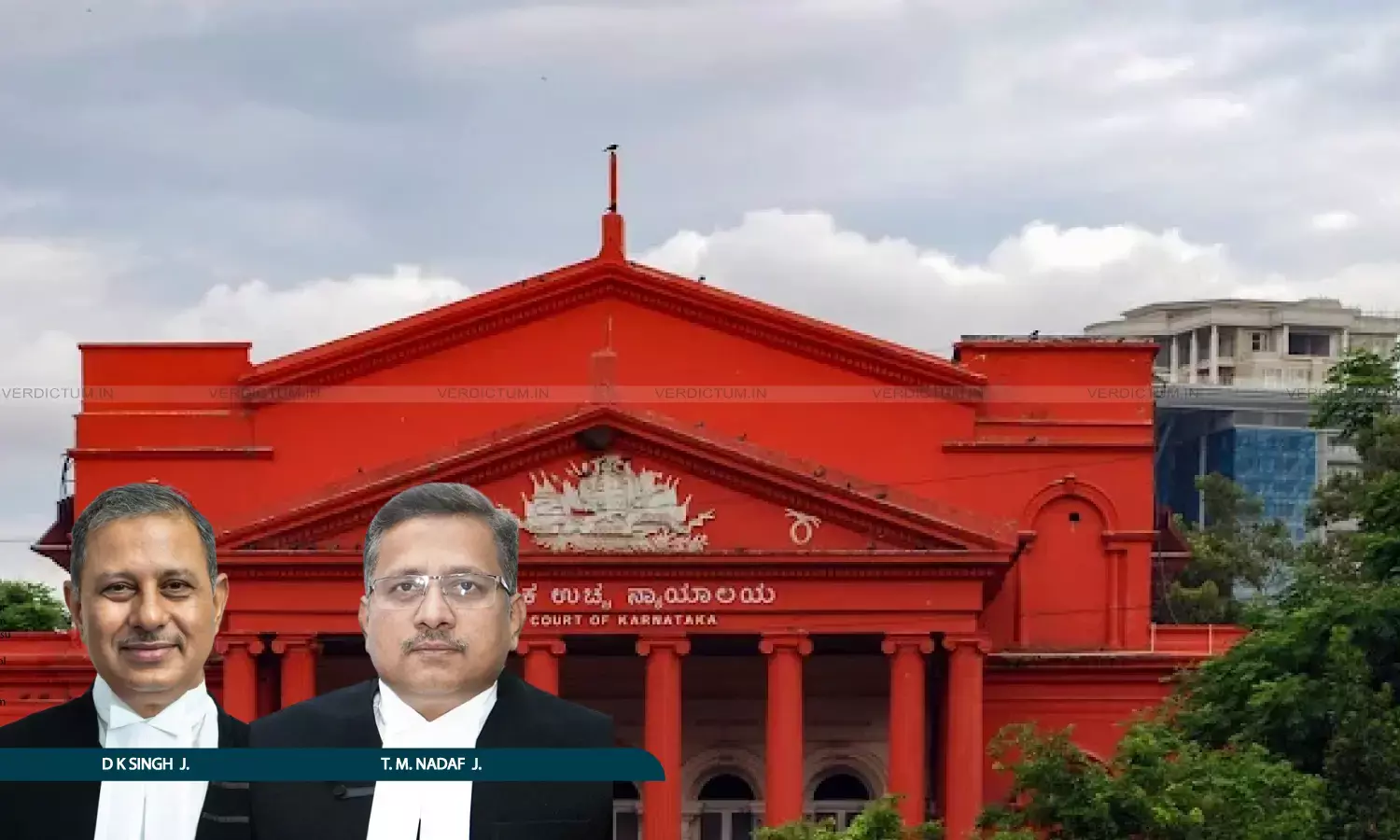
Justice D K Singh, Justice T.M. Nadaf, Karnataka High Court
The Karnataka High Court has held that land acquisition under the Karnataka Industrial Areas Development Act, 1966, cannot be undertaken for the benefit of a private entity under the guise of industrial development and that exercise of eminent domain powers must strictly serve the statutory public purpose contemplated under the enactment.
The Court further held that the Government cannot acquire land for an individual entity of its choice at the expense of poor landowners and that acquisition proceedings undertaken without genuinely subserving the statutory public purpose would amount to a colourable exercise of power and fraud on the statute.
The Court was hearing a batch of intra-court appeals arising out of a common judgment passed by the writ court in petitions challenging acquisition proceedings initiated under Section 28 of the Karnataka Industrial Areas Development Act, 1966, for the acquisition of lands in favour of the Indian Machine Tool Manufacturers Association (IMTMA) for the expansion of the Bangalore International Exhibition Centre project and the construction of a multi-level parking facility.
A Division Bench of Justice D K Singh and Justice T.M. Nadaf observed: “The Government cannot acquire the land for an individual entity of its choice at the expense and cost of the poor landowners. The object of the Act is public purpose in creating industrial areas for development of the industries and industrialisation of the State. The Government cannot acquire the land for an individual person/entity of its choice by exercising the power of eminent domain.”
The Bench further observed: “The acquisition of land or the property of individuals in exercise of the powers of eminent domain must not be conveyable exercise or fraud on statute or merely a device to transfer land to private hands.”
The Court added: “If the purpose namely, public purpose as envisaged under a statute under which the property is acquired is not subserved, then the exercise of the power of use of eminent domain must be held to be a colourable exercise of power and fraud on the statute.”
Senior Advocates H.N. Shashidhara and Basavaraj V. Sabarad, along with Advocates Maina Varma, Swaroop Anand R., Aditya Narayan, M.N. Sudev Hegde and others, appeared for the parties.
Background
The appeals arose from acquisition proceedings initiated under Section 28 of the KIAD Act for the acquisition of lands situated in Madanayakanahalli village in favour of IMTMA for the expansion of the Bangalore International Exhibition Centre project.
The Court noted that IMTMA had been established as a charitable company under Section 25 of the Companies Act, 1956. Pursuant to Government approval granted in 2003, land measuring 34 acres and 11 guntas was transferred by Nandi Infrastructure Corridor Enterprises (NICE) out of land acquired for the Bangalore-Mysore Infrastructure Corridor Project.
Subsequently, IMTMA acquired additional extents of land, including 6 acres and 10 guntas for the development of an approach road and 22 acres and 33 guntas through private purchase for the construction of additional exhibition halls. The Court recorded that IMTMA eventually acquired title over approximately 73 acres and 14 guntas of land.
Thereafter, IMTMA requested the State Government to acquire further lands measuring 23 acres and 38 guntas for the construction of a multi-level parking facility. Acting upon the request, the State authorities issued notifications under Section 28 of the KIAD Act.
The landowners challenged the acquisition proceedings before the writ court. The learned Single Judge partly allowed the writ petitions and held that only 7 acres of land could be acquired for the project, while quashing acquisition proceedings in respect of the remaining land.
The Single Judge had noted that NICE had already undertaken to provide 5 acres of land free of cost to IMTMA for parking purposes and that IMTMA had separately entered into agreements to purchase additional lands through private negotiations at prevailing market rates.
Aggrieved by the partial quashing of acquisition proceedings, appeals came to be filed by KIADB, IMTMA and the landowners.
Court’s Observation
The Division Bench examined the scheme and object of the KIAD Act and observed that the legislation was enacted for the orderly establishment and development of industries through the creation of industrial areas serving public purpose.
The Court observed: “The object of the KIAD Act is to acquire the land for the purpose of setting up the industrial areas and not for acquiring the land for an individual entity. After setting up an industrial area, the Government may allot the land to an applicant for setting up the industries in the industrial area.”
The Bench held that eminent domain powers exercised by the State must strictly conform to the public purpose contemplated under the statute and cannot be used merely to transfer lands to private entities.
The Court further observed: “The Act does not contemplate acquiring the land for an individual entity, and such a purpose cannot be said to be a public purpose. Setting up an industrial area is a public purpose and acquiring the land for a profit making entity for its expansion would not be in the line of the objects of the KIAD Act.”
The Court noted that IMTMA had already acquired substantial extents of land through private purchases and transfers from NICE and that acquisition proceedings were initiated specifically at the request of IMTMA for its expansion and parking requirements.
The Bench also took note of the fact that no award had been passed and no compensation had been deposited or paid to the landowners, even after nearly 14 years from the date of final notification.
The Court held that compulsory acquisition cannot be treated as a device to transfer land to private hands. It observed: “When an act is done by the State under the colour of authority of law, it must be for a lawful purpose envisaged under the statute.”
The Court further remarked: “This kind of exercise of power is a statutory and constitutional fraud by the State Authorities.”
The Division Bench also undertook a detailed examination of Sections 28 and 29 of the KIAD Act and held that the statute provides a complete mechanism governing compulsory acquisition of land.
The Court observed: “Thus, Sections 28 and 29 provide a complete mechanism for acquiring the land under the provisions of the KIAD Act i.e., issuing the notification under Section 28(1), filing the objections, considering the objections, providing opportunity of hearing, issuing the final notification under Section 28(4), issuing notice to surrender or deliver possession of the land to the State Government and thereafter, for payment of compensation.”
The Bench emphasised that acquisition proceedings attain legality only when every statutory safeguard is complied with strictly in the manner prescribed under the statute.
The Court observed: “All the steps are to be taken in the manner as provided for in the statute and if time has not been granted for filing the objections or the objectors have not been heard or no notice has been issued for surrendering possession or no compensation has been paid, then the land acquisition proceedings cannot be said to be complete.”
The Court further held: “The land acquisition proceedings would be susceptible to be declared illegal and ultra vires the statute and the Constitution of India being in violation of Articles 14, 21 and 300A of the Constitution.”
The Bench also relied extensively upon the Constitution Bench judgment in Kolkata Municipal Corporation v. Bimal Kumar Shah (2024) while examining the scope of the constitutional right to property under Article 300A.
The Court observed: “The right to property has to be given broader and meaningful interpretation. The right to property has seven sub-rights and it does not limit to twin components of public purpose and compensation.”
Referring to Bimal Kumar Shah (2024), the Court noted that the Supreme Court had recognised seven constitutional sub-rights constituting the right to property, including the right to notice, right to be heard, right to a reasoned decision, duty to acquire only for public purpose, right to fair compensation, right to an efficient process and right of conclusion of proceedings.
The Bench held that these procedural safeguards form substantive constitutional protections under Article 300A, and their non-compliance would render the acquisition unconstitutional and without authority of law.
The Court observed: “These seven rights though are procedures, but they do constitute real content of the right to property under Article 300A and non-compliance of these will amount to violation of the right to property being without the authority of law.”
The Court also emphasised that acquisition of private property must advance larger constitutional goals of a welfare State and distributive justice, and cannot merely facilitate transfer of land to a private entity chosen by the Government.
Conclusion
The Karnataka High Court held that acquisition under the KIAD Act cannot be undertaken merely for the benefit of a private entity and that the statutory power of eminent domain must genuinely serve a public purpose.
The Court upheld the principle adopted by the learned Single Judge restricting acquisition only to a limited extent while disapproving of excessive acquisition of lands from farmers and landowners for the benefit of IMTMA.
Accordingly, the batch of appeals came to be adjudicated in light of the above principles governing public purpose, constitutional property rights and permissible exercise of eminent domain powers under the KIAD Act.
Cause Title: Mukesh Kumar v. The State of Karnataka & Connected Matters
