

Private Interest Subordinate To Public Safety In Urban Planning; Fire Safety Norms Cannot Be Compromised: Karnataka High Court
The Court held that zoning and planning regulations, though restrictive on individual property rights, are justified where necessary to ensure public safety, particularly in high-rise constructions.
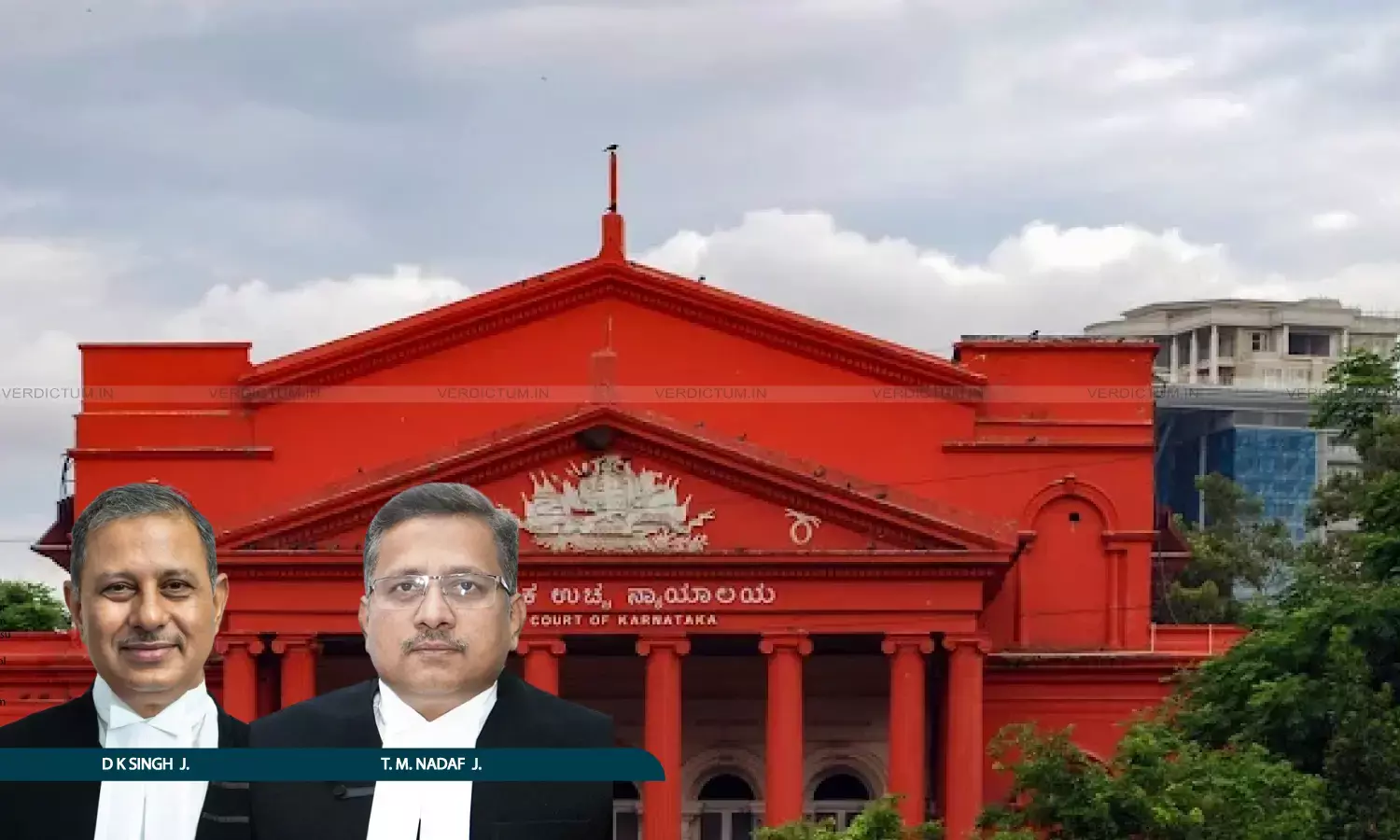
Justice D K Singh, Justice T.M. Nadaf, Karnataka High Court
The Karnataka High Court has held that zoning regulations and planning restrictions, even if they impose hardship on property owners or developers, cannot be termed arbitrary when they are aimed at safeguarding public safety and welfare.
The Court emphasised that private rights must yield to the larger public interest, particularly in cases involving high-rise constructions and compliance with fire safety norms.
The Court was hearing a writ appeal challenging the order of the Single Judge directing compliance with setback requirements and restraining construction that was found to violate fire safety norms.
A Division Bench of Justice D.K. Singh and Justice T.M. Nadaf observed: “… high rise buildings with pocket apartments, regardless of the luxury they provide in the apartments cannot be permitted to stand at the risk of General Public particularly the residents of the building and others in the neighbouring and nearby vicinities, … This is based on the principle that the private interest stands subordinate to the public interest and public good”.
The exercise of such governance by the local authorities, the Bench added, “is justified on account of its being reasonably necessary for the public health, safety and general welfare of the residents of the apartment as well as nearby vicinities”.
Senior Advocate P.S. Rajagopal appeared for the Appellant; AGA M.N. Sudev Hegde appeared for the Respondents.
Background
The dispute arose from a challenge to orders concerning a modified sanction plan and a Fire No Objection Certificate (NOC) issued for a residential-cum-commercial development project. The Apartment Owners’ Association had questioned the validity of the revised plan and NOC because the construction violated mandatory setback requirements, thereby compromising access for emergency services.
The Single Judge, after considering inspection reports of the Fire and Emergency Services Department, found that the required setback for movement of fire-fighting vehicles, particularly aerial ladder platforms, was not maintained. Accordingly, directions were issued to bring the construction into conformity with safety norms, including demolition of structures encroaching upon setback areas.
Aggrieved by the said directions, the builder preferred the present writ appeal.
Court’s Observation
The Court undertook a detailed examination of the material on record, including inspection reports submitted by the Fire and Emergency Services Department. It noted that the available setback space around the building was insufficient to permit movement of large fire-fighting vehicles, particularly aerial ladder platforms, which are essential for rescue operations in high-rise buildings.
The Court emphasised that compliance with fire safety norms is not a mere technical requirement but a substantive safeguard to ensure protection of life and property. It was observed that where such norms are violated, the consequences extend beyond individual inconvenience and directly impact public safety, including that of residents and persons in the surrounding vicinity.
The Court acknowledged the contention that regulatory restrictions caused undue hardship to the developer. However, the Court held that zoning regulations and planning controls inherently limit the manner in which property may be used, and such limitations cannot be considered arbitrary merely because they restrict individual freedom.
The Court further held that high-rise constructions, irrespective of the amenities or luxury they provide, cannot be permitted to exist in a manner that compromises emergency access or disaster response capabilities. It noted that absence of adequate setback and access routes would render it extremely difficult for authorities to respond effectively in case of fire or other emergencies.
Reiterating the principle that private interest must yield to public good, the Court held that regulatory measures governing building height, setbacks, density, and open spaces are indispensable components of urban planning and are necessary to ensure orderly development and safety.
“… Any deviation which is at the cost of the public safety at large cannot be condoned and brought in line, except taking the actions to make it in line by providing space, including the demolition of the extent of the building which has become an obstacle in the free passage of movement of vehicles, including heavy fire engines with other safety equipment”, the Court remarked,
The Court also relied upon precedents including Supertech Ltd. v. Emerald Court Owner Resident Welfare Association (2021), M.I. Builders Pvt. Ltd. v. Radhey Shyam Sahu (1999), and Rajendra Kumar Barjatya v. U.P. Avas Evam Vikas Parishad (2024) to reiterate that illegal constructions in violation of statutory norms cannot be regularised merely on account of investment or passage of time, and must be dealt with strictly.
Conclusion
The High Court found no infirmity in the order of the Single Judge directing compliance with fire safety norms and setback requirements.
Accordingly, the writ appeal was dismissed, and the directions to rectify violations, including the removal of construction obstructing emergency access, were upheld.
Cause Title: M/s Vishnu Sri Builders and Developers v. The Commissioner, BBMP & Ors. (Neutral Citation: 2026:KHC:18906-DB)
Appearances
Appellant: Senior Advocate P.S. Rajagopal; Advocate Sudhakar G.V.
Respondents: AGA M.N. Sudev Hegde; Advocate Madhukar Deshpande
Click here to read/download Judgment