

50% Reservation Ceiling Is A Firm Rule: Karnataka High Court Strikes Down Increase In SC/ST Quota To 17% And 7%
The Bench noted that the population proportion and subjective opinion are not “extraordinary circumstances”.

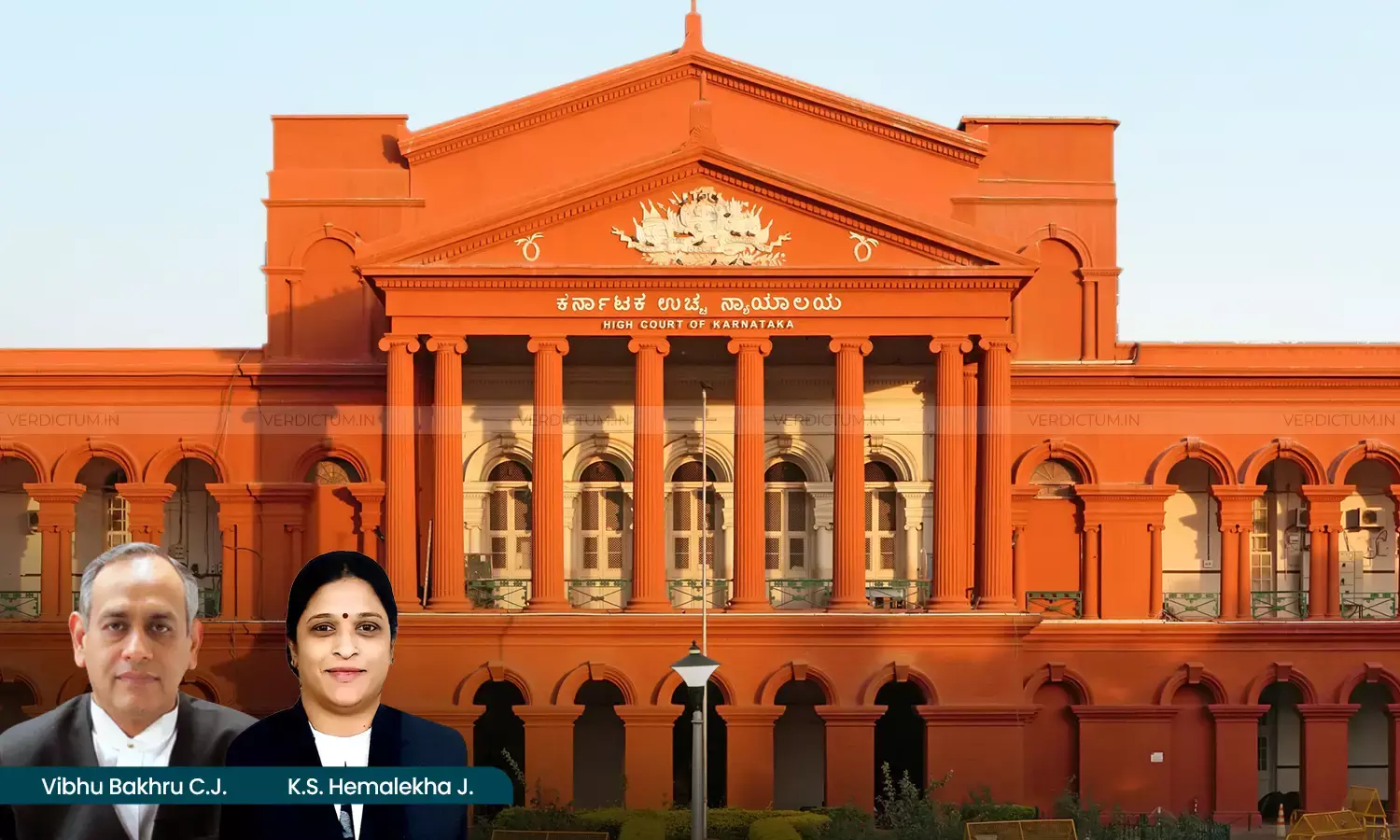
The Karnataka High Court has held that the 50% ceiling on reservation is a firm rule grounded in the equality clauses of the Constitution of India, and not a rule of prudence or an elastic guideline. The Court said the rule admits a departure only in extraordinary circumstances.
Applying that principle, the Court struck down Sections 3 and 4 of the Karnataka Scheduled Castes and Scheduled Tribes (Reservation) Act, 2022, which raised reservation for Scheduled Castes from 15% to 17% and for Scheduled Tribes from 3% to 7%. It held that the State’s reliance on population growth, and on reservation being lower than population share, did not amount to an extraordinary circumstance.
A Division Bench of Chief Justice Vibhu Bakhru and Justice K.S. Hemalekha observed, “…there can be little doubt that the 50% rule is not a rule of prudence or an ad hoc, elastic rule. It is a firm rule, albeit subject to an exception in extraordinary circumstances…Section 3 of the Act, insofar as it takes the aggregate reservation beyond the ceiling of 50%, is struck down as it violates Articles 14 and 15 of the Constitution. Section 4 of the Act is also struck down as unconstitutional, as it violates Articles 14 and 16 of the Constitution.”.
“In order to invoke the exception of extraordinary circumstances, the least that would be necessary is to establish that, but for exceeding the limit, there is no possibility for the leftout communities to have any meaningful participation. It is not the State’s case that, but for the increase in reservation beyond 50%, there is no possibility for a community or caste to have any real participation in the services of the State or to have a ‘look in’ in the administration”, it noted further.
In the matter the petitioner-in-person appeared and Senior Advocate Prof. Ravivarma Kumar appeared for the respondent.
The Act, deemed effective from November 01, 2022, replaced an Ordinance and was based on the Nagamohan Das Commission Report. With the 32% reservation for other backward classes unchanged, it raised aggregate reservation from 50% to 56%. A KPSC notification of March 13, 2024 reserved 51 of 92 Assistant Engineer posts in the BBMP.
The challenge came in a public interest petition by Mahendra Kumar Mitra and a petition by three civil engineering graduates. The Karnataka State Administrative Tribunal had earlier set aside the Government Order of December 28, 2022 prescribing roster points. The State’s challenge to that ruling was directed to be listed separately. In November 2025 the Court barred fresh recruitment on the increased reservation, with ongoing processes made subject to the final outcome.
On reasoning, the Court traced the ceiling from M.R. Balaji to Indra Sawhney and Dr. Jaishri Laxmanrao Patil. It held that the rule is the point of balance between the equality clauses. It rejected the argument that the 103rd Amendment, which provides EWS reservation, had obliterated the ceiling, noting that Janhit Abhiyan confines the ceiling to Articles 15(4), 15(5) and 16(4) of the Constitution of India.
The Court said quantifiable data on backwardness and inadequacy of representation cannot by itself justify exceeding 50%. It found that the Nagamohan Das Commission proceeded on proportionate representation, though Article 16(4) speaks of adequate representation. The Commission also relied on dated data, did not compare other communities, and found that the existing quotas had not been exhausted. Later Directorate of Economics and Statistics data showed SC representation at 18.65% and ST at 5.05%. The Court added that marginalisation within SCs and STs may justify internal reservation, but not a breach of the ceiling.
“Undoubtedly, the provision of reservation in pursuance of the State’s policy is a major policy matter. Thus, notwithstanding the State’s legislative competence to enact the Act, it was mandatory for the State Government to consult the National Commission for Scheduled Castes and the National Commission for Scheduled Tribes. Merely writing a letter after enacting the Act cannot be considered as consultation as required under clause (9) of Article 338 and clause (9) of Article 338A of the Constitution. The letters relied upon by the State, dated 10.12.2025 and 20.01.2026, were addressed nearly three years after the Act was enacted, and after its validity had been called in question before this Court. Consultation, to be meaningful and effective, must precede the decision. The contention that consultation is mandatory only if the policy adversely affects any Scheduled Castes or Scheduled Tribes is also unmerited. The language of clause (9) of Articles 338 and 338A of the Constitution is unambiguous, and it requires consultation on all major policy matters affecting the Scheduled Castes or the Scheduled Tribes”, the Bench noted.
The Court did not examine the consultation challenge any further, though it noted that consultation with the National Commissions under Articles 338(9) and 338A(9) is mandatory and must precede the decision.
Cause Title: Mahendra Kumar Mitra v. Secretary to Government of India, Ministry of Social Justice and Empowerment & Ors. WP No. 200448 of 2025
Appearances:
Petitioner: Petitioner in person.
Respondent: CGSC Harsha P. Banad, Senior Advocate Prof. Ravivarma Kumar with Ashwini O., Senior Advocate Ruben Jacob with K.M. Prakash for KPSC.