

Imprisonment In Default U/S 8(3) BNS Is A Coercive Mechanism To Secure Payment, Not A Disproportionately Oppressive Penalty: Karnataka High Court
In the matter, three consecutive default sentences were imposed on a cheque-dishonour convict across three prosecutions arising from a single loan transaction and one statutory demand notice.

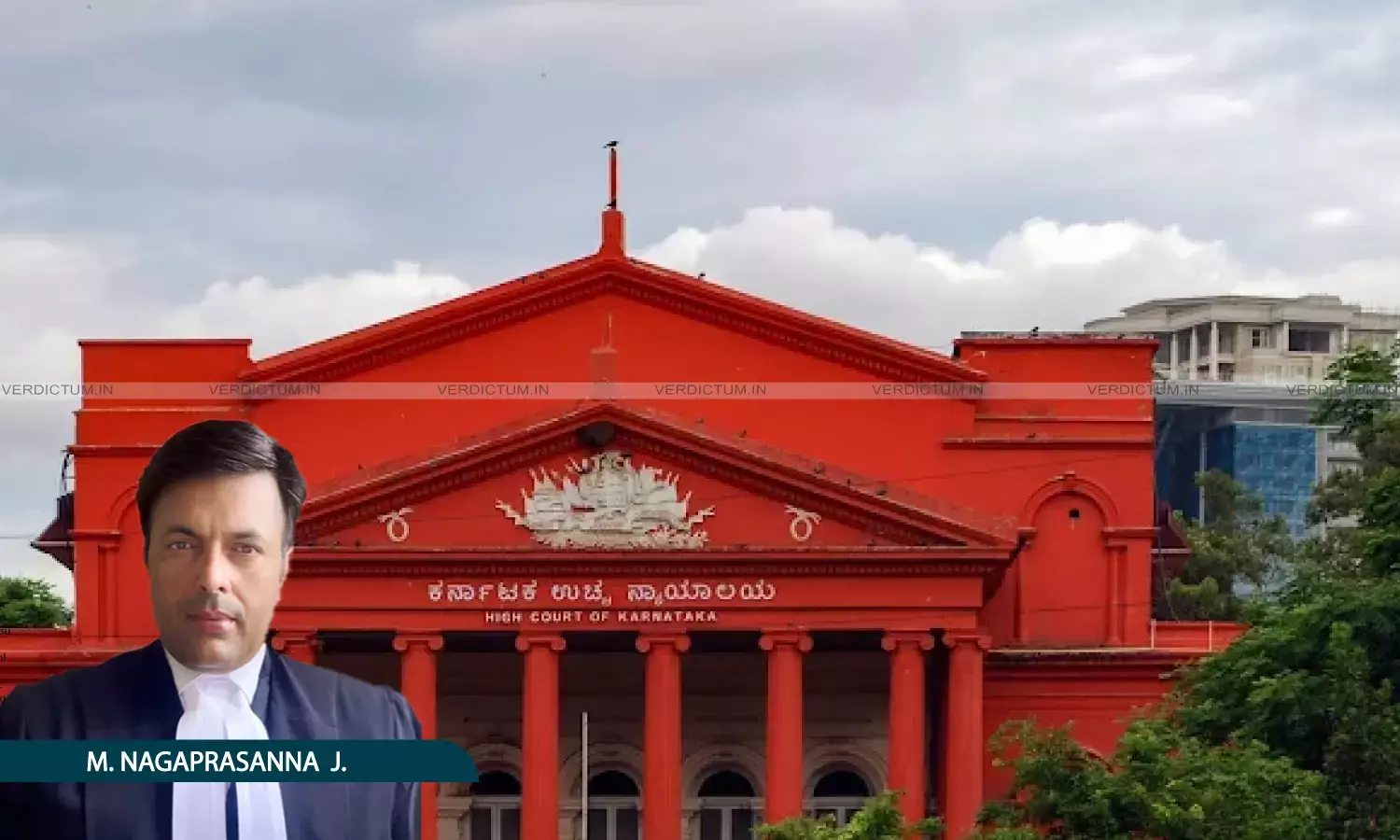
Justice M. Nagaprasanna, Karnataka High Court
The Karnataka High Court has held that Section 65 IPC, now Section 8(3) BNS, embodies a salutary restraint upon the sentencing power of criminal Courts, and that imprisonment in default of payment of fine is not to assume the character of a disproportionately oppressive penalty but is intended merely as a coercive mechanism to secure payment of fine.
The Court invoked the principle to equalize three consecutive default sentences imposed on a cheque-dishonour convict across three prosecutions arising from a single loan transaction and one statutory demand notice.
The Court further held that where the cumulative operation of separate default sentences, each individually within the statutory ceiling but collectively disproportionate, visits upon a financially incapable convict an aggregate imprisonment that the law would never sanction in a single prosecution. The constitutional guarantee of personal liberty under Article 21 of the Constitution of India obliges the Court to intervene in exercise of its inherent jurisdiction under Section 528 BNSS, without disturbing the complainant's surviving right to pursue recovery proceedings in accordance with law.
The pertinent question that the court identified as the pivotal issue was, whether the imposition of separate default sentences in three distinct prosecutions, all springing from one transaction, results in a punitive excess contrary to the mandate of Section 65 of the IPC, now mirrored in Section 8(3) of the BNS, thereby entitling the petitioner to immediate release from custody.
Justice M. Nagaprasanna observed, “Section 65 of the IPC, now reincarnated as Section 8(3) of the BNS, embodies a salutary restraint upon the sentencing power of criminal Courts. The provision ordains that where an offence is punishable with both imprisonment and fine, the term of imprisonment imposed in default of payment of fine shall not exceed one-fourth of the maximum term of imprisonment prescribed for that offence. The legislative intent underlying the provision is luminous: imprisonment in default is not to assume the character of a disproportionately oppressive penalty, but is intended merely as a coercive mechanism to secure payment of fine”.
“Equally germane are Section 30 of the Cr.P.C. and its successor provision, Section 24 of the BNSS, which further circumscribe the authority of a Magistrate while imposing imprisonment in default of payment of fine…”, the Bench further observed.
Advocate Keerthi Reddy appeared for the petitioner and B.N. Jagadeesha, Additional State Public Prosecutor, Senior Advocate Vikram Huilgol appeared for the respondent.
For the facts, on December 22, 2017, the petitioner, entered into a loan agreement with M/s. Jupiter Capital Pvt. Ltd. under which an amount of Rs. 5.96 crores was disbursed. By August 15, 2020, the outstanding repayment fell due, thereafter, the petitioner issued three cheques, for Rs. 50 lakhs, Rs. 3.5 crores and Rs. 5 crores respectively, towards repayment of principal and interest.
All three cheques were presented on the same day and dishonoured for want of sufficient funds. On September 11, 2020, the respondent-company issued a single statutory demand notice under Section 138 of the NI Act, filing three separate complaints thereafter.
The trial Court convicted the petitioner in all three cases on December 14, 2023, imposing fines of Rs. 61.67 lakhs, Rs. 4.31 crores and Rs. 6.16 crores respectively, with a default sentence of three months' simple imprisonment in each case.
The petitioner having failed to deposit the fine amounts, the learned Magistrate by separate orders dated September 29, 2025 directed him to undergo the default sentence across all three cases. Attachment proceedings under Section 421(1) Cr.P.C. were simultaneously initiated against the petitioner's properties in two of the three matters.
Having served over six months in judicial custody at Central Prison, Parapana Agrahara, Bengaluru, the petitioner preferred the present criminal petition before the High Court seeking reduction and equalization of the aggregate default sentence.
Drawing upon the Supreme Court's decision in K. Pranil Reddy v. State of Telangana, the Delhi High Court's ruling in Sanjay Vasudeva v. State of NCT, Delhi, where equalization was granted across 82 complaints, and the Bombay High Court's judgment in Cyrus Noshirwan Kartak v. State of Maharashtra 2026 SCC OnLine Bom 2921, the Court reaffirmed that default imprisonment is remedial and coercive in character, qualitatively distinct from substantive punishment, and that its mechanical or excessive imposition offends Articles 14 and 21 of the Constitution of India.
“In the light of the petitioner’s demonstrated financial incapacity to satisfy the enormous fine amounts imposed upon him, the acute hardship and destitution suffered by his family during his prolonged incarceration, and the principles so luminously enunciated by the Apex Court and the High Courts of Delhi and Bombay in the afore-quoted judgments, this Court is of the considered view that the petitioner has made out a compelling case for grant of relief”, the Bench observed.
Accordingly, the criminal petition was allowed, and the Court proportionately staggered, moderated and equalized the aggregate default sentence imposed across, to the period of imprisonment already undergone by the petitioner. He was directed to be enlarged from custody forthwith, and in any event within four days of receipt of a certified copy of the order, subject to his detention not being required in any other case or proceedings.
The Registry was directed to communicate the order to the Jail Authorities without delay. Attachment and recovery proceedings initiated under Section 421(1) Cr.P.C. against the petitioner's properties were expressly preserved and held to be unaffected by the present adjudication.
Cause Title: Dinesh Malpani v. State of Karnataka & Ors. Criminal Petition No. 5718 of 2026
Appearances:
Petitioner: Keerthi Reddy, Adbhuth J. Kaushik, Advocates.
Respondent: B.N. Jagadeesha, Additional State Public Prosecutor, Vikram Huilgol, Senior Advocate, with Amrita Shivaprasad, Advocate.