

Whether Residential JDAs Fall Within "Construction & Infrastructure Contracts" Under Commercial Courts Act: Karnataka High Court Refers To Larger Bench
The second question was whether the provisions of Section 2(1)(c)(vi) of the CC Act have to be interpreted as one uniform phrase “construction and infrastructure contracts” or as two words “construction” and “infrastructure” contracts separately.

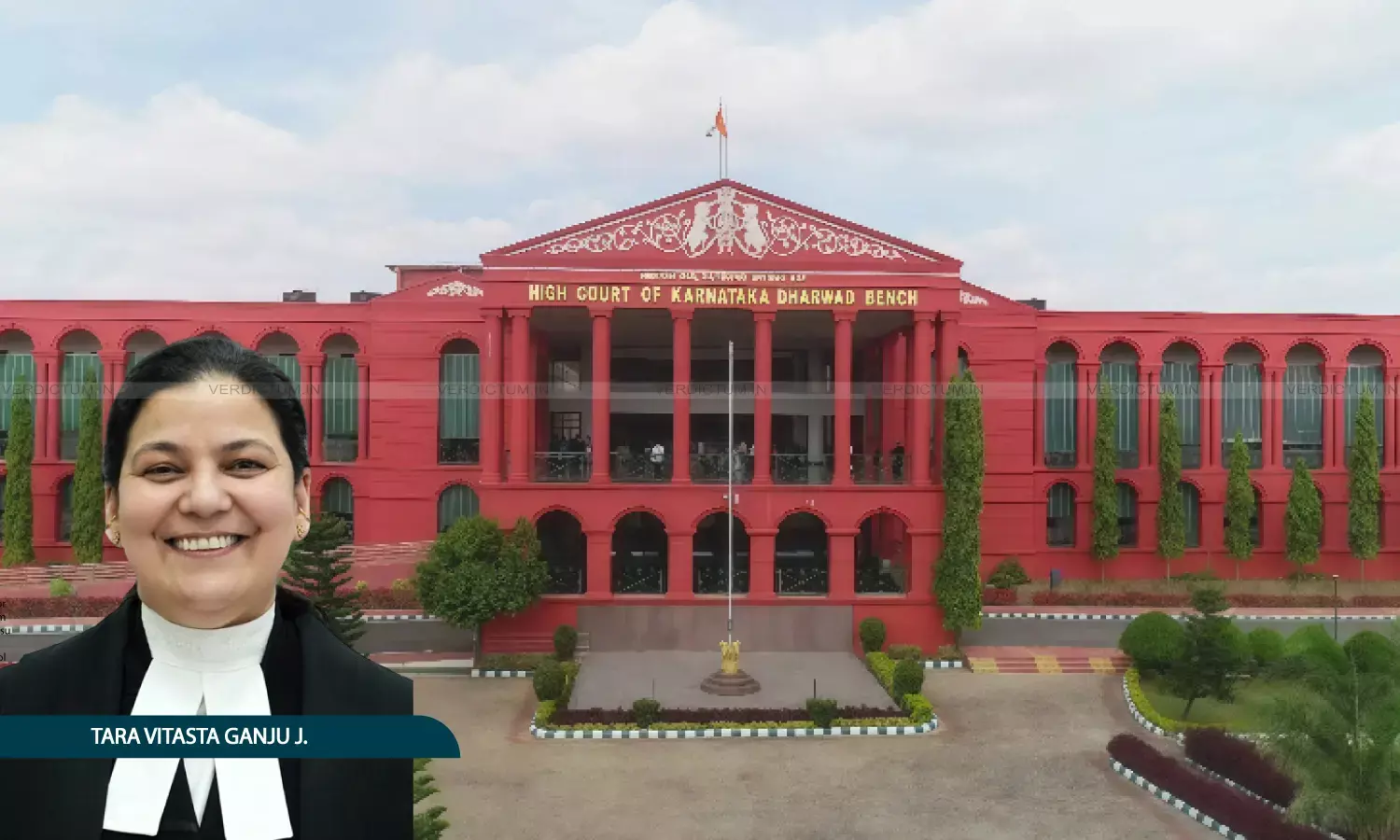
The Karnataka High Court has held that disputes arising out of joint development agreements (JDAs) for construction of residential apartments may not automatically constitute "commercial disputes" under the Commercial Courts Act, 2015, and has referred two connected questions of law to a larger bench owing to conflicting views among coordinate benches of the same Court.
The referral crystallises the interpretation of Section 2(1)(c)(vi) of the Commercial Courts Act, specifically, whether the phrase "construction and infrastructure contracts" must be read as a unified composite expression carrying an inherent commercial character, or whether the word "construction" alone is sufficient to bring a residential development agreement within the jurisdiction of a Commercial Court.
Justice Tara Vitasta Ganju observed, “…the property in dispute, which was developed pursuant to the JDA, cannot be said to be immovable property used exclusively in trade or commerce within the meaning of Section 2(1)(c)(vii) of the CC Act. The dispute pertains to development and allocation of residential apartments. Both parties are individuals and share the redeveloped flats and area as re-constructed. There is no material to indicate that the property was actually used for trade or commerce. Consequently, Section 2(1)(c)(vii) of the CC Act would not be attracted to the facts of the present case”.
“The JDA in question also does not satisfy the requirements of a true joint venture within the meaning of Section 2(1)(c)(xi) of the CC Act either. There is no provision in the agreement rendering one party liable for the acts or omissions of the other; nor does the material on record disclose joint control, shared management, or active participation by both parties in the development activity…”, the Bench observed.
Advocate Chintan Chinnappa M appeared for the petitioners and Advocate C.V. Manjunath appeared for the respondents.
On the interpretation of the provision of Section 2(1)(c)(vi) of the Act, the Bench noted that there were two views to the term “construction and infrastructure contracts”, therefore, the two questions that the Bench has referred to the larger Bench, are:
- Whether the Joint Development Agreements for construction of flats/floors for residential purposes where one or more party is an individual, without involving any commercial dispute of any nature, can be referred to as ‘construction and infrastructure contracts’ in terms of the provisions of Section 2(1)(c)(vi) of the CC Act?
- Whether the provisions of Section 2(1)(c)(vi) of the CC Act have to be interpreted as one uniform phrase “construction and infrastructure contracts” or as two words “construction” and “infrastructure” contracts separately?
The petitioners, a developer and his wife, had entered into a Joint Development Agreement dated March 24, 2011 with the respondent landowners for construction of a multistoried residential apartment complex in Devarabisanahalli, Bengaluru.
Under the agreement, the developer was entitled to 60% and the landowners to 40% of the super built-up area. Disputes arose over excess appropriation of built-up area and non-delivery of a penthouse, leading to arbitration, which culminated in an award dated July 12, 2019 dismissing the landowners' claims.
The respondent-landowners challenged the award under Section 34 of the Arbitration and Conciliation Act, 1996 before the LXXXIII Additional City Civil and Sessions Judge, Commercial Court Complex/
The petitioners filed an I.A. under Section 151 CPC seeking return of the petition on the ground that the dispute was not a "commercial dispute". The Commercial Court rejected the application by order dated 3 January 2023, holding the dispute fell under Section 2(1)(c)(vi) of the Commercial Courts Act. That order was challenged in the present writ petition under Article 227 of the Constitution of India.
The Court examined the JDA and Supplementary Agreements and found that the transaction was not a pure construction contract but a collaborative development arrangement in which a transferable interest in the land was created in favour of the developer.
Applying the Supreme Court's framework in Sushil Kumar Agarwal v. Meenakshi Sadhu (2019) 2 SCC 241, the Court noted that in a pure construction contract the contractor holds no interest in the land or construction, whereas here the developer was entitled to 60% of the undivided land share and the developed area, a materially different arrangement.
The Court further held, following its own judgment in Vijay Kohli v. Sanjay Jethwani 2025 SCC OnLine Del 8115, that "construction and infrastructure contracts" under Section 2(1)(c)(vi) must be read as a unified phrase, requiring both a construction dimension and an infrastructure or commercial character, and not as two disjunctive categories.
Since the project was purely residential and both parties were individuals, it did not satisfy either limb. The Court respectfully disagreed with the coordinate bench decisions in M/s Kiran Builders v. M. Surya Babu and R.J. Dayananda v. Narasamma, which had relied on the Andhra Pradesh Division Bench ruling in Blue Nile Developers Pvt. Ltd. v. Movva Chandra Sekhar 2021 SCC OnLine AP 3964, observing that the Blue Nile decision did not account for the Supreme Court's binding analysis in Sushil Kumar Agarwal.
The Court equally confirmed, following Faqir Chand Gulati v. Uppal Agencies Pvt.Ltd. & Anr. and the coordinate bench in M/s. Indraprastha Shelters Pvt. Ltd. v. South India Biblical Seminary, that the JDA was not a "joint venture" within Section 2(1)(c)(xi), nor did the property qualify as one "used exclusively in trade or commerce" under Section 2(1)(c)(vii).
“This Court is respectfully unable to agree with the judgments passed by the Co-ordinate benches and the interpretation that has been given by the Co-ordinate benches to the definition of ‘construction and infrastructure contracts’ Kiran Builders case as well as in R.J. Dayananda case…The developer appears to have undertaken the project independently in terms of the contractual arrangement based on specifications given by the owners. Accordingly, the agreement cannot be construed as a joint venture agreement so as to attract Section 2(1)(c)(xi) of the CC Act”, the Bench further observed.
The writ petition was disposed of in those terms and all pending applications were closed.
Cause Title: D. Arun Reddy & Anr. v. Late Muni Reddy (Represented By Legal Heirs) & Ors. (Neutral Citation: 2026:KHC:25826)
Appearances:
Petitioners: Chintan Chinnappa M., Advocate.
Respondents: C.V. Manjunath, V. Shivakumar, Advocates.