Offence Committed Before Accused Became Legislator Can Be Tried By MP/MLA Special Court: Karnataka High Court
The Court quashed the proceedings before the regular Magistrate but remitted the matter to the designated Special Court to regulate its procedure and pass appropriate orders.
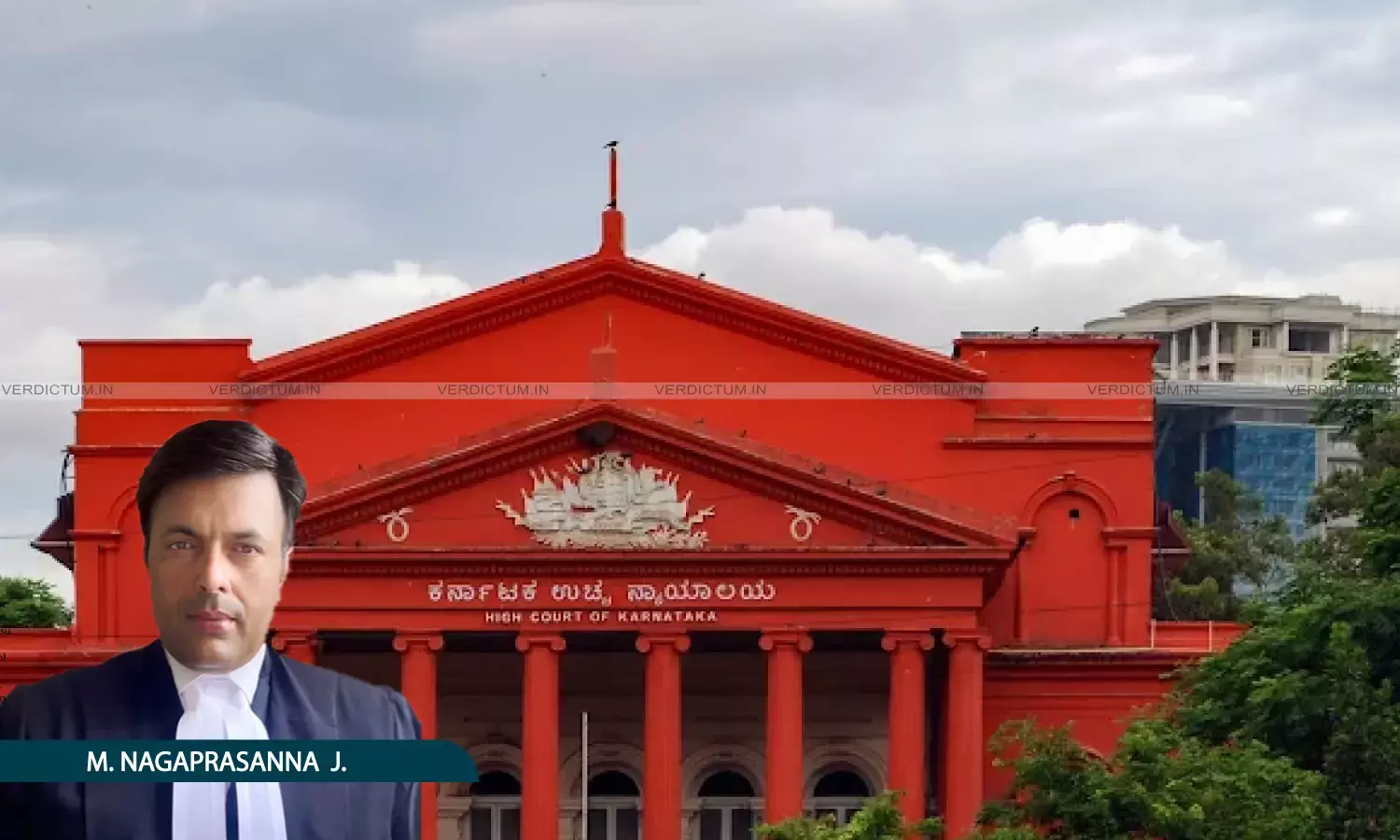
Justice M. Nagaprasanna, Karnataka High Court
The Karnataka High Court has held that Special Courts constituted to try criminal cases against sitting and former MPs and MLAs are competent to take cognizance of and try such cases irrespective of whether the alleged offence was committed before or after the accused became a legislator.
The Court consequently set aside the proceedings before the regular Magistrate and remitted the matter to the Special Court designated to try cases against sitting and former MPs and MLAs that are triable by Magistrates in Karnataka.
The Court was hearing a petition under Section 482 of the Code of Criminal Procedure, 1973, challenging the cognizance taken by a regular Magistrate in proceedings alleging offences under the Indian Penal Code, 1860. The petitioner confined his challenge to the Magistrate's jurisdiction and sought remittal of the matter to the designated Special Court.
A Bench of Justice M. Nagaprasanna observed that “the Special Courts, constituted pursuant to the direction of the Apex Court for trial of cases against sitting and former MPs and MLAs, are the Courts competent to take cognizance of and try such cases, irrespective of whether the offence is committed before or after the accused becomes a legislator, the object being expeditious disposal of such cases.”
Senior Advocate M. Aruna Shyam appeared for the petitioner. State Public Prosecutor-I B.N. Jagadeesha represented the State, while Advocate Sathyanarayana Chalke appeared for the second respondent.
Background
Criminal proceedings were initiated against the petitioner for alleged criminal breach of trust, cheating, forgery, use of forged documents and conspiracy under the IPC. After the investigation, the police filed a closure report. The complainant filed a protest petition, following which the regular Magistrate took cognizance of the alleged offences.
In the intervening period, the petitioner became a legislator. He approached the High Court contending that the regular Magistrate lacked jurisdiction because cases involving sitting and former legislators were required to be dealt with by the Special Court constituted for that purpose.
The petitioner sought remittal rather than termination of the case. Although the State opposed the petition on the merits, it accepted that earlier High Court decisions required the Special Court to take cognizance.
Court's Observations
Special Courts Designated According To Nature Of Trial
The Court relied on Dr. K. Sudhakar v. State of Karnataka (2024), which explained that Karnataka had constituted separate Special Courts for cases against sitting and former MPs and MLAs depending on whether the offences were triable by a Magistrate or a Court of Session.
The earlier decision had held: “The petitioner is an elected representative, insofar as elected representatives are concerned, two Courts are constituted pursuant to the direction of the Apex Court. One, the Special Court for trial of cases filed against sitting as well as former MP's and MLA’s, triable by Magistrate in the State of Karnataka and the other Special Court of the District Judge - the Court of Session. Since, the petitioner was a people representative, the police after investigation ought to have filed their final report before the Special Court for trial of cases filed against sitting as well as former MP's and MLA’s, triable by Magistrate in the State of Karnataka and not the Court of the Regular Magistrate.”
Applying that ruling, the Court held that the present matter should have been placed before the Special Court competent to deal with Magistrate-triable cases involving legislators.
Status On Date Of Alleged Offence Was Immaterial
The Court also relied on Dr Y. Ramappa v. State of Karnataka (2026), in which a coordinate Bench considered decisions of the Delhi and Manipur High Courts.
The Manipur High Court had held that “the Special Courts have jurisdiction to try all cases against the former and sitting legislatures irrespective of their status at the time of commission of such offences.”
The coordinate Bench had preferred this approach over the view that jurisdiction depended on the accused being a sitting legislator when the alleged offence was committed. The present Court applied that reasoning.
Jurisdictional Error Did Not Extinguish The Case
The Court clarified that cognizance taken by a court lacking jurisdiction was unsustainable, but this did not nullify the complaint or investigation. The matter had to be placed before the competent Special Court for further orders.
The Karnataka High Court in Dr. K. Sudhakar (2024) had explained: “Who has taken cognizance is discernable by an order itself and it is an admitted fact that the said Court does not have jurisdiction to deal with cases of people's representatives. Therefore, the final report ought to have been placed before the Special Court so constituted. Since it is a jurisdictional error, it is on the face of it, unsustainable. However, that does not mean that the complaint or investigation would vanish. The final report must be placed before the jurisdictional Court and the jurisdictional Court to take the matter further by regulating its procedure.”
Conclusion
The High Court allowed the petition and quashed the proceedings pending before the regular Magistrate. It remitted the matter to the Special Court constituted to try Magistrate-triable cases against sitting and former MPs and MLAs in Karnataka.
The Special Court was directed to regulate its procedure and pass appropriate orders in accordance with law. The complaint and investigation were therefore preserved for consideration by the competent court.
Cause Title: B.M. Farooq @ Bava Mohammed Farookh v. State of Karnataka and Another
Appearances
Petitioner: M. Aruna Shyam, Senior Advocate, assisted by Suyog Herele E., Advocate
Respondents: B.N. Jagadeesha, State Public Prosecutor-I; Sathyanarayana Chalke, Advocate, for S. Rajendra, Advocate