

Not Merely An Error Of Judgment: Karnataka HC Directs Inquiry After Police Charged Man With Abetment Of Suicide When His Wife Was Still Alive
The Bench directed a departmental inquiry against the erring police officer, observing that a citizen's personal liberty cannot be sacrificed at the altar of investigative negligence.

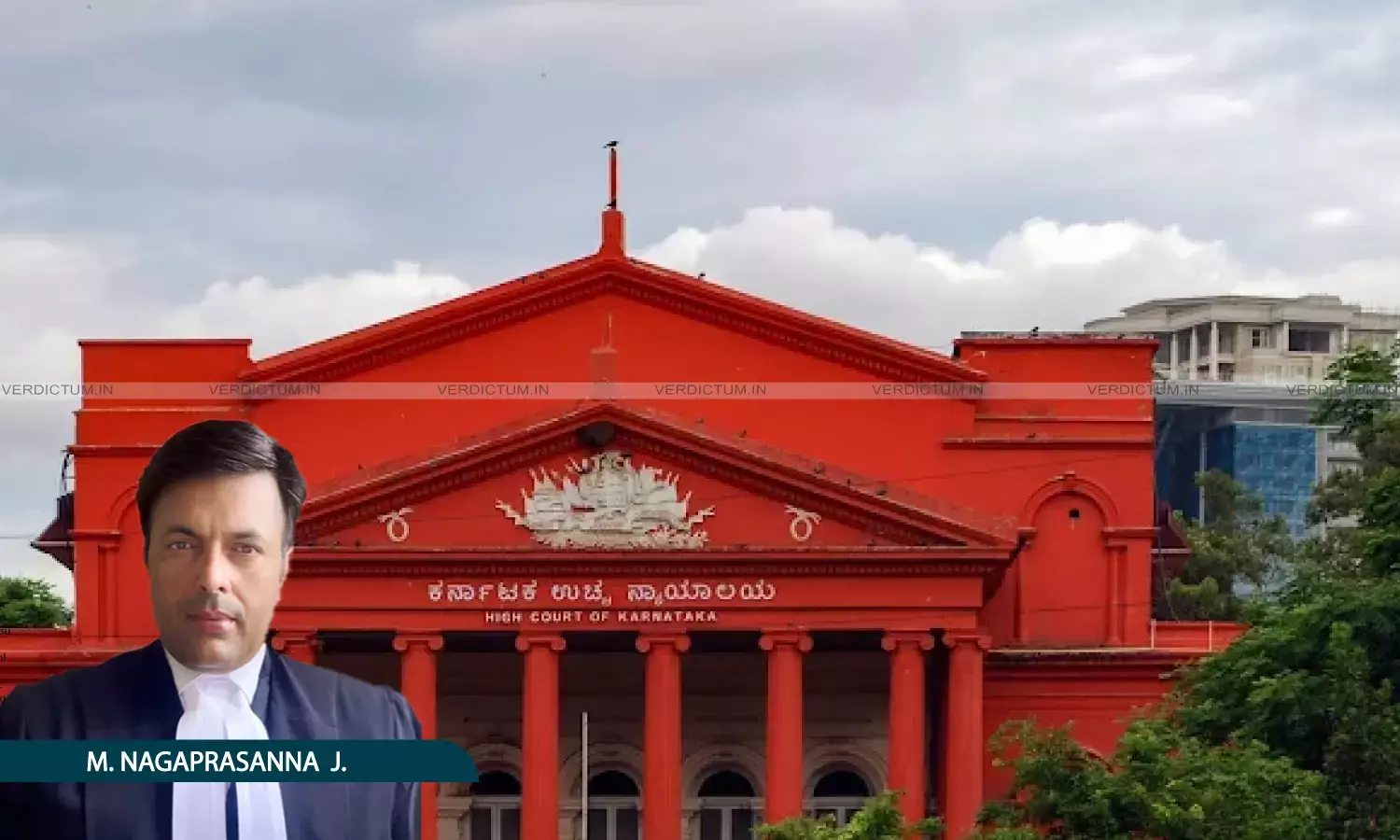
Justice M. Nagaprasanna, Karnataka High Court
The Karnataka High Court quashed criminal proceedings against a husband accused of abetment to suicide, pointing out that the alleged victim—his wife—was alive, healthy, and standing right inside the courtroom.
While allowing the quashing petition on the ground of a mutual matrimonial settlement, the Court expressed deep shock over the fact that the petitioner had been forced to languish in prison for six months under a charge sheet that lacked any legal legs to stand on.
Emphasizing that the criminal justice system cannot be reduced to a frolicsome act driven by the whims and fancies of investigating authorities, the Court ruled that accountability must follow such abuse of power and directed the competent authority to initiate a meaningful departmental enquiry against the officer-in-charge of the police station.
The Bench of Justice M Nagaprasanna observed, "The criminal justice system cannot be permitted to be reduced to a frolicsome act of the investigating officer, where accusations are drafted upon whim and fancy. Liberty of a person cannot be sacrificed at the altar of negligence. The present case is not merely an error of judgment; it is a glaring manifestation of nonapplication of mind that has resulted in the incarceration of a citizen for half a year, for an offence that was legally non-existent. It is therefore, imperative, that accountability must follow such abuse of authority."
Brief Facts of the Case
The petitioner, being the husband of the second respondent, was arrayed as the sole accused in a criminal proceeding registered for offences punishable under Sections 108, 62, 85, and 352 of the Bharatiya Nyaya Sanhita (BNS). The matrimonial relationship between the parties suffered a strain, culminating in a domestic alteraction. On the evening of the incident, the petitioner arrived home in an inebriated state and attempted to assault the complainant. Driven by distress, the complainant attempted to commit suicide by jumping from the second floor of their residential house.
The said attempt did not result in her demise, though she sustained bodily injuries for which she received medical treatment. Subsequently, the complainant approached the jurisdictional police and lodged a formal complaint clearly narrating the attempt to commit suicide. Based on the said information, the law enforcement agency registered a first information report and, upon concluding the investigation, filed a charge sheet against the petitioner.
Consequent to the registration of the case for abetment of suicide, the petitioner was apprehended and remanded to judicial custody, where he continued to remain incarcerated. During the pendency of the proceedings, the husband and wife reconciled, resolved their matrimonial disputes, and mutually desired a reunion. Consequently, the petitioner moved the High Court seeking the quashing of the criminal proceedings on the strength of a compromise.
Contention of the Parties
The petitioner contended that the very invocation of the penal provision for abetment of suicide was legally unsustainable and reflected a mechanical application of mind by the prosecution. It was argued that since the complainant survived the attempt, no offense of suicide occurred in the eye of the law, thereby rendering the charge of abetment of commission of suicide completely inapplicable to the admitted facts. The counsel further submitted that since the parties arrived at an amicable settlement to resume their conjugal life, the pending criminal proceedings ought to be quashed to facilitate the petitioner’s release from prison.
The second respondent/complainant concurred with the submissions of the petitioner and admitted the factum of settlement arrived at between the parties, endorsing the prayer for closure of the criminal case in the interest of their matrimonial reunion.
Observations of the Court
The High Court observed that the case presented a deeply troubling and disquieting narrative of a mechanical prosecution and a reckless invocation of penal provisions by the law enforcement agency. It was noted that the primary offence invoked against the petitioner was abetment to suicide under Section 108 of the Bharatiya Nyaya Sanhita (BNS). The Court emphasized that the statutory provision of Section 108 of the BNS was neither ambiguous nor elastic, as it remained anchored upon the undeniable and mandatory prerequisite of an actual commission of suicide.
The Court further observed that since the complainant survived the attempt and stood alive and healthy before the Bench, the very foundation and substratum of the accusation under Section 108 of the BNS was rendered wholly illusory. Despite the clear absence of a demise, the officer-in-charge of the police station and the Investigating Officer displayed an astonishing degree of recklessness, prosecutorial haste, and foolhardiness by not only registering the first information report but also routinely filing a charge sheet for a legally non-existent offence.
Expressing deep shock, the Court remarked that its judicial conscience was severely troubled not merely by the erroneous invocation of the legal provision, but by the grave consequence it entailed on personal liberty. It was highlighted that the petitioner languished behind prison walls for six long months under a charge sheet that could not remotely sustain legal scrutiny.
The Court characterized the prolonged incarceration as a stark manifestation of investigative imprudence, severe non-application of mind, and a total indifference to the constitutional right to liberty, concluding that the criminal justice system could not be permitted to be reduced to a frolicsome act driven by the whims and fancies of investigating authorities.
"This Court, would have accepted the settlement and closed the issue. But in the teeth of the aforesaid facts, this Court cannot remain a silent spectator to such cavalier exercise of police power. The investigating officer who without even adverting to the elementary ingredients of the offence punishable under Section 108 of the BNS – abetment to suicide, registered the crime and goes on to file the charge sheet even. Such recklessness cannot be permitted to escape scrutiny", it said.
Consequently, while accepting the genuine and voluntary matrimonial settlement arrived at between the parties to restore harmony, the Court held that it could not remain a silent spectator to such a cavalier exercise of police power. Accountability was deemed imperative to prevent the sacrifice of personal liberty at the altar of official negligence.
The Court therefore directed the competent authority to initiate a meaningful, non-ritualistic departmental enquiry against the erring officer-in-charge of the police station for patent irresponsibility, commanding that an action-taken report be submitted to the High Court within a stipulated period of three months.
Cause Title: Mr Nixon v. State and Anr. [Neutral Citation:2026:KHC:21203]
Appearances:
Petitioner: Advocate Ranganath Reddy R
Respondents: Advocate BN Jagadeesha