

Pending Trial Doesn't Divest Undertrial Of His Ownership Over Properties: Karnataka High Court Directs Authorities To Facilitate Sub-Registrar's Visit To Prison
The Court observed that an accused person who is in judicial custody as an under-trial prisoner does not suffer a civil death merely because he is facing criminal prosecution.

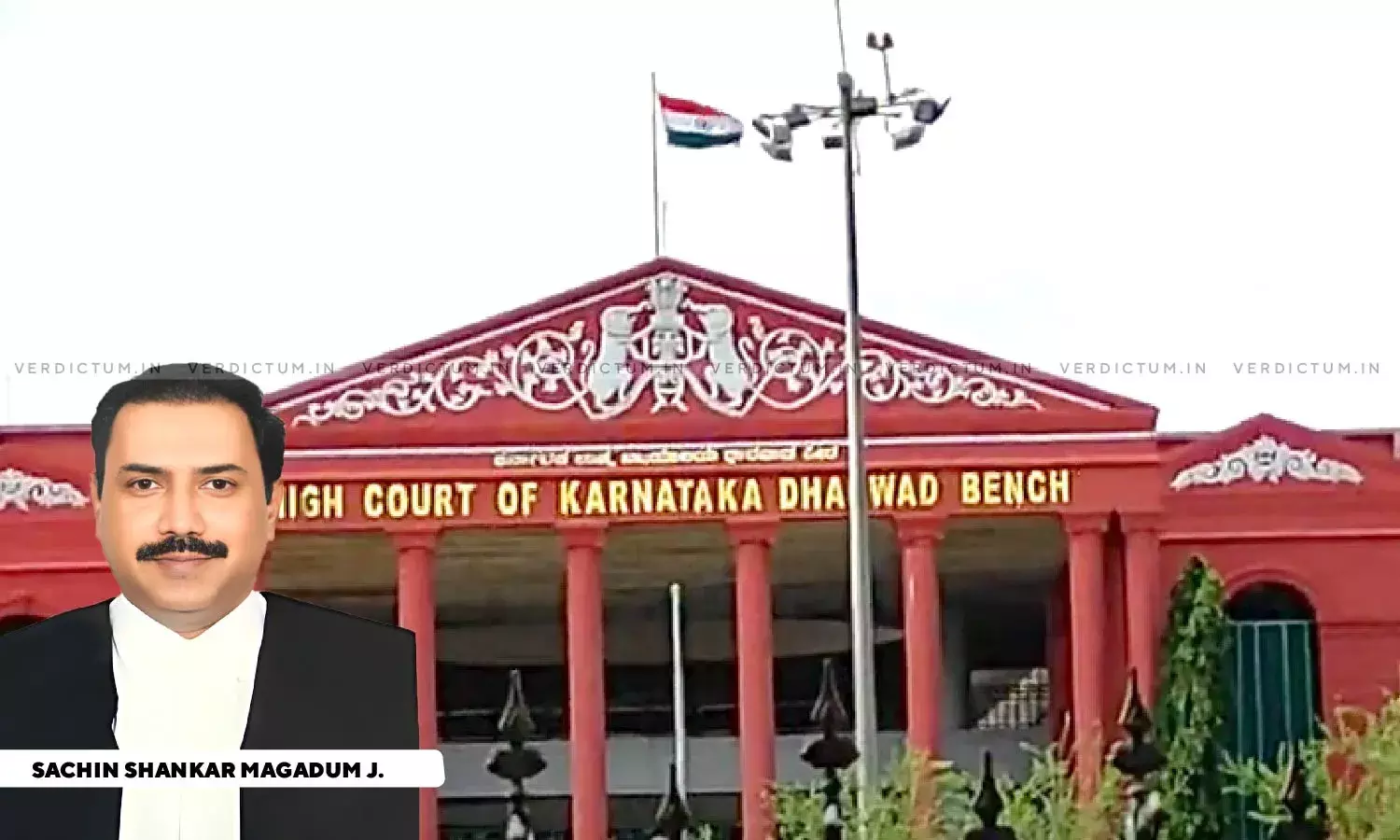
Justice Sachin Shankar Magadum, Karnataka High Court, Dharwad Bench
The Karnataka High Court has held that under-trial prisoners possess a legal and enforceable right to execute and register a conveyance relating to their property by resorting to the procedure prescribed under Section 38 of the Registration Act, 1908.
The Court observed that his incarceration pending trial does not divest him of his ownership over his movable or immovable properties nor does it extinguish his civil rights except to the extent that restrictions are necessarily imposed by law for maintaining prison discipline, security and orderly administration.
It also said that the Registering Officer is under a statutory obligation to undertake the exercise, while the prison authorities are under a public duty to facilitate such exercise by permitting the Registering Officer to enter the prison premises and complete the necessary formalities.
The Bench of Justice Sachin Shankar Magadum held, "It is equally well settled that an accused person who is in judicial custody as an under-trial prisoner does not suffer a civil death merely because he is facing criminal prosecution. His incarceration pending trial does not divest him of his ownership over his movable or immovable properties nor does it extinguish his civil rights except to the extent that restrictions are necessarily imposed by law for maintaining prison discipline, security and orderly administration. An under-trial continues to remain clothed with all proprietary rights available to an ordinary citizen, including the right to alienate, transfer or otherwise deal with his property in accordance with law."
Advocate Sanket Shankrappa Ambali appeared for the Petitioner, while AGA Sharad V. Magadum appeared for the Respondents.
Brief Facts
The petitioner, an under-trial prisoner, was lodged in judicial custody at the Central Prison, Dharwad. Being incarcerated, he was unable to personally appear before the office of the Sub-Registrar to execute and register a sale deed concerning his immovable property, specifically measuring 22 guntas situated at Kamalapur Village, Dharwad.
Consequently, he preferred the instant writ petition under Articles 226 and 227 of the Constitution of India seeking a writ of mandamus to direct the prison authorities to permit the jurisdictional Sub-Registrar to enter the prison premises to complete the statutory registration formalities.
Contentions of the Parties
The Petitioner contended that the petitioner's incarceration pending trial did not strip him of his proprietary rights to alienate his immovable property. It was further submitted that Section 38 of the Registration Act, 1908, explicitly carved out an exception exempting persons confined in jail under civil or criminal process from personal appearance at the registration office, thereby mandating the registering officer to visit the prison for such purposes.
The Respondent authorities submitted that the jurisdictional Sub-Registrar had indeed addressed a communication to the Superintendent of the Central Prison requesting facilitation of the registration. However, the said communication was never placed before the competent prison authority. It was contended that the failure to facilitate the registration process was not deliberate but was owing to the non-receipt or non-placement of the said communication before the Superintendent.
Observations of the Court
The High Court observed that a plain and meaningful reading of Section 38 of the Registration Act, 1908, left no room for doubt that the Legislature consciously recognized the practical difficulties faced by incarcerated individuals.
The Court noted that the provision used mandatory language, obligating the Registering Officer either to personally visit the jail or to issue a commission for the examination of the confined person, ensuring that legal incapacity to physically appear did not result in the deprivation of property rights.
The Court further observed that an accused person in judicial custody did not suffer a civil death merely because he faced criminal prosecution. Incarceration did not divest an under-trial prisoner of his ownership over properties or extinguish his civil rights, except for necessary restrictions imposed to maintain prison discipline and security.
The Court observed, "This Court is therefore satisfied that the petitioner, though presently an under-trial prisoner, possesses a legal and enforceable right to execute and register a conveyance relating to his property by resorting to the procedure prescribed under Section 38 of the Act. Correspondingly, the Registering Officer is under a statutory obligation to undertake the exercise contemplated under the said provision, while the prison authorities are under a public duty to facilitate such exercise by permitting the Registering Officer to enter the prison premises and complete the necessary formalities in accordance with law."
The Court held that an under-trial continued to remain clothed with all proprietary rights, including the right to alienate property, and that administrative inconvenience could not be cited as a ground to defeat a statutory right.
"In the present case, the petitioner seeks only to avail the statutory procedure expressly contemplated under Section 38 of the Act. The request neither seeks any extraordinary indulgence nor requires this Court to carve out a new procedure. What is sought is only enforcement of an existing statutory obligation. Once the jurisdictional Sub-Registrar has expressed his willingness to visit the prison for completion of the registration process, the prison authorities are equally duty-bound to extend necessary cooperation by facilitating access to the petitioner, subject of course to compliance with the prison rules and such security measures as may be considered necessary. Administrative inconvenience cannot be put forth as a ground to defeat a statutory right expressly recognized by Parliament", the Court observed.
Finding that the petitioner possessed an enforceable legal right and that the respondents did not dispute his entitlement, the Court allowed the writ petition and directed the Superintendent of the Central Prison to permit the Sub-Registrar to visit the jail premises to complete the registration process in accordance with law.
Cause Title: Shri Basavaraj Shankrappa Avvannavar v, The Superintendent, Central Prison and Ors. [Neutral Citation: 2026: KHC-D:8208]
Appearances:
Petitioner: Advocate Sanket Shankrappa Ambali
Respondents: Advocate Sharad V. Magadum.
Click here to read/download the Order