

ED Is Not A Super Cop; Cannot File Private Complaint When Police Don’t Act On Information Shared U/S 66(2) PMLA: Karnataka High Court
The High Court also held that once the predicate offence is closed for want of sanction, the ED cannot continue investigation into proceeds of crime under the PMLA.

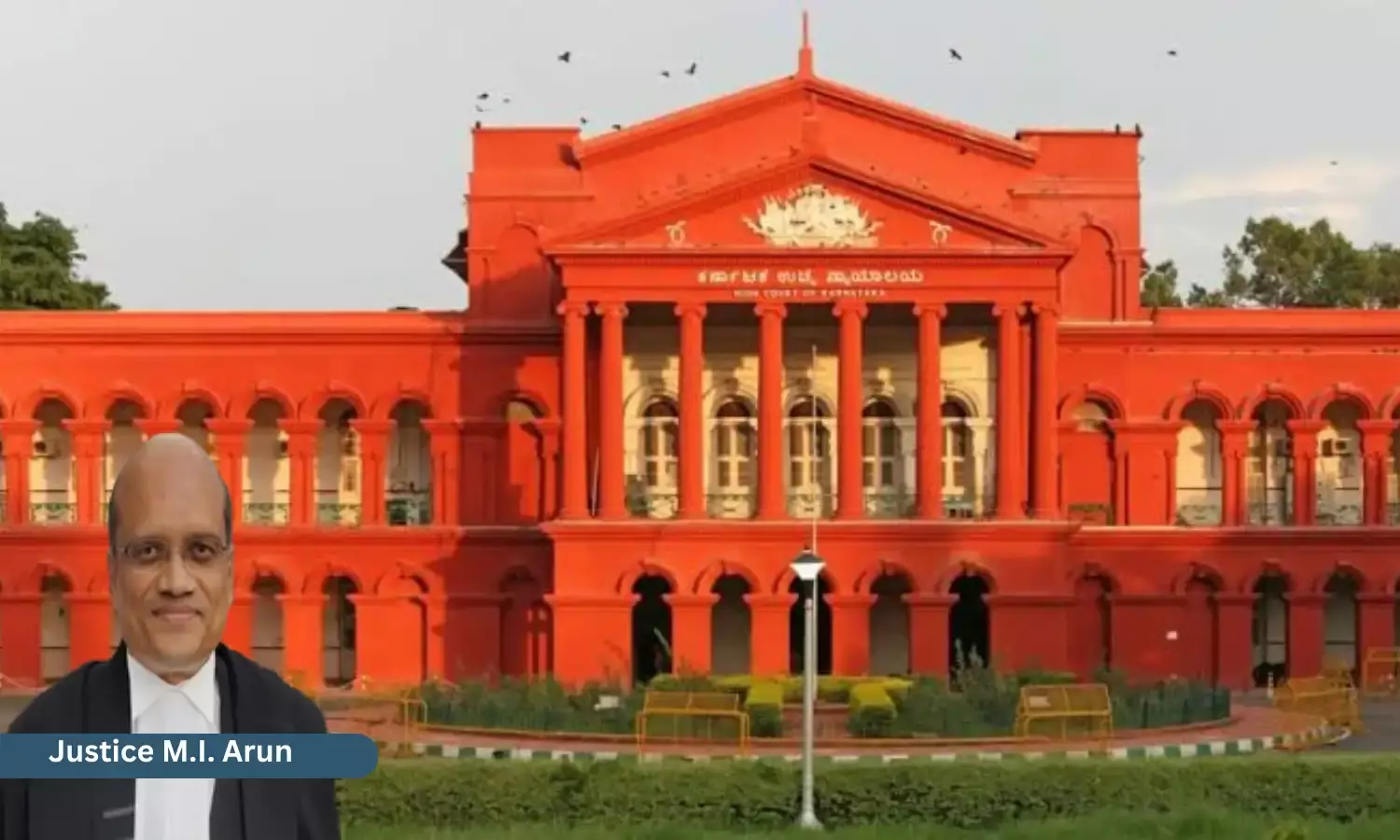
Justice M.I.Arun, Karnataka High Court
The Karnataka High Court has held that when the Enforcement Directorate (ED) shares information about a scheduled offence with the concerned agency under Section 66(2) of the Prevention of Money-Laundering Act, 2002 (PMLA), and that agency does not initiate prosecution, the ED is not empowered to file a private complaint under Section 200 of the Code of Criminal Procedure, 1973/Section 223 of the Bharatiya Nagarik Suraksha Sanhita, 2023 (BNSS) and then proceed under the PMLA.
The Court observed that the power of the ED is derivative and not original, and it cannot initiate an investigation suo motu based on a standalone suspicion of money laundering. It further held that when the predicate offence is terminated in favour of the accused, even on a technical ground such as want of sanction, the proceedings under the PMLA cannot continue.
The Court allowed a batch of writ petitions and quashed the ECIR, the summons, the show-cause notice, the order of the Adjudicating Authority confirming the seizure, and the private complaint filed by the ED before the Special Court.
The Bench of Justice M.I. Arun observed, “The ED is not a super cop to investigate anything and everything which comes into its notice… The ED is not like any other person to file a complaint under Section 200 Cr.P.C./223 of BNSS. It has to exercise only those powers expressly conferred on it by the PMLA. Filing of a private complaint by the ED is not contemplated under the PMLA. Allowing the ED to prefer a private complaint, when the other government authorities deem it inappropriate to initiate any proceedings against anybody, will amount to permitting the ED to act as a super cop and it goes against the philosophy of the Act which requires a predicate offence to be in existence for the ED to initiate proceedings as contemplated under the PMLA.”
Senior Advocate Kiran S. Javali appeared for the Petitioners, while Additional Solicitor General S.V. Raju appeared for the ED.
Brief Facts
The petitioner in one of the writ petitions, K.Y. Nanje Gowda, was the Chairman of the Land Grant Committee of Malur, Kolar District. It was alleged that he, in collusion with other Members of the Committee, recommended grant of land measuring about 80 acres for about 38 persons by abusing their official position, in an illegal manner (the ‘Land Scam Case’).
A private complaint was filed before the Chief Metropolitan Magistrate, Bangalore alleging commission of offences under Sections 468, 464, 465, 471, 420 and 120B of the Indian Penal Code, 1860. Thereafter, Nanje Gowda was appointed as Chairman of Kolar and Chikkaballapur Milk Union Ltd. (KOMUL).
Treating the Land Scam Case as a predicate offence, the ED registered an ECIR. While conducting searches, the ED came across certain materials which, in its opinion, amounted to a scam pertaining to recruitments of employees to KOMUL (the ‘Job Scam Case’). Summons were issued to Y.B. Ashwathanarayan on the basis of this material.
The ED filed an Original Application under Section 17(4) of the PMLA before the Adjudicating Authority, which issued a show-cause notice. The ED also shared information about the Job Scam Case with the jurisdictional police/authority under Section 66(2) of the PMLA.
Meanwhile, a closure report was filed in the Land Scam Case. The complainant filed a protest petition, but as the allegations were against a public servant and the requisite government sanction was not obtained, the Trial Court dismissed the case for non-prosecution.
The Adjudicating Authority confirmed the seizure. As the jurisdictional police/authority did not deem it fit to act upon the information shared under Section 66(2), the ED itself filed a PCR before the Special Court, seeking to have the case referred to the Lokayukta Police for investigation under Sections 7, 11, 12 and 13 of the Prevention of Corruption Act, 1988 and Sections 120B, 420, 464, 465, 468 and 471 of the IPC. The Special Court took cognizance and called for a status report.
Aggrieved, the petitioners approached the High Court.
Contentions of the Parties
The petitioners contended that once a predicate offence is closed, either on merits or on technical grounds, the ED cannot continue investigation under the provisions of the PMLA.
They argued that when the ED, while investigating proceeds of crime under one offence, comes across material which in its opinion amounts to an altogether different scheduled offence, it is only empowered to share the information with the relevant police/authority.
The ED contended that once investigation is taken up based on the existence of a predicate offence and that offence is closed on technical grounds and not on merits, the ED is still empowered to investigate the offence of money laundering.
It was also contended that when the concerned authority does not act upon the information received under Section 66(2) of the PMLA, then, as any person is empowered to set criminal proceedings in motion, the ED is empowered to maintain a private complaint under Section 200 CrPC/Section 223 BNSS.
Observations/Findings of the Court
The Court framed two questions: whether the ED can continue investigation into proceeds of crime when the predicate offence is closed on a technical ground such as want of sanction, and whether the ED can prefer a complaint under Section 200 CrPC/Section 223 BNSS when the agency to which information was shared under Section 66(2) fails to initiate prosecution.
Referring to Sections 3 and 2(1)(u) of the PMLA and the decisions of the Supreme Court in Vijay Madanlal Choudhary and Others v. Union of India and Others and V. Senthil Balaji v. Deputy Director, Directorate of Enforcement, the Court noted that an investigation or inquiry into the existence of ‘proceeds of crime’ can be made only if there is pre-existence of a predicate offence and not otherwise.
The Court observed, “Thus, the role of ED under PMLA commences only after a primary law enforcement agency registers a FIR or a formal criminal complaint regarding scheduled/predicate offence. The power of the ED is derivative and not original. It cannot initiate an investigation suo motu based on a standalone suspicion of money laundering. If there is no existence of the predicate offence, then in that event, proceedings under PMLA cannot exist; meaning even when the predicate offence is terminated in favour of the accused therein, the proceedings under PMLA cannot continue.”
The Court noted that the private complaint in the Land Scam Case had been closed for want of sanction from the competent authority and had reached finality.
It held that the question of any person being convicted for the said offences does not arise, and therefore the ED’s continued investigation into proceeds of crime derived from the scheduled offences alleged in the Land Scam Case “cannot be sustained.”
On the second question, the Court held that under Section 66(2) of the PMLA, if the ED comes across violations of other provisions of law during investigation, “it is duty bound to intimate the concerned agency and not take up the investigation by itself. In law, where an act is to be done in a particular way, it must be done in that way and in no other way.”
The Court also invoked the constitutional principle of separation of powers, observing, “Our Constitution envisages separation of powers between different organs of government. The reason being that one institution in the country does not become supreme so that it is in a position to abuse the powers conferred on it. Law recognizes the requirements of checks and balances.”
It further remarked that maintaining law and order is the responsibility of the State and not the Centre. It is the duty of the concerned agency to examine the same and to take a decision whether to prosecute the matter further or not.
Cautioning against the consequences of accepting the ED’s stand, the Court observed, “If the ED is permitted to file a private complaint, it will be in a position to file a private complaint against any person by itself and take up investigation against them. This is not contemplated under the provisions of the PMLA.”
The Court held that the decision of the Supreme Court in Mukesh Singh v. State (Narcotic Branch of Delhi) was not applicable, as it pertains to the NDPS Act and not the PMLA.
Examining the facts, the Court noted that the jurisdictional police had filed a ‘B’ Report in the Land Scam Case and the sanctioning authority had not issued sanction.
It observed, “If we were to accept the contention of the ED in the instant case, it would amount to concluding that the jurisdictional police and the sanctioning authority are guilty of dereliction of their respective duties and the ED alone is correct. Similarly, in Job Scam Case, it amounts to presuming the Lokayukta Police/agency, who have not proceeded against the accused by not initiating any criminal proceedings based on the information provided by the ED, are guilty of dereliction of their respective duties and putting the ED on a higher pedestal, which is not contemplated in law.”
The Court added that the scheme of the PMLA envisages that prosecution regarding the predicate offence has to be initiated by the respective prosecuting agency/third party, but not ED or Authorities constituted under the PMLA.
Accordingly, the Court allowed all the petitions. It quashed the order of the Adjudicating Authority, insofar as it related to the petitioner, and directed the return of the articles seized from him.
It also quashed the ECIR, the summons and the consequential proceedings, including the show-cause notice, insofar as they related to the petitioners concerned.
Lastly, it quashed the proceedings in PCR pending before the Special Court, insofar as they related to the petitioners concerned.
Cause Title: Y.B. Ashwathanarayan v. Union of India & Anr. and connected matters [Neutral Citation: 2026:KHC:61902]
Appearances:
Petitioners: Senior Advocate Kiran S. Javali, Advocates Mahendra Gouda C.R., Mayank Jain and Thammaiah H.N.
Respondents: Additional Solicitor General S.V. Raju, Advocates Anuparna Bordoloi and B.S. Prasad.